

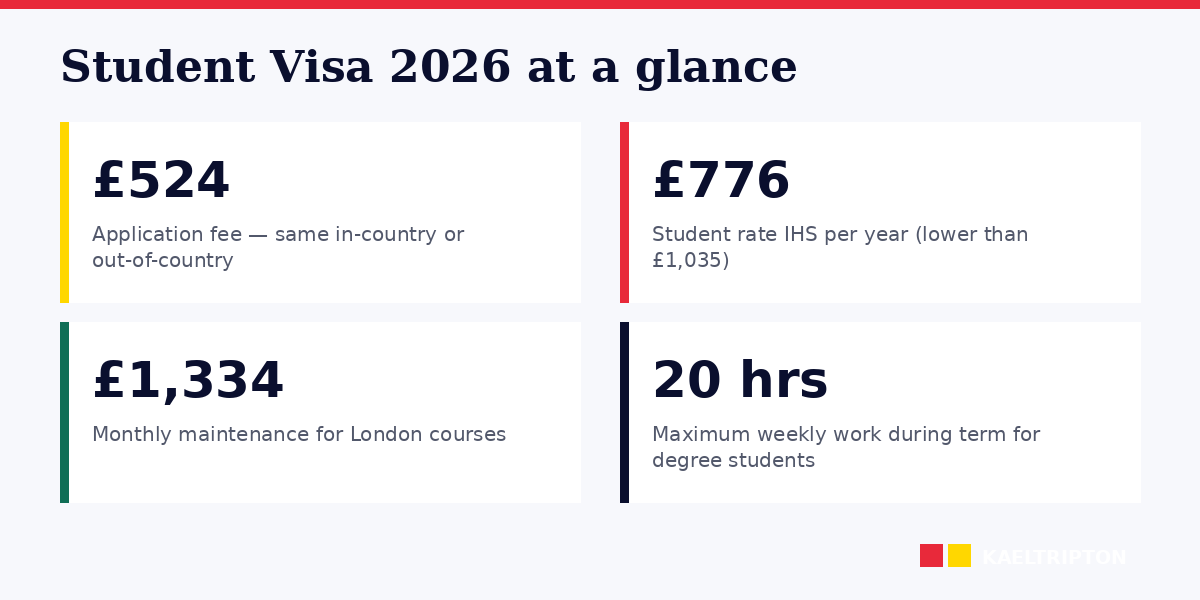
The UK Student Visa is the main route for international students at UK universities and other registered education institutions. 2026 requirements: a Confirmation of Acceptance for Studies (CAS) from a Student route sponsor, £524 application fee, £776 per year Immigration Health Surcharge, proof of sufficient maintenance funds (£1,334/month in London or £1,023/month elsewhere for up to 9 months), and English language proficiency. On completion of a qualifying UK degree, graduates can switch to the Graduate route for 2 years post-study (3 years for PhDs). This guide covers 2026 eligibility, evidence requirements, typical fees, and the Graduate route that follows.
| ★ EDITOR'S VERDICT CAS from a licensed sponsor is the gatekeeper. Everything else follows. |
Without a Confirmation of Acceptance for Studies from a Home Office-licensed institution, you cannot apply for a Student Visa. Always verify sponsor licence status before accepting an offer. £524 application fee plus £776/year IHS (student-rate). Maintenance: £1,334/month in London or £1,023 elsewhere, held in your name for 28 days before applying. 20-hour work limit during term time for degree students. Self-employment prohibited. Graduate route post-study - 2 years bachelor's/master's, 3 years PhD - is where most students transition to Skilled Worker. |
UK visa fees: key facts (checked 16 October 2026) Current Home Office fees (most rose on 8 April 2026). Fees are per person and paid when you apply; the health surcharge is paid on top for each year of the visa.
|
Who needs a Student Visa
From our sister site A UK data eSIM before you land Install a data-only UK eSIM before you fly and be connected at the airport: see uk esim plans. Delivered as a QR code by email. Slashtel also sells an Arrival Bundle for people landing in the UK. Slashtel also sells eSIMs for 190+ countries and top-ups to 170+ countries. Disclosure: Slashtel is operated by Kael Tripton Ltd, which also publishes this site. Our editorial coverage is independent of it. |
Non-UK/Ireland nationals aged 16+ studying in the UK on a course of more than 6 months at an approved institution need a Student Visa (formerly Tier 4). Shorter courses (6-11 months) use the Short-term Study Visa at lower cost. Under-16s use the Child Student Visa.
UK/Irish citizens don't need a visa - they have unrestricted access to UK education. EU/EEA citizens who were UK-resident before 31 December 2020 may continue under EU Settlement Scheme provisions. All other nationals entering the UK after January 2021 for long courses need a Student Visa.
The Confirmation of Acceptance for Studies (CAS)
CAS is a unique reference number issued by the UK education institution confirming:
- The student has been offered a place on a specific course
- The institution holds a valid Student route sponsor licence
- The course meets the duration and level requirements
- The student has met English language and academic requirements
- The institution has assessed the student's ability to pay and study
CAS is 14 characters alphanumeric. Issued via the institution's Sponsorship Management System (SMS). Valid for 6 months from issue date - visa must be applied for within this window. Each CAS is single-use and specific to one student and one course.
Key point: you cannot apply for a Student Visa without a CAS. The course offer alone is not enough - the institution must formally sponsor the application through their licence. Some institutions charge a CAS fee (often £200-£500) though most include it in course fees.
Eligible institutions: the Student Sponsor Licence
Only institutions holding a Student route sponsor licence can issue CAS. UKVI maintains a public register at gov.uk/government/publications/register-of-licensed-sponsors-students.
Most UK universities, colleges, and many private education providers hold the licence. Key sponsor tiers:
- Track Record of Compliance: the premium tier. Universities with strong compliance records. Students from these institutions have the easiest access to Graduate route post-study.
- Standard sponsor: holds the licence without the Track Record premium. Still eligible to sponsor students but additional scrutiny may apply.
Institutions without sponsor licences cannot issue CAS - any course at such places is not a visa-eligible programme regardless of quality. Always verify sponsor status before accepting an offer if visa-dependent.
Maintenance funds requirement
Students must prove they have enough money to support themselves and pay course fees (if not paid upfront). Rates for 2026:
- Course in London: £1,334 per month for up to 9 months (total up to £12,006)
- Course outside London: £1,023 per month for up to 9 months (total up to £9,207)
- + Unpaid portion of first-year tuition fees
- + £845/month in London or £680/month outside for each dependant (partner, children)
Maintenance funds must be held in the student's own name (or parent's name with written consent), for 28 consecutive days before application, ending no more than 31 days before the application date. Accepted evidence: bank statements, savings accounts, fixed deposits. Investments, crypto, or other fluctuating assets generally don't qualify.
Exemption: nationals of specific countries may be exempt from evidencing maintenance funds if their home country is on the "Low Risk" list (Appendix ST of the Immigration Rules). This list has shifted in 2024-2026 - verify your nationality's current status before relying on exemption.
English language requirements
Students must demonstrate English at the required level for their course:
- Undergraduate degree: B2 level (CEFR) minimum
- Postgraduate degree: B2 level minimum, often higher depending on institution
- Below degree level: B1 level minimum
- Pre-sessional English courses: lower thresholds depending on the bridging course
Accepted tests: IELTS for UKVI, Trinity GESE, Pearson PTE Academic. The institution may also accept its own internal English assessment if they are an approved Home Office HEI using their own test.
Exemption: nationals of majority English-speaking countries (US, Canada, Australia, New Zealand, Ireland, South Africa, several Caribbean countries) don't need a test. Applicants with a UK degree previously obtained also exempt.
Fees and Immigration Health Surcharge 2026
- Out-of-country application fee: £524
- In-country extension fee: £524
- Child Student Visa fee: £524
- Immigration Health Surcharge: £776 per year of visa validity (student rate, lower than £1,035 general)
- Priority Service: £500 for 5 working day decision (available for most student applications)
Total for a 3-year undergraduate degree: £524 + (£776 × 3) + Priority if desired = £2,852-£3,352 in government fees.
The application process
Before applying
- Receive offer from UK institution
- Accept offer, pay required deposit
- Institution issues CAS (typically 2-4 weeks after confirmation)
- Gather financial evidence - bank statements over 28 days
- Book English language test if required
- Check maintenance fund requirement and confirm funds in place
- Obtain tuberculosis test certificate if from a listed country
Applying
- Apply online at gov.uk/student-visa up to 6 months before course start date
- Pay visa fee (£524) and IHS upfront
- Book biometric appointment at TLScontact or VFS Global in your home country
- Attend biometrics; upload or post supporting documents
- Typical processing: 3 weeks standard, 5 working days Priority
On arrival
- Collect BRP if issued (phased out from 2025 - most students receive eVisa instead)
- Register with institution student services
- Register with a UK GP
- Open UK bank account (most banks handle student account opening rapidly with visa and university offer)
Working on a Student Visa
Work rights depend on the institution tier:
- Degree-level students at HEIs: up to 20 hours per week during term time, full-time during vacations
- Below-degree-level students: up to 10 hours per week during term time
- All students: cannot be self-employed, cannot be entertainers or professional sportspeople
Work limits are strictly enforced. Exceeding hours can end the visa and create future UK immigration complications. Employers verify right-to-work via online sharing codes.
Common exempt activities: compulsory work placements that are part of the course, some internships linked to academic study, research and teaching assistant roles within the university.
The Graduate Route post-study
After completing a UK degree at a Track Record of Compliance institution, students can switch to the Graduate route for unsponsored work:
- Undergraduate or master's degree: 2 years Graduate route
- PhD: 3 years Graduate route
- Application fee: £822
- IHS: £1,035/year (not student rate - full IHS)
- Maintenance requirement: none
- No sponsor required: can work in any role, any employer, self-employed
Graduate route can only be used once per person. No extensions possible. After 2-3 years, must switch to Skilled Worker (sponsored) or other route, or leave the UK.
A real 2026 scenario: Indian undergraduate at University of Manchester
An 18-year-old from Mumbai accepts a Computer Science BSc offer at University of Manchester starting September 2026. 3-year course, tuition £28,000/year.
May 2026: receives CAS from the university. English test (IELTS 7.0) already passed in 2025. Parents hold £35,000 in joint account.
June 2026: applies online for Student Visa. Fee £524 + IHS £776 × 3 = £2,328. Priority Service £500 for 5-day decision. Total £3,352. Financial evidence: parents' bank statements for 28 days plus consent letter.
June 2026: biometric appointment at VFS Mumbai. Documents scanned. Decision arrives in 4 working days: granted.
September 2026: arrives in Manchester. Registers with UoM. Opens NatWest student account. Accommodation in Fallowfield.
During study: works 18 hours/week in term time at UoM student café. Part-time earnings £180/week during term, full-time during 16 weeks of summer vacation.
June 2029: graduates. Applies for Graduate route: £822 + £1,035 × 2 = £2,892. Approved within 3 weeks.
2029-2031: Graduate route visa. Takes a software engineer role at a Manchester fintech. Total UK tax residence: 5 years by 2031. If she switches to Skilled Worker in 2030 and stays another 5 years, she's eligible for ILR in 2035.
Frequently asked questions
Can I switch to a Student Visa from another UK visa?
Yes, for most in-country routes. Skilled Worker to Student, Graduate to Student (to pursue further study), and some family route holders can switch. Visitor Visa holders generally cannot switch in-country to a Student Visa - must leave and apply from home country.
What happens if I don't complete my course?
Your sponsor (the institution) must report the termination to UKVI within 10 working days. Your visa becomes invalid and you have typically 60 days to leave the UK or find another valid course. Repeated non-completion impacts future UK visa applications.
Can my spouse or partner come with me on a Student Visa?
Only for postgraduate degrees (master's, PhD) of 9+ months. Undergraduate Student Visa holders generally cannot bring dependants. Partners must apply as Student Visa dependants with their own application and fee, plus additional maintenance funds requirement.
How long is a Student Visa valid?
Varies with course length. Typically the course length + 4 months buffer at the end. For a 3-year undergraduate degree, the visa is usually 3 years + 4 months. PhD students often get longer overall durations reflecting their degree structure.
Does the Graduate route count toward ILR?
Graduate route time alone does not count toward ILR. You need 5 years on a qualifying route (Skilled Worker, Scale-up, Innovator Founder). However, time on Graduate route can bridge between Student and Skilled Worker - you can switch into Skilled Worker once you have a qualifying job offer, and ILR clock then runs from the Skilled Worker start.
Do I need to register with the police?
No. The police registration scheme for international students was abolished on 4 August 2022. Students no longer register at police stations on arrival. Some older materials reference this - the requirement has ended.
Can Student Visa holders work as self-employed?
No. Student Visa specifically prohibits self-employment. No freelancing, no company directorships, no consulting. Even unpaid self-employed activity typically breaches the terms. Graduate route removes this restriction entirely.
Sources
- GOV.UK, Student visa - gov.uk/student-visa
- Immigration Rules, Appendix Student
- Home Office, Student route caseworker guidance 2026
- GOV.UK, Register of licensed Student route sponsors
- Immigration Rules, Appendix Finance (maintenance fund requirements)
- Home Office, Graduate visa - gov.uk/graduate-visa
- UK Visas and Immigration, Student visa fees 2026


