

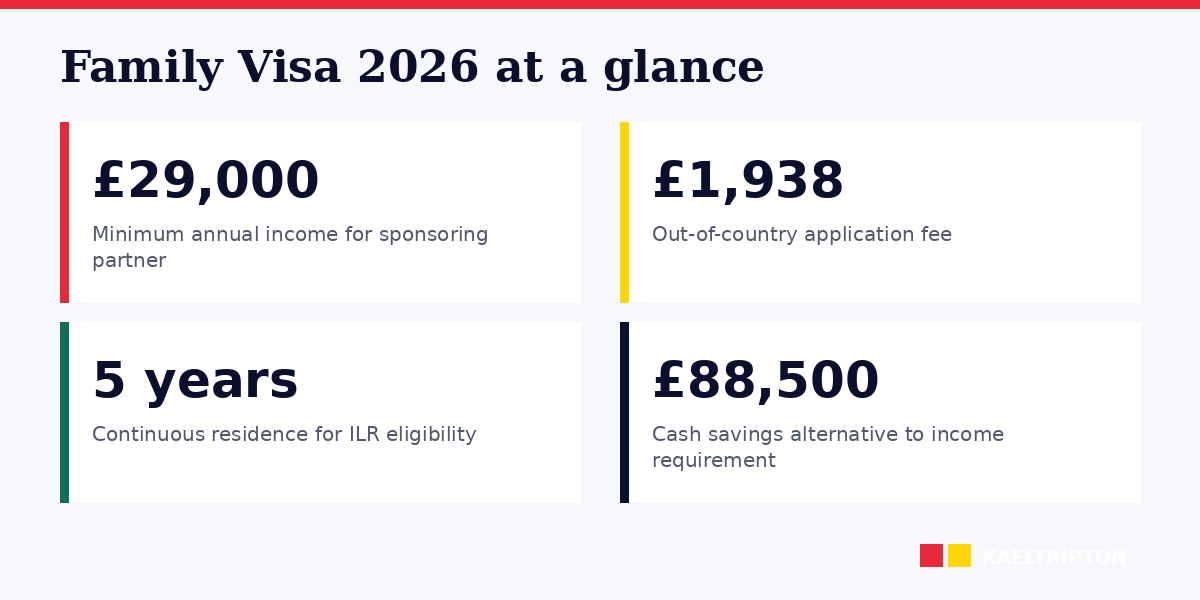
The UK Family Visa route lets British citizens and settled residents bring a foreign spouse, unmarried partner, civil partner, fiancé(e), or dependent children to live in the UK. The 2026 minimum income requirement is £29,000 per year (raised from £18,600 on 11 April 2024; planned further rise to £38,700 has been deferred pending Migration Advisory Committee review). Alternative: cash savings of £88,500 plus 1× the shortfall for any income gap. English language A1 required at application, A2 for extensions, B1 for ILR. This guide covers spouse/partner routes, income alternatives, fees £1,938 out of country, and the 5-year route to Indefinite Leave to Remain.
| ★ EDITOR'S VERDICT £29,000 income requirement, not £38,700 in 2026. The planned rise is on hold. |
The UK Family Visa still uses £29,000 as the minimum income for sponsoring a partner. The planned rise to £38,700 was deferred pending Migration Advisory Committee review. £88,500 in cash savings is the no-income alternative; blended combinations also work using Category F calculations. 5-year route to ILR: 2.5-year visa + 2.5-year extension + ILR at year 5. English A1 at application, A2 at extension, B1 at ILR. Most refusals are evidence-based - precise payslips, 6-month bank statements, and sworn-translated relationship documents fix 80% of problems. |
UK visa fees: key facts (checked 16 October 2026) Current Home Office fees (most rose on 8 April 2026). Fees are per person and paid when you apply; the health surcharge is paid on top for each year of the visa.
|
Who qualifies under Appendix FM
The Family Visa route is governed by Appendix FM of the Immigration Rules. Eligible sponsors:
- British citizens (natural-born or naturalised)
- Settled persons (ILR, permanent residence, or pre-settled/settled status under EUSS)
- Refugees and persons with humanitarian protection
- Certain other protected categories
Eligible applicants (the overseas family member):
- Spouse or civil partner - legally married or in civil partnership
- Unmarried partner - relationship of at least 2 years cohabitation (the durable partnership test)
- Fiancé(e) / proposed civil partner - intention to marry within 6 months of UK arrival
- Dependent children - biological or adopted, under 18
- Adult dependent relatives - parent, grandparent, or sibling requiring long-term personal care (very strict criteria)
The 2026 income requirement
The headline rule: £29,000 minimum income for the sponsoring partner. Changed from £18,600 on 11 April 2024. Originally planned to rise to £38,700 in stages - the Labour government deferred this in late 2024 pending Migration Advisory Committee (MAC) review. As of April 2026, £29,000 remains in force.
Additional income requirements for dependents:
- Base: £29,000/year for sponsor + partner
- + £3,800 for first non-British dependent child
- + £2,400 for each additional non-British dependent child
Practical example: British husband in UK sponsoring Peruvian wife with one Peruvian child - needs £29,000 + £3,800 = £32,800/year demonstrated income.
How income is evidenced
- Employment income: 6 months of payslips, P60, contract of employment, bank statements showing salary receipt
- Self-employment: 12 months of accounts, SA302 tax calculations, business bank statements
- Pension income: pension statements, bank deposits
- Property rental: tenancy agreements, rent receipts, tax returns
- Dividends or investment income: dividend vouchers, tax returns
Only specific income sources count. Non-qualifying: benefits income (except certain disability benefits), gifts, maintenance from ex-partners in most cases, income from the applicant themselves if outside the UK.
Savings alternative and Category B/C/D/E/F
If income alone falls short, cash savings can supplement. The basic savings threshold: £88,500 held for at least 6 months before application.
Lower savings + partial income combinations are allowed under "Category F" calculations. Formula: (£29,000 × 2.5) - gross income × 2.5 = required savings. For £20,000 income: (£29,000 × 2.5) - (£20,000 × 2.5) = £22,500 savings shortfall needed.
Savings must be held in the sponsor's name, the applicant's name, or jointly - not family or employer accounts. Held for 6 consecutive months before application in accessible form (current accounts, savings accounts, ISAs). Investments that fluctuate (stocks, crypto) generally don't qualify unless immediately realisable.
English language requirements
English tests at stages:
- At initial application: A1 level (basic user). IELTS for UKVI, Trinity College GESE, or Pearson PTE Academic are acceptable tests.
- At extension (after 2.5 years): A2 level.
- At ILR (after 5 years): B1 level (intermediate) plus the Life in the UK test.
Exemptions: English-speaking country nationals (US, Canada, Australia, etc.), applicants with UK degrees taught in English, applicants aged 65+, or those with serious physical/mental conditions preventing testing.
The application process
Outside the UK
- Sponsor gathers income evidence; applicant gathers relationship evidence
- Applicant applies online at gov.uk/family-visa
- Application fee £1,938 (from 8 April 2024)
- Immigration Health Surcharge £1,035/year × 2.5 years = £2,587.50 upfront (family visa is 2.5 + 2.5 year structure)
- Biometric appointment at TLScontact or VFS Global in the applicant's country
- Processing typically 12 weeks (priority services not always available for family visas)
Inside the UK (switching or extension)
- In-country extension fee: £1,321
- IHS £1,035/year × 2.5 years
- UKVCAS appointment for biometrics
- Processing typically 8 weeks
The 5-year route to ILR
Family Visa leads to Indefinite Leave to Remain (ILR) after 5 years of continuous residence:
- Year 0-2.5: Initial Family Visa (2.5 years)
- Year 2.5-5: Family Visa extension (2.5 years). Re-evidence income, relationship continuation, English A2 level.
- Year 5: ILR application. Income requirement re-evidenced, English B1, Life in the UK test passed.
10-year route: if income requirement isn't met but the refusal would breach human rights (typically Article 8 family life engaged by separation), a 10-year route may apply - longer wait but achievable when the income bar simply can't be cleared.
ILR fee at year 5: £3,226 (2026 rate). Plus Life in UK test £50. English test (if not previously taken at B1): £150-£200.
Common refusal reasons
- Insufficient income evidence - most common. Payslips missing, tax returns wrong year, bank statements don't match declared income.
- Savings held less than 6 months - must be in place for the full 6-month window before application.
- Relationship not proved genuine - UKVI may question arranged marriages, rapid engagements, significant age gaps, or limited cohabitation evidence.
- English language test not accepted - only specific approved tests count. Informal qualifications or employer statements don't meet the rules.
- Suitability issues - criminal records of sponsor or applicant, previous UK immigration breaches.
Family Visa refusals usually have full appeal rights to the First-tier Tribunal (human rights grounds engaged). Appeal fee £80 paper / £140 oral hearing. Success rates with legal representation moderate-to-high when relationship and income are genuinely demonstrable.
A real 2026 scenario: British-Filipino marriage
A British teacher (35, earning £34,500) wants to bring his Filipino wife to the UK. Married 2024 in Manila. One shared child aged 2 (Filipino citizenship).
Income requirement: £29,000 base + £3,800 first dependent child = £32,800 needed. Sponsor's £34,500 clears this comfortably.
Evidence gathering (March 2026): sponsor's 6 months of payslips from his school, P60 for 2024-25 tax year, bank statements showing consistent salary receipt, employment contract from the school. Wife's relationship evidence: marriage certificate, photos from 2022-2026, communications records (WhatsApp exports, video call logs), joint financial responsibilities, letters from family.
Application (April 2026): wife applies online from Manila. Sponsor visa fee £1,938 + child fee £1,938 = £3,876. IHS for wife £1,035 × 2.5 = £2,587.50. Child IHS at student rate £776 × 2.5 = £1,940. Total fees £8,403.
Biometric appointment: VFS Global Manila, scheduled 2 weeks later.
Decision (July 2026): granted after 12 weeks processing. Wife and child receive 2.5-year family visa. Flights arranged for August arrival.
Year 2028-2029: apply for 2.5-year extension. Re-evidence income, wife takes A2 English test. Fee £1,321 + IHS. Total approximately £4,000 for renewal.
Year 2031: apply for ILR after 5 years. Fee £3,029. Life in UK test and B1 English required.
Total 5-year family visa cost for this family: approximately £15,500 in Home Office fees. Plus legal fees if using a solicitor (typical £2,000-£4,000).
Fiancé(e) visa: a bridge to family visa
For couples not yet married, the fiancé(e) visa permits UK entry for 6 months to marry. Fee £1,938. Must marry within 6 months or leave the UK. Cannot work on the fiancé(e) visa.
After marriage, switch in-country to the full spouse visa at £1,321 + IHS. This is a common route when the sponsor can't easily travel for a ceremony abroad, or when a UK-based wedding is preferred.
Fiancé(e) visa evidence: proof of relationship + intention to marry. Wedding venue booking, marriage notice if already filed, evidence of ongoing relationship. Must meet the full financial requirement.
Frequently asked questions
Did the £38,700 income requirement come into effect in 2026?
No. The planned rise from £29,000 to £38,700 was deferred by the Labour government pending Migration Advisory Committee (MAC) review. As of April 2026, the threshold remains £29,000. The MAC report was expected mid-2026 but further review means the threshold could change in a future Immigration Rules statement of changes.
Can my spouse's income count toward the £29,000?
Usually no. Only the UK sponsor's income counts for the standard route, unless the spouse is applying in-country and both are employed. Overseas applicants' income generally doesn't count because it's assumed to end when they move to the UK.
What if my income is just under £29,000?
You can top up with savings using Category F: (£29,000 × 2.5) - (your income × 2.5) = savings shortfall. For £27,000 income, you'd need £5,000 × 2.5 = £12,500 in savings held for 6 months. More savings the lower the income - £0 income needs £88,500.
Can I use savings instead of income entirely?
Yes, under Category D: £88,500 in cash savings held for 6 months. All applications based on savings alone require very careful documentation - fluctuating balances in the 6-month window can lead to refusals.
Does the sponsor need to be in the UK for the application?
Yes. Sponsors must be physically resident in the UK and holding qualifying status (British, ILR, EUSS). Sponsors temporarily abroad for short periods generally still qualify if their main residence is UK.
What happens if we break up after 1 year on the Family Visa?
The visa is tied to the relationship. Serious breakdown requires reporting to UKVI. Continuing visa grounds may exist in specific cases (domestic violence, shared children with British citizens, long UK residence). Specialist advice essential - don't hide the separation.
Can I work on a Family Visa?
Yes, unrestricted work rights from day one. You can work full-time, part-time, self-employed, freelance - any role for any employer. No sponsor licence needed. This is more flexible than most work visas.
Sources
- GOV.UK, Family of a settled person visa - gov.uk/uk-family-visa
- Immigration Rules, Appendix FM
- Home Office, Partner and Family migration: financial requirement 2026
- Migration Advisory Committee (MAC), Review of the Minimum Income Requirement 2025-26
- GOV.UK, UK English language tests for visa and citizenship applications
- Home Office, Appendix FM caseworker guidance 2026
- UK Visas and Immigration, Family visa fees 2026


