

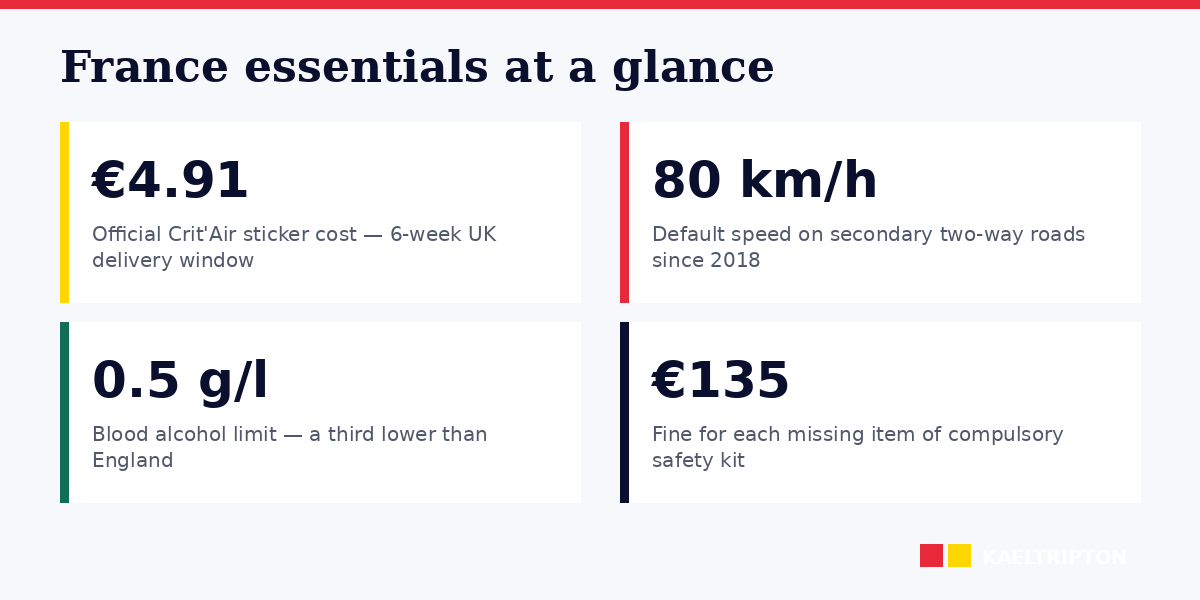
Driving in France from the UK requires a photocard licence, a Crit'Air sticker, and kit in the boot. No IDP, Green Card, or exotic paperwork is needed. The Crit'Air sticker costs €4.91. Speed limits include 80 km/h on secondary roads and 130 km/h on motorways in dry weather. The drink-drive limit is 0.5.
A UK photocard licence is all you need to drive in France in 2026 - no International Driving Permit, no Green Card, no extra paperwork. What catches UK drivers out is the Crit'Air sticker required in low-emission zones, the compulsory kit you must carry in the boot, the 80 km/h limit on most secondary roads, and the tightened drink-driving limit. This guide walks through every requirement GOV.UK and the French transport ministry publish for 2026.
| ★ EDITOR'S VERDICT Photocard licence, Crit'Air sticker, kit in the boot. |
France is the simplest EU destination for UK drivers - no IDP, no Green Card, no exotic paperwork. Order the €4.91 Crit'Air sticker six weeks before you travel. Pack the reflective jacket, warning triangle and headlamp deflectors. Remember the 80 km/h secondary road limit and the 0.5 drink-drive limit. Do those four things and you will have the same trip every generation of UK drivers has had, minus the fines. |
What you legally need to carry
French law requires every vehicle on French roads, foreign-registered or otherwise, to carry a specific set of documents and safety equipment. Miss any of these and roadside fines start at €135 per item.
Documents (must be in the vehicle at all times):
- Full UK photocard driving licence. A paper licence alone is not accepted - if you still hold one, upgrade to photocard before travelling. No International Driving Permit is needed for France.
- V5C vehicle registration certificate (logbook) in the registered keeper's name. If the vehicle is hired, leased, or on company finance, a VE103 certificate from the leasing company is required instead.
- Motor insurance certificate. UK insurance typically provides third-party cover automatically in the EU, but confirm with your insurer and carry the certificate. A Green Card is not needed for France since August 2021.
- Valid MOT certificate if your vehicle is over three years old. Not strictly required to be in the car, but a stopped vehicle that cannot prove its roadworthiness status faces complications.
- Passport valid for the full duration of your trip and, for post-Brexit travel, with at least three months remaining validity on your return date.
Equipment (physical items that must be in the car):
- Warning triangle - at least one, reachable from inside the vehicle
- High-visibility reflective jacket - one per occupant, stored in the cabin (not the boot - you must be able to put one on before getting out after a breakdown)
- Headlamp beam deflectors for driving on the right - stickers applied to the lens, or manual adjustment on cars where it is possible
- UK sticker on the rear of the vehicle, unless your number plate already shows the UK identifier with the Union flag. GB stickers have been invalid since September 2021.
- Spare pair of prescription glasses if you wear glasses to drive - this is a strict legal requirement, not a recommendation
Items no longer required in 2026: the personal breathalyser kit (abolished in 2020), fire extinguisher (never required in private cars), spare headlamp bulbs (recommended but not mandatory).
Crit'Air sticker: where you need one and how to get it
The Crit'Air vignette is a windscreen-displayed emissions certificate classifying your vehicle by Euro standard. It is required for driving in any French Zone à Faibles Émissions (ZFE), the French equivalent of a UK Clean Air Zone. Every French city with a population above 150,000 now operates a ZFE, which means virtually every major urban centre UK drivers would want to visit.
The six categories are:
- Crit'Air E (green) - fully electric and hydrogen vehicles
- Crit'Air 1 (purple) - petrol Euro 5 or 6, plug-in hybrids
- Crit'Air 2 (yellow) - petrol Euro 4, diesel Euro 5 or 6
- Crit'Air 3 (orange) - petrol Euro 2 or 3, diesel Euro 4
- Crit'Air 4 (maroon) - diesel Euro 3
- Crit'Air 5 (grey) - diesel Euro 2
Older petrol cars (registered before 1997) and older diesel cars (registered before 2001) are not eligible for any sticker and cannot enter a ZFE at all.
UK drivers can only buy the sticker from the official French government portal at certificat-air.gouv.fr. The sticker costs €4.91 (roughly £4.20) including postage to the UK. Scam sites charge €20 to €40 for the same sticker. Allow up to six weeks for delivery to a UK address - if you are travelling in the next month, order immediately. Driving in a ZFE without a displayed sticker is a €68 fine for cars, €135 for LGVs and commercial vehicles.
Speed limits in 2026
France uses the metric system, so every road sign shows kilometres per hour. The default limits are:
| Road type | Dry weather | Wet weather |
|---|---|---|
| Motorways (autoroutes) | 130 km/h (81 mph) | 110 km/h (68 mph) |
| Dual carriageways | 110 km/h (68 mph) | 100 km/h (62 mph) |
| Secondary roads (two-way without central reservation) | 80 km/h (50 mph) | 80 km/h (50 mph) |
| Built-up areas | 50 km/h (31 mph) | 50 km/h (31 mph) |
| Urban zones 30 | 30 km/h (19 mph) | 30 km/h (19 mph) |
The 80 km/h limit on secondary roads was introduced in 2018 and tightened in 2022. Many UK drivers assume single-carriageway roads are 90 km/h because that was the pre-2018 rule - they are not. A speeding fine starts at €135 for up to 20 km/h over the limit, rising to licence confiscation on the spot for more than 50 km/h over.
Drink-driving: the 0.5 limit
The French blood alcohol limit is 0.5 g/l, a third lower than England and Wales (0.8 g/l). Drivers with less than three years' licence experience face a tighter 0.2 g/l limit. Police perform random roadside checks at all hours, and fines escalate quickly: €135 for 0.5 to 0.8 g/l, €4,500 and two years' licence withdrawal for anything above 0.8 g/l.
The practical rule for UK drivers: if you have had more than one small glass of wine in the past two to three hours, you are probably over the French limit but still legal in England. Plan meals accordingly, and never assume a light lunch clears in time for the afternoon drive.
Tolls (péages)
French motorways are predominantly tolled, operated by private concessionaires. The typical cost from Calais to Paris is around €23, Paris to Lyon around €38, Lyon to Marseille around €27. You pay at toll booths either by card (including contactless), cash, or with an electronic télépéage transponder (Bip&Go is the main consumer brand; the transponder takes about three weeks to ship to the UK).
For a one-off UK visitor, a contactless card is the simplest option. For regular travellers, Bip&Go saves queueing time but charges a small monthly management fee. Free alternative routes exist (the N-numbered national roads) but typically add two to four hours to a Calais-to-Paris journey.
Roundabouts and priority rules
French roundabouts mostly follow the UK model: vehicles already on the roundabout have priority. However, a small number of older rural roundabouts still operate under the old priorité à droite rule - traffic entering from the right has priority. These are indicated by a triangular sign with a red border showing three arrows forming a circle with a red cross through it. When you see the sign with the red cross, behave as if it is a UK roundabout. When the sign is absent, the entering traffic has priority.
At unmarked junctions (rare but real on rural roads), priorité à droite applies across France. A car approaching from your right has priority over you, even if you are on the apparently larger road.
A real 2026 scenario: the family weekend to Lyon
A family of four from Reading plans a four-day trip to Lyon in June 2026: ferry from Dover to Calais, drive via Paris to Lyon, return via Dijon and Calais. Here is what their pre-travel checklist looks like.
Three weeks before: order Crit'Air sticker from certificat-air.gouv.fr (€4.91). Check all four passports have six months' validity. Confirm breakdown cover covers France. Check insurance policy covers EU driving up to the duration of the trip.
Two weeks before: buy European driving kit from the AA shop at Folkestone or Halfords (£15 to £25 depending on contents). Kit should include reflective jackets for all four occupants, warning triangle, headlamp beam deflectors, and UK sticker if the number plate does not already show the UK identifier.
The day before: apply headlamp deflectors to the car, confirm spare glasses are in the glovebox, charge dashcam.
Route cost estimate: ferry return £100 for the car, Calais-Lyon-Calais round trip €120 in tolls, fuel approximately €180 based on 1,600 km at 6 l/100km and €1.80/l. Crit'Air sticker displayed on windscreen throughout because Lyon, Paris and Dijon all operate ZFEs.
What happens in an accident or breakdown
On a motorway or major road, put on your reflective jacket before leaving the vehicle, deploy the warning triangle at least 30 metres behind the car (100 metres on motorways), and call the French emergency services on 112. All emergency call points on French motorways are orange and placed every two kilometres.
For an accident, the French constat amiable (European Accident Statement) is the standard form. Both drivers complete one together at the scene, recording facts and signing off. Your UK insurer will accept a constat amiable - it is the standard document across all EU insurance systems.
Breakdown recovery in France is expensive. Vehicle repatriation from southern France to the UK can cost up to £1,300 without breakdown cover. A European single-trip breakdown policy from the AA, RAC or Green Flag typically costs £25 to £60 for a two-week trip and covers repatriation.
Frequently asked questions
Do I need an International Driving Permit to drive in France?
No. A full UK photocard driving licence is all you need. IDPs are required for some countries outside the EU/EEA (for example, Albania or Moldova), but not for France or any other EU member state. If you only hold a paper UK licence, upgrade to photocard before travel.
Do I need a Green Card for insurance in France?
No. Since 2 August 2021, UK drivers no longer need a Green Card to prove insurance in France or any other EU country. Your normal UK insurance certificate is sufficient. However, you must still carry the certificate in the car and most UK policies provide only third-party cover abroad - check whether you want to pay for comprehensive cover during the trip.
How long does a Crit'Air sticker take to arrive in the UK?
Order from certificat-air.gouv.fr and allow up to six weeks for UK delivery. The sticker itself costs €4.91. If you need it urgently, printing the confirmation email gives you no legal cover - the physical sticker must be displayed on the windscreen.
Can I use my UK Blue Badge in France?
Yes, to a limited extent. French local authorities generally recognise UK Blue Badges for parking concessions, but the rules vary by commune. Display the badge clearly on the dashboard and check the specific city's parking regulations. Some Parisian arrondissements have stopped recognising foreign disability badges altogether - verify with your destination before relying on the concession.
What is the minimum driving age in France?
18 for cars and motorcycles over 125cc. 16 for mopeds and motorcycles up to 125cc. A valid UK provisional licence is not accepted - you must hold a full UK licence. Hire companies typically set their own minimum ages, often 21 or 25, with additional young-driver surcharges.
Are French speed cameras as strict as UK ones?
Yes, and increasingly sophisticated. The new Mesta Fusion cameras can simultaneously detect speeding, mobile phone use, seatbelt absence, illegal overtaking and tailgating. Post-Brexit, France can no longer directly fine UK-registered vehicles by post for camera offences, but camera fines are enforced at the border if unpaid when you return on a subsequent trip. The practical rule: don't gamble.
What happens if I drive in a Paris ZFE without a Crit'Air sticker?
On-the-spot fine of €68 for a car, €135 for a van or commercial vehicle. Repeat offences can attract higher penalties. Paris cameras enforce automatically, and the fine will be sent to the DVLA-registered address. Pay promptly - French enforcement for unpaid fines to foreign drivers is now much more active than it was three years ago.
Sources
- GOV.UK, Driving in the EU and Driving abroad: country guides - France
- French Ministry of Ecological Transition, Certificat qualité de l'air (Crit'Air) - certificat-air.gouv.fr
- Sécurité Routière (French Road Safety Delegation), Driving rules and road safety guidance
- French Foreign Office (via GOV.UK Foreign Travel Advice - France)
- European Commission, Going abroad by car - France
- Légifrance, Code de la route and Décret n° 2018-487 du 15 juin 2018 (80 km/h on secondary roads)
- French Ministry of the Interior, Conduire en France


