

Italy gives UK drivers the best food, some of the best roads, and the most expensive mistake on the continent - the ZTL zone fine. Every major Italian city blocks private cars from its historic centre, and the cameras fine tourists six to twelve months after the trip is over. Beyond the ZTLs, Italian driving is similar to France: a UK photocard licence works, no IDP needed, no Green Card, tolls on most motorways. This guide walks through the requirements for 2026 from GOV.UK, the Italian Ministry of Infrastructure and Transport, and the Automobile Club d'Italia.
| ★ EDITOR'S VERDICT Park outside every Italian city. Walk in. |
Italian driving is easy everywhere except in the cities - and the cities are where tourists go. Every historic centre from Bologna to Palermo has a ZTL camera that fines foreigners €83 to €120 per infringement, months after the trip. The discipline is simple: park in a P+R or parcheggio, walk or take the metro, never follow another car into a restricted zone. Do that and Italy is one of the best driving countries in Europe. |
What you legally need
Italy's requirements for a UK-registered vehicle on a tourist trip are straightforward. The deeper problem is always ZTLs, not paperwork.
Documents:
- Full UK photocard driving licence. No International Driving Permit required for tourist trips. UK paper-only licences are not accepted.
- V5C registration certificate or VE103 for hired or leased vehicles
- Motor insurance certificate - UK policies provide third-party cover in Italy automatically; Green Card not required since August 2021. Confirm comprehensive cover with your insurer before travel if you want it for Italy.
- Passport valid for the full trip duration
- Valid MOT (UK equivalent of Italy's revisione) if the vehicle is over three years old
Equipment:
- Warning triangle - at least one, accessible from inside the cabin
- High-visibility reflective jacket - one per occupant, accessible without leaving the vehicle. Italy fines both for missing jacket in the car and for being on the hard shoulder without one worn.
- UK sticker on the rear of the vehicle, unless the number plate already shows the UK identifier with the Union flag
- Spare glasses if you wear them to drive - strongly recommended, fined if required on licence code
Not required: fire extinguisher, first aid kit, breathalyser, headlamp deflectors (Italy does not mandate these, unlike France).
ZTL zones: the single biggest financial risk
The Zona a Traffico Limitato (ZTL, "limited traffic zone") is the defining Italian driving rule for UK tourists. Every major Italian city - Rome, Florence, Milan, Bologna, Naples, Pisa, Siena, Lucca, Verona, Palermo - restricts private vehicle access to its historic centre. Cameras at every entry point read number plates and issue automatic fines to unauthorised vehicles.
The key facts for 2026:
- ZTLs are marked by a white circular sign with a red border and the letters "ZTL" or full text "Zona a Traffico Limitato"
- Most ZTLs operate only at certain hours - Rome's Centro Storico is active roughly 06:30-18:00 weekdays and 14:00-18:00 Saturdays, while Bologna's is 07:00-20:00 daily
- Electronic panels above each entry show "ZTL ATTIVA" (active) or "ZTL NON ATTIVA" (not active)
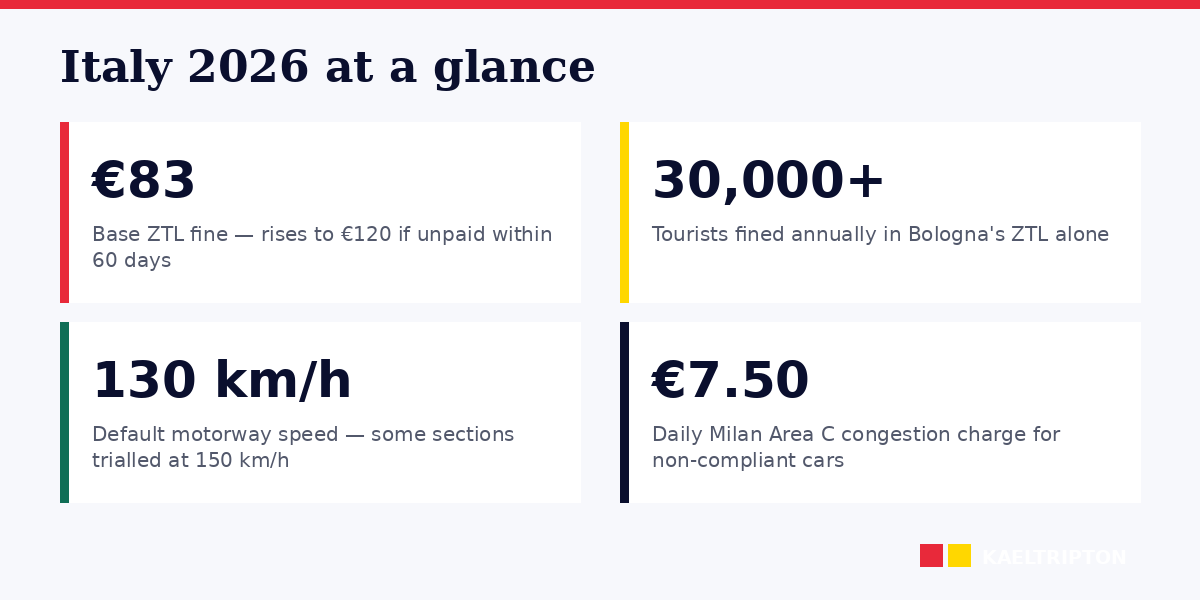
- Fines start at €83 and rise to €120 if not paid within 60 days
- Hire car companies add an administrative fee of €45 to €60 for forwarding your details to the council when you are fined. The council's fine plus the hire company surcharge usually totals €130-180 per violation.
- Multiple entries in the same day each draw a separate fine
- Satnav systems do not always show ZTL boundaries - Google Maps has improved but still misses some zones
The cities that catch UK drivers most
Bologna issues more ZTL fines to tourists than any other Italian city, partly because the signs appear after you have committed to a turn onto a restricted street. Over 30,000 tourists are fined annually.
Florence operates five sub-sectors with different schedules. The Santa Maria Novella area is active 24/7. Fines arrive several months after the trip with surprising regularity.
Rome's historic centre ZTL was extended in 2026 to reach the Colosseum area. Hours are 06:30-18:00 Monday to Friday and 14:00-18:00 Saturday, with specific exceptions for the Trastevere ZTL (evenings and nights).
Milan combines a ZTL with Area C, its congestion charge zone. Area C covers the historic centre, operates Monday-Friday 07:30-19:30, and charges non-compliant cars €7.50 per day (electric vehicles free with registration). Area B is a separate larger low-emission zone covering most of Milan and restricting the most polluting vehicles 24/7.
How to avoid ZTL fines
- Park outside the historic centre in a parcheggio or park-and-ride (look for a large P sign) and walk or take the metro
- If your hotel is inside a ZTL, ask them to register your number plate with the city council - most central Italian hotels offer this free, and it gives you a brief window to drive in and out during check-in and check-out
- Download city-specific ZTL maps before your trip (every major city publishes them on its official website)
- If you see other cars turning into a restricted zone, don't follow them - those will be residents
- Treat any white circle with a red border as a stop sign until you've read the text
Speed limits in 2026
| Road type | Dry conditions | Wet conditions |
|---|---|---|
| Motorways (autostrade) | 130 km/h (81 mph) | 110 km/h (68 mph) |
| Dual carriageways | 110 km/h (68 mph) | 90 km/h (56 mph) |
| Main roads outside built-up areas | 90 km/h (56 mph) | 90 km/h |
| Built-up areas | 50 km/h (31 mph) | 50 km/h |
| Some motorways (marked) | 150 km/h (93 mph) | - |
Italy trialled a 150 km/h limit on specific stretches of the A1 and A14 from 2023, and several sections remain signposted at 150 km/h in 2026. Default motorway limit is 130 km/h. Speed cameras are heavily used on the autostrade; fines escalate from €42 for up to 10 km/h over the limit to €544 and licence-point deduction for 40-60 km/h over. Above 60 km/h over the limit, the licence is suspended on the spot.
New drivers (first three years post-licence) face tighter limits - 100 km/h on motorways, 90 km/h on dual carriageways - but these only apply to Italian-licensed drivers, not UK-licensed visitors.
Drink-driving: 0.5 general, 0.0 for new drivers
Italy's general blood alcohol limit is 0.5 g/l. For drivers in the first three years of their licence, commercial drivers, and anyone under 21, the limit is zero - any trace of alcohol is an offence. UK licence holders over 21 and more than three years post-licence are treated at the 0.5 level.
Fines escalate sharply: €543-2,170 plus three-to-six month licence suspension for 0.5-0.8 g/l, rising to criminal prosecution for higher levels. Italian police stop and breath-test drivers routinely, particularly on weekend evenings and near tourist destinations. Drug testing accompanies alcohol testing at every stop.
Tolls and autostrade
Most Italian motorways are tolled. Payment methods at toll booths:
- Cash at manned booths (blue and white signs)
- Credit or debit card at automated booths (yellow signs)
- Telepass electronic transponder (yellow "T" signs) - the Italian equivalent of French télépéage
- Viacard prepaid card (purchasable at service stations and toll booths)
Typical costs: Milan to Florence around €24, Florence to Rome around €18, Milan to Venice around €20. A full Milan-to-Naples journey is approximately €60 in tolls. Telepass devices work across Italy, France, Spain, Portugal and Croatia, so for combined European road trips they pay for themselves quickly. Non-Italian residents can order a short-term Telepass online at telepass.com; delivery to a UK address takes three to four weeks.
A real 2026 scenario: the Tuscany family week
A family of four flies into Pisa, hires a car, and spends seven days driving to Florence, Siena, Volterra, San Gimignano and back. Here is what catches UK drivers on this classic route.
Hire car pickup at Pisa Airport: Italian-plated hire vehicle, fully insured through the rental contract. The parents confirm the kit (triangle, jacket) is present and ask the rental company to register their plate for any hotel ZTLs via its concierge service.
Pisa: the historic centre around the Leaning Tower is a ZTL. They park at the Park&Ride Pietrasantina (€3/day) and take the free shuttle to Piazza dei Miracoli.
Florence: the entire historic centre is a multi-sector ZTL. They park at Piazzale Michelangelo (free) and walk down to the Duomo. Their hotel (booked outside the ZTL) confirms it is not inside any restricted zone.
Siena: one of Italy's strictest ZTLs. The entire medieval city is closed to non-resident vehicles. They park at Santa Caterina (€2/hour) and walk in.
Volterra and San Gimignano: both have ZTLs covering the medieval centres. Park outside, walk in.
Total saved in avoided ZTL fines over the week: potentially €500-800 if every zone had been breached. Total spent instead on parking: about €85 for the whole week.
Frequently asked questions
Do I need an IDP to drive in Italy?
No. A full UK photocard driving licence is sufficient for tourist trips. Paper-only licences are not accepted. If you stay longer than 12 months and become a resident, you can exchange your UK licence for an Italian one without taking tests under the UK-Italy post-Brexit agreement.
Do I need a Green Card?
No. Italy is in the EU so Green Cards have not been required for UK drivers since August 2021. Your normal UK insurance certificate provides third-party cover automatically. Check with your insurer whether you want to extend comprehensive cover for Italy.
Can I appeal an Italian ZTL fine?
Yes, in principle. Appeals must be in Italian, submitted within 60 days of notification, and the fine stays outstanding during the appeal. In practice, only cases involving genuine errors (wrong plate, demonstrable vehicle registered elsewhere, proof of legal entry) succeed. "I didn't see the sign" and "my satnav took me there" are not grounds. Pay the fine within 60 days to access the reduced rate of €83 rather than €120.
How long does it take for an Italian fine to reach me in the UK?
Typically six to twelve months after the violation. Post-Brexit, Italy cannot directly enforce civil fines against UK-registered vehicles, but hire car companies in Italy always forward your details, so fines on rental cars reach you reliably. Own-car fines in Italy post-Brexit are less certain to be enforced in the UK, but unpaid fines remain attached to your number plate and can catch you on subsequent Schengen visits.
What is the difference between ZTL and Milan's Area C?
A ZTL bans non-authorised vehicles outright during active hours. Area C is a congestion charge: non-compliant cars pay €7.50 per day to enter. Electric vehicles enter free with pre-registration. Area C is specifically a Milan feature; no other Italian city operates a paid congestion-charge system in 2026.
Are Italian roundabouts different from UK ones?
Slightly. Italy switched in 2000 to the UK-style rule: vehicles already on the roundabout have priority. Older roundabouts with priorità a destra (priority to the right) signs still exist, particularly in rural areas, where traffic entering from the right has priority. Look for a triangular sign with three arrows forming a circle - if the sign has no red cross, priorità a destra applies.
Do I need snow chains in Italy in winter?
On specific mountain routes, yes. Italy requires winter tyres or snow chains on board from 15 November to 15 April on designated roads in the Alps and Apennines. Signs indicate where the requirement starts and ends. Hire cars in winter typically include chains; confirm at pickup.
Sources
- GOV.UK, Driving in the EU and Foreign travel advice - Italy
- Italian Ministry of Infrastructure and Transport (MIT), Codice della Strada (Italian Highway Code)
- Automobile Club d'Italia (ACI), Safety and ZTL guidance
- Roma Capitale, Zona a Traffico Limitato - Centro Storico
- Milan City Council, Area C and Area B - Comune di Milano
- Florence City Council, ZTL Firenze - Comune di Firenze
- European Commission, Going abroad by car - Italy
- Italian Tourism Authority (ENIT), Driving in Italy


