

|
Part of:
UK Fines and Appeals 2026
|
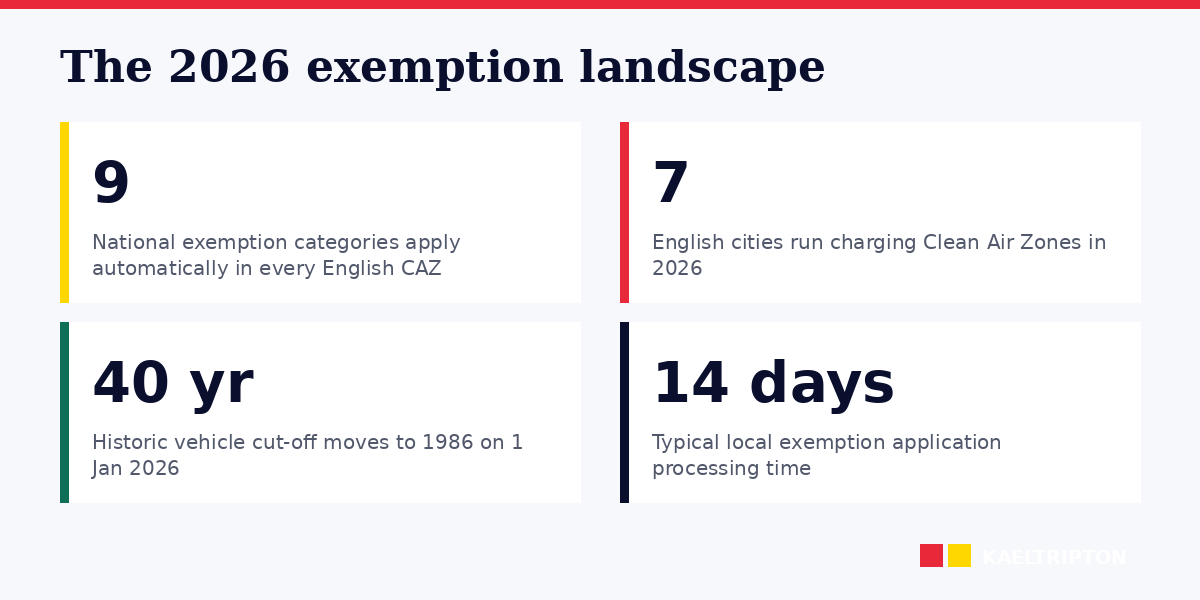
Seven English cities now run charging Clean Air Zones, with Glasgow operating Scotland's equivalent Low Emission Zone. Nine categories of vehicle are automatically exempt across every English CAZ under the national framework set out by DEFRA and DfT. Dozens more qualify for local exemptions that only work in the city that granted them, and a Bristol exemption will not protect a driver in Birmingham. This guide breaks down the national list first, then walks through the local variations that trip drivers up most often in 2026.
| ★ EDITOR'S VERDICT Check national first, local second. |
Nine national exemption categories apply automatically everywhere and need no application. Local exemptions only cover the city that granted them and require fourteen working days to process. A Blue Badge alone does nothing; the V5C tax class is what ANPR reads. Before you drive, check GOV.UK. Before you apply, check the exemption actually exists in 2026. |
The national exemption list (applies everywhere automatically)
A national exemption removes the CAZ charge in every English Clean Air Zone without any application. The list is identical across Bath, Birmingham, Bradford, Bristol, Portsmouth, Sheffield and Tyneside, because it sits in the Clean Air Zone Framework for England, the policy document that governs how local authorities design and operate charging zones under powers in Part III of the Transport Act 2000.
A vehicle is automatically exempt from CAZ charges if it falls into any of these nine categories:
- Vehicles in the disabled tax class (DVLA tax class 85, formerly "disabled")
- Vehicles in the disabled passenger vehicle tax class
- Vehicles retrofitted with technology accredited by the Clean Vehicle Retrofit Accreditation Scheme (CVRAS)
- Historic vehicles (currently those built before 1 January 1986, a rolling 40-year cut-off)
- Vehicles in the historic vehicle tax class
- Certain military vehicles on operational duties
- Ultra Low Emission Vehicles that already meet Euro 6 for diesel or Euro 4 for petrol (these never needed an exemption; they simply are not chargeable)
- Vehicles built to meet an earlier Euro standard but already compliant with the minimum emission standard for their class
- Certain showman's vehicles (HGVs and specialist vehicles used exclusively for travelling fairs and shows)
The DVLA's Automatic Number Plate Recognition system applies national exemptions automatically. A driver of a disabled-taxed Vauxhall Corsa does not need to apply anywhere, display a sticker, or notify the council. The cameras match the number plate against the DVLA record and no charge is raised.
Why a Blue Badge does not exempt you from CAZ charges
The single most common misconception in 2026 is that a Blue Badge provides automatic CAZ exemption. It does not. A Blue Badge is a parking concession issued by local authorities; it sits in a completely separate legislative regime. GOV.UK guidance explicitly states that a Blue Badge alone does not exempt any vehicle from a Clean Air Zone charge.
The distinction that matters for exemption is the vehicle tax class shown on the V5C registration certificate. If the V5C shows "Disabled" (tax class 85) or "Disabled Passenger Vehicle", the ANPR cameras will recognise it automatically. A Blue Badge holder driving a car in the standard private passenger tax class has no national exemption and will be charged if the car fails the Euro standard.
Individual cities do offer extra local concessions for Blue Badge holders. Bath allows Blue Badge holders to apply for a local discount. Birmingham, Sheffield and Tyneside have at various points operated limited-term Blue Badge exemptions tied to residency or hospital visits. These are not portable; a Birmingham Blue Badge exemption will not protect a driver entering Bristol.
Local exemptions: city by city in 2026
Every CAZ authority may apply to DEFRA for local exemptions to soften the impact on specific groups during transition. These must be time-limited and justified, and they only apply within that authority's boundary. Here is what is live in early 2026.
Bath
Bath runs a Class C zone, so private cars and motorbikes are not charged at all. Local exemptions and discounts target commercial vehicle categories. A discounted £9 daily charge (rather than the standard £100) applies to larger motorhomes and horse transporters classified as Private Heavy Goods Vehicles that are not used commercially. All Bath applications must be made through MiPermit and can take up to fourteen days to process. Several of Bath's earlier transitional exemptions expired on 14 March 2025 and have not been reinstated.
Birmingham
Birmingham runs the only Class D zone in England, so private cars are charged £8 per day if non-compliant. Birmingham's local exemptions focus on hospital appointments at the Queen Elizabeth and Birmingham Women's Hospitals, NHS staff commuting to specified sites, and vehicles registered to residents within the zone boundary. The scheme has tightened since launch; the general low-income exemption closed to new applicants and most transitional relief for commercial vehicles has ended.
Bradford
Bradford operates a Class C+ zone (Class C plus taxis). Private cars are not charged. Bradford's local exemptions require the vehicle to have been registered to the applicant before 26 September 2022, the zone's launch date. Anyone buying a non-compliant vehicle after that cut-off cannot obtain a Bradford local exemption, and the exemption is cancelled if the vehicle is sold.
Bristol
Bristol runs a Class D zone covering central Bristol, so private cars are chargeable at £9 per day if non-compliant. Bristol's local exemption categories include specialist vehicles (DVLA tax classes 4, 8, 11), emergency vehicles (tax class 12), and a Hospital Patient and Visitor Exemption that covers certain appointments at the Bristol Royal Infirmary complex. Bristol's earlier Financial Assistance Scheme Exemption closed to applications on 31 July 2023 and no equivalent replacement has been introduced.
Portsmouth
Portsmouth runs a Class B zone, so only buses, coaches, HGVs, taxis and private hire vehicles pay. Local exemptions are narrow and focus on Portsmouth-registered taxi and PHV drivers transitioning to compliant vehicles, plus bus operators signed up to the Bus Service Improvement Plan. Private motorists have no exposure to Portsmouth's scheme in the first place.
Sheffield
Sheffield runs a Class C zone, so private cars are not charged. Sheffield's local exemptions centre on HGVs, LGVs, buses, coaches, taxis and PHVs registered in the S1 to S36 postcode range, with applications processed through the Sheffield CAZ online portal. The temporary LGV exemption that operated through 2023 has been closed.
Tyneside (Newcastle and Gateshead)
Tyneside runs a Class C zone covering Newcastle city centre and parts of Gateshead. Local exemptions are broader than most, partly because the scheme launched later and had to accommodate a large hospital sector. Exempt categories include vehicles used by healthcare staff on rota at the Royal Victoria Infirmary and Queen Elizabeth Hospital Gateshead, specialist vehicles in DVLA tax classes 4, 8, 11 and 12, and vehicles registered to Tyneside residents within certain income thresholds. The earlier LGV transitional exemption ended in July 2023.
Glasgow Low Emission Zone
Glasgow's scheme is not a CAZ; it is a Low Emission Zone operated under the Transport (Scotland) Act 2019. The exemption rules are fundamentally different. Scotland does not charge non-compliant vehicles a daily fee - it issues a penalty directly. National exemptions in Scotland cover emergency vehicles, military vehicles, historic vehicles, disabled-class vehicles, and vehicles retrofitted under CVRAS. Glasgow also runs a time-limited local exemption for residents within the zone who owned their non-compliant vehicle before 1 June 2023.
How to apply for a local exemption
Every local exemption requires an application. None are automatic, and none are retrospective - if a driver enters the zone before their application is approved, they must still pay the daily charge. Applications typically take up to fourteen working days.
The process is similar across all English CAZ authorities and is built around three documents:
- V5C logbook showing the registered keeper and tax class
- Proof of address (recent council tax bill, utility bill, or bank statement) for residency-based exemptions
- Evidence of circumstance - a hospital appointment letter, NHS employee ID, charity registration number, or small-business accounts, depending on which exemption category is being claimed
Rejections are common. The most frequent reasons are: the vehicle was acquired after the scheme launch date, the address evidence is outside the eligible postcode range, or the applicant already claimed the same exemption on another vehicle. Drivers have a right to request the council's reasons in writing and to submit a formal representation if they believe the rejection was in error.
What "hard-to-replace" means in practice
A common scenario in 2026: a self-employed plumber in the Sheffield postcodes drives a 2012 Ford Transit Custom that does not meet Euro 6. The Transit is a £12,000 replacement she cannot afford while rebuilding after a slow winter. She applies for Sheffield's LGV local exemption. The application is rejected because the LGV transitional exemption closed in 2023.
Her options: apply for the Sheffield Clean Air Fund grant towards a retrofit; accept the £10 daily charge on the roughly forty working days a year she enters the zone (£400 total); or sell the Transit and buy a 2016-plate Euro 6 compliant replacement using the grant top-up. Most sole traders in this position default to the £400 annual charge because the retrofit cost-benefit does not clear the bar until mileage inside the zone exceeds roughly one hundred days a year.
Exemption changes to watch in 2026
Three policy shifts are likely to move during 2026. First, the rolling 40-year historic vehicle exemption will admit vehicles first registered in 1986, widening the eligible pool by one model year. Second, several authorities are reviewing whether to extend Blue Badge concessions now that the initial three-year transition period has passed. Third, DEFRA is consulting on whether vehicles that have been successfully retrofitted under CVRAS should be granted lifetime portable exemption across all English CAZs rather than requiring proof at each local application.
None of these changes are guaranteed, and the default position for 2026 remains: check the national list first, then check your destination city's local rules separately, then apply before you drive if a local exemption is needed.
Frequently asked questions
Does a Blue Badge exempt me from CAZ charges?
No. A Blue Badge is a parking concession and has no effect on CAZ charges unless the vehicle itself is also in the disabled tax class on the V5C. Several cities offer separate local Blue Badge concessions that must be applied for and only work within that city's zone.
Are classic cars exempt from Clean Air Zones?
Yes, if they meet the historic vehicle definition. A vehicle built before 1 January 1986 is automatically exempt under the national framework. The rolling 40-year cut-off moves forward one year every January, so 1986 vehicles become eligible from 1 January 2026. The exemption applies automatically through ANPR - no application is needed.
If I get an exemption in one city, does it cover me in others?
Only for national exemptions. A local exemption granted by Bristol, Birmingham, Sheffield or any other authority only applies within that authority's zone. Drivers who need to cross multiple zones must apply separately to each or rely on national exemption categories.
Can I apply for an exemption after I have driven in the zone?
No. Exemptions are not retrospective. If you entered the zone before your application was approved, you must pay the daily charge within six days to avoid a Penalty Charge Notice, even if your application is subsequently granted.
Do electric vehicles need an exemption?
No. Fully electric vehicles already meet every CAZ emission standard and are never chargeable. The same applies to hydrogen fuel cell vehicles. Plug-in hybrids are a different category - they must meet Euro 6 diesel or Euro 4 petrol standards on their combustion engine to avoid the charge.
What happens if the DVLA has my vehicle wrongly classified?
Japanese Domestic Market imports frequently arrive in the UK with a blank "Euro Status" field on the V5C, which causes ANPR systems to treat them as non-compliant. The fix is to contact the DVLA's vehicle customer services team with the manufacturer's Certificate of Conformity showing the Euro standard. Once the V5C is updated, the DVLA record flows through to the CAZ vehicle checker within a few working days.
Can I retrofit my older vehicle to become exempt?
Yes, if an accredited retrofit exists for your vehicle type. The Clean Vehicle Retrofit Accreditation Scheme lists approved technologies - mostly for buses, coaches, black cabs and some HGVs. Accredited retrofit automatically qualifies for national exemption. For private cars, no CVRAS retrofit is currently accredited, and aftermarket modifications that claim to deliver "Euro 6 compliance" do not provide any CAZ exemption.
Sources
- DEFRA and DfT, Clean Air Zone Framework for England, updated 6 October 2022
- GOV.UK, Drive in a Clean Air Zone and Driving in a Clean Air Zone
- GOV.UK vehicle checker, vehiclecheck.drive-clean-air-zone.service.gov.uk
- Transport Act 2000, Part III
- Transport (Scotland) Act 2019
- Bath and North East Somerset Council, Bath's Clean Air Zone exemptions and discounts
- Bristol City Council, Bristol Clean Air Zone exemptions
- Bradford Council, Breathe Better Bradford - exemptions
- Tyneside Breathe Clean Air scheme, Exemptions guidance
- House of Commons Library Briefing CBP-9816, Clean Air Zones, Low Emission Zones and the London ULEZ
|
Related guides
More fines and appeals guides
|


