

|
Part of:
UK Fines and Appeals 2026
|
You live in Leeds, visiting your sister in Bristol for the weekend. You took the A38 into the city, parked near her flat, had lunch at Clifton, drove home Sunday evening. Six weeks later a £120 Penalty Charge Notice arrives with an image of your number plate. This guide is for UK drivers who visit Clean Air Zone cities occasionally rather than living in one. It covers what to check before you go, how to pay within the six-day window, what the signage actually looks like, and what to do if a PCN arrives you think is wrong.
| ★ EDITOR'S VERDICT Thirty seconds of prep saves a £120 letter in six weeks. |
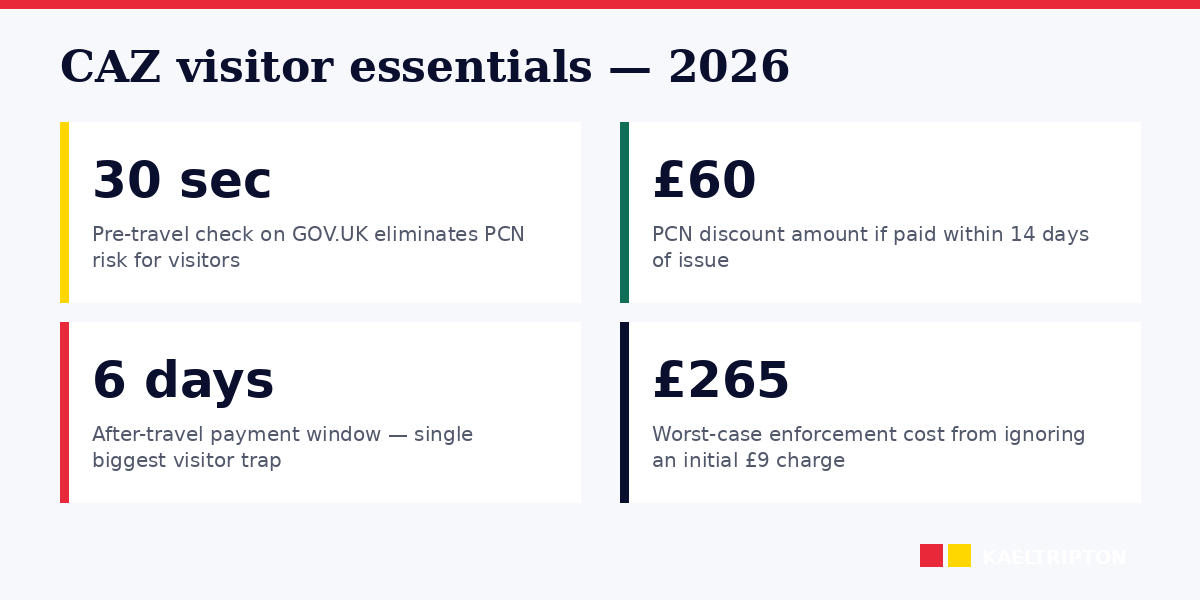
If you drive into an unfamiliar UK city this year, check the GOV.UK CAZ checker before you leave. Ten seconds, free, screenshot the result. If your vehicle is non-compliant, pay within six days of travel - the payment window is the single most common trap for visiting drivers. Ignorance of signage is not a legal ground for appeal and fails reliably at the Traffic Penalty Tribunal. The £8 daily Birmingham charge becomes £265 if ignored; the same £9 Bristol charge becomes £265 for the same behaviour. Thirty seconds saves all of it. |
Who this guide is for
The published Clean Air Zone guidance is mostly aimed at residents and commercial fleet operators. Visiting drivers - tourists, weekenders, sports fans, wedding guests, occasional business travellers - fall through the gaps. They see a CAZ sign, assume "that must be for local taxis", and drive straight through.
The risk is sharpest for:
- Out-of-area drivers of older diesel vans (trades, self-employed, couriers routing through unfamiliar cities)
- Hire car customers picking up a non-compliant vehicle
- Drivers of older used cars where the DVLA Euro standard record may be missing or wrong
- Overseas visitors driving UK rental cars without ANPR pre-registration
If you live in one of the seven CAZ cities you already know the rules. This guide is written for the other 60 million people in the UK who might drive into a CAZ once a year.
The 30-second pre-travel check
Before any UK road trip that might pass through an unfamiliar city, three steps take about 30 seconds and eliminate the PCN risk almost entirely:
- Type your registration into the GOV.UK checker at vehiclecheck.drive-clean-air-zone.service.gov.uk. It covers all seven English CAZs in one query. If it returns "you do not need to pay" for every zone, you can stop reading here - your vehicle is compliant and no charge will ever apply.
- Take a screenshot of the result. Keep it on your phone for the duration of the trip. If a PCN ever arrives incorrectly, this is your evidence.
- For non-compliant vehicles, check which cities are on your route. Cross-reference your journey plan against the live CAZ city list and note which zones you will enter.
That is the entire pre-travel process for a compliant vehicle. For non-compliant vehicles the next step is planning the payment - covered below.
Which vehicles typically fail the Euro standard
A rough rule of thumb before you even open the checker:
- Petrol car registered before 1 January 2006 - likely Euro 3 or earlier, will be charged in Birmingham and Bristol (the only two Class D CAZs that charge cars) and London ULEZ.
- Diesel car registered before 1 September 2015 - likely Euro 5 or earlier, charged in Birmingham, Bristol, London ULEZ.
- Diesel van registered before 1 September 2016 - likely Euro 5 or earlier, charged in every English CAZ and ULEZ.
- Motorcycle registered before 1 January 2007 - likely pre-Euro 3, charged in London ULEZ only (no English CAZ charges motorcycles in 2026).
Vehicles younger than the cut-off dates are almost always compliant. The checker is the authoritative answer but these rules cover 99 percent of cases.
Spotting CAZ signage on approach
Every CAZ uses the same signage standard under the Traffic Signs Regulations and General Directions 2016:
- Round white sign with green border and the text "Clean Air Zone" (or "Low Emission Zone" in Glasgow). This marks the boundary where the zone starts.
- Supplementary plate below showing "Class B", "Class C" or "Class D" and typically listing which vehicles are affected (e.g. "HGVs Buses Coaches £100 per day")
- Red cross / cloud symbol in some Class D zones denoting that all vehicles up to and including private cars are within scope
The signs are placed at every road entering the zone and are required to be visible at driver eye-level from at least 60 metres away in daytime conditions. Missing or obscured signs are one of the few successful grounds for appeal at the Traffic Penalty Tribunal.
What you will not see: a barrier, a toll booth, a red light stopping traffic. CAZs are ANPR-enforced. You simply drive in. The cameras do their work silently.
How to pay within the six-day window
You drive into the zone Saturday afternoon. The clock starts. You have until 23:59 on the following Friday - six days later - to pay the daily charge or a PCN is issued automatically.
The payment sequence:
- Go to gov.uk/clean-air-zones
- Select "Pay or check a vehicle's charge"
- Enter the registration number, the city, and the travel date
- The system confirms the amount (£8 Birmingham, £9 Bath/Bristol/Bradford, £10 Sheffield, £12.50 Tyneside)
- Pay by debit or credit card. No account needed for a single payment.
- Save the email receipt - this is your defence if anything goes wrong
London ULEZ uses a separate TfL system at tfl.gov.uk/pay-the-ulez-charge. Window is shorter - midnight of the travel day to midnight three days later.
Glasgow LEZ has no pre-payment. Non-compliant entry triggers a £60 penalty automatically. Compliant entries need no action.
What happens if a PCN arrives
PCNs typically arrive three to six weeks after the trip. The envelope is usually brown and labelled with the council's CAZ team. Open immediately, read the alleged date and location, and act within the first 14 days for the £60 discounted rate.
Three routes to resolve a PCN:
- Pay within 14 days at the £60 discount rate. Fastest and cheapest if you know you owe it.
- Submit formal representations within 28 days if you believe the PCN is wrong. Representations go through the council's online portal (linked on the PCN itself). Grounds that succeed include compliance evidence, keeper-change proof, ANPR image showing a different vehicle, or procedural error.
- Appeal to the Traffic Penalty Tribunal if representations are rejected. Free to appeal, independent adjudicators, typically decided within four to eight weeks of submission.
Two mistakes to avoid: paying the full £120 unnecessarily when you have good evidence to dispute, and ignoring the PCN entirely. Both are expensive. The former costs you the £60 discount; the latter escalates to £180, then court recovery fees, then enforcement agent fees potentially totalling £265 or more.
A real 2026 scenario: the Leeds-to-Bristol weekender
A couple from Leeds drives their 2013 Volkswagen Golf 1.6 TDI to Bristol for a weekend visit. The Golf is Euro 5 diesel - non-compliant in the Bristol CAZ at £9 per day.
They enter the zone on the A38 Friday afternoon, park near Clifton Village, and leave Sunday morning via the same route. Two calendar days in the zone (Friday and Saturday - they left before midnight on Sunday so no third-day charge).
Two options:
Option A - they check the GOV.UK tool on Monday morning. It confirms their Golf is charged. They pay £18 for the two days immediately. Total cost: £18. Time spent: five minutes.
Option B - they don't check. Six weeks later, two PCNs arrive for £120 each. They pay within 14 days at the discounted rate: £60 × 2 = £120. Total cost: £120. Time spent: an unpleasant hour of paperwork.
The difference between Option A and Option B - £102 per trip - is entirely a function of whether the driver knew about the 6-day payment window. A compliant vehicle would have cost £0 in either scenario.
Hire cars and rental vehicles
UK hire car fleets are almost entirely Euro 6 compliant by 2026, so private car hire rarely triggers CAZ charges. Van hire is different - hire companies retain older Euro 5 vans for cost reasons and these are chargeable in every English CAZ.
Key questions to ask at pickup:
- "Is this vehicle CAZ-compliant for all English zones?" A reputable rental desk will check immediately.
- "How does the company handle CAZ charges if I enter a zone?" Three models exist: some pay the charge for you and invoice afterwards (typically with a £3-5 admin fee); some pass the entire cost directly; some refuse to cover it and the PCN goes to the registered keeper (the hire company) who passes your details.
- "What about PCNs that arrive after my rental period ends?" All hire agreements authorise the company to debit your payment card for any PCN traced to your rental dates, usually with an admin fee.
A cheap van hire that turns out to be non-compliant can add £50 to a three-day trip through admin fees alone. The honest rental desks disclose this upfront; the cheap ones hide it in the terms and conditions.
Overseas visitors driving UK-registered vehicles
UK hire cars driven by overseas visitors are handled by the hire company as described above. Private UK vehicles driven by overseas visitors (for example, borrowing a friend's car during a UK holiday) are handled exactly as if the owner were driving - the PCN goes to the DVLA-registered keeper, who passes it on as a private matter.
Overseas visitors driving foreign-registered vehicles (for example, French-plated cars on UK ferry trips) are still liable for CAZ charges. Enforcement is through international data-sharing and the PCN is forwarded to the vehicle's national authority in the home country. This does not always work quickly - some EU-registered visitors have gone months without receiving the PCN - but the liability remains.
Frequently asked questions
How do I know if my car is charged before I enter a zone?
Use the free official checker at vehiclecheck.drive-clean-air-zone.service.gov.uk. Enter the registration, wait ten seconds, see the result for all seven English CAZs at once. The checker uses live DVLA data and is legally authoritative.
Does CAZ signage always show the charge amount?
Not the exact amount in every case. Signs typically show the class and the affected vehicles but may not show the £ figure. The Class C or Class D label is what matters - combined with knowing your vehicle type, it tells you whether you need to pay.
If I enter a zone briefly by accident, do I still pay?
Yes. There is no grace period, no tolerance for short entries, no "transit exemption". Crossing the boundary at any speed, for any duration, is an entry. The ANPR captures it and the charge applies. This is the single hardest aspect of CAZ enforcement for visiting drivers to accept.
Can I appeal if I genuinely didn't know there was a CAZ?
Not successfully. "I didn't know" is explicitly listed by every CAZ council as a reason that will not normally be accepted. The legal position is that signage meets the statutory standard and knowledge of the rules is the driver's responsibility. Tribunal adjudicators consistently reject ignorance-based appeals.
Do I need to register my vehicle with each city before visiting?
No, not for UK-registered vehicles. You just need to pay the daily charge if you enter and you are non-compliant. Foreign-registered vehicles also do not need to register in advance for English CAZs - the system works retrospectively through data-sharing.
What if I drive past a CAZ sign but do a U-turn before the cameras?
The cameras are at the zone entry points, typically 50 to 100 metres inside the zone. A U-turn before the camera does not trigger a charge. A U-turn after the camera but before exiting does not reduce the charge - one entry is one day's charge regardless of how long you stay.
Is there a grace period for new residents or visitors?
No general grace period. Some cities offered transitional exemptions at launch for specific groups (residents, Blue Badge holders) but these have largely expired by 2026. Visitors are treated identically to occasional non-resident drivers with no concessions.
Sources
- GOV.UK, Driving in a Clean Air Zone and Clean Air Zone vehicle checker
- DEFRA and DfT, Clean Air Zone Framework for England
- Transport Signs Regulations and General Directions 2016 (signage standards)
- Road User Charging Schemes (Penalty Charges, Adjudication and Enforcement) (England) Regulations 2013
- Traffic Penalty Tribunal, city-specific grounds of appeal pages
- Transport for London, Ultra Low Emission Zone guidance for visitors
- Low Emission Zones Scotland, Glasgow LEZ visitor information
|
Related guides
More fines and appeals guides
|


