

|
Part of:
UK Fines and Appeals 2026
|
The fastest way to check Clean Air Zone compliance takes about ten seconds and costs nothing. Type your registration into the official GOV.UK vehicle checker at vehiclecheck.drive-clean-air-zone.service.gov.uk and you will see whether your car is chargeable in each of the seven English CAZs. The harder question is why a 2015-plate diesel might be charged when a 2006-plate petrol drives through for free. This guide walks through both the quick check and the underlying rules so you can predict the answer for any vehicle, including imports and older stock where the government checker sometimes gets it wrong.
| ★ EDITOR'S VERDICT Ten seconds on GOV.UK settles it. |
Type the registration into the free official checker and you have an authoritative answer for all seven English CAZs. Petrol from 2006, diesel from September 2015, electric always - those rules catch 99% of vehicles. Imports and pre-2001 cars are where the DVLA record breaks and the checker gets it wrong; fix that with a Certificate of Conformity, not a call to the council. |
The fastest check: GOV.UK vehicle checker
The official Clean Air Zone vehicle checker is operated by the Joint Air Quality Unit, jointly run by DEFRA and DfT. It is the only source that combines live DVLA registration data with the minimum emission standards set by the Clean Air Zone Framework for England.
To use it:
- Go to gov.uk/clean-air-zones and select "Check if you need to pay"
- Enter your vehicle's registration number (number plate) - no payment is needed for a check
- The checker returns a result for all seven English Clean Air Zones plus a note about London's ULEZ and Scottish LEZs (both of which use different checkers)
The result shows either "You do not need to pay" or "You need to pay £X" for each zone. If the result is "You do not need to pay" you are compliant and no further action is required. If it says you need to pay, the checker does not explain why - you need to understand the Euro standard rules to know whether you have options.
What the Euro standard rules actually say
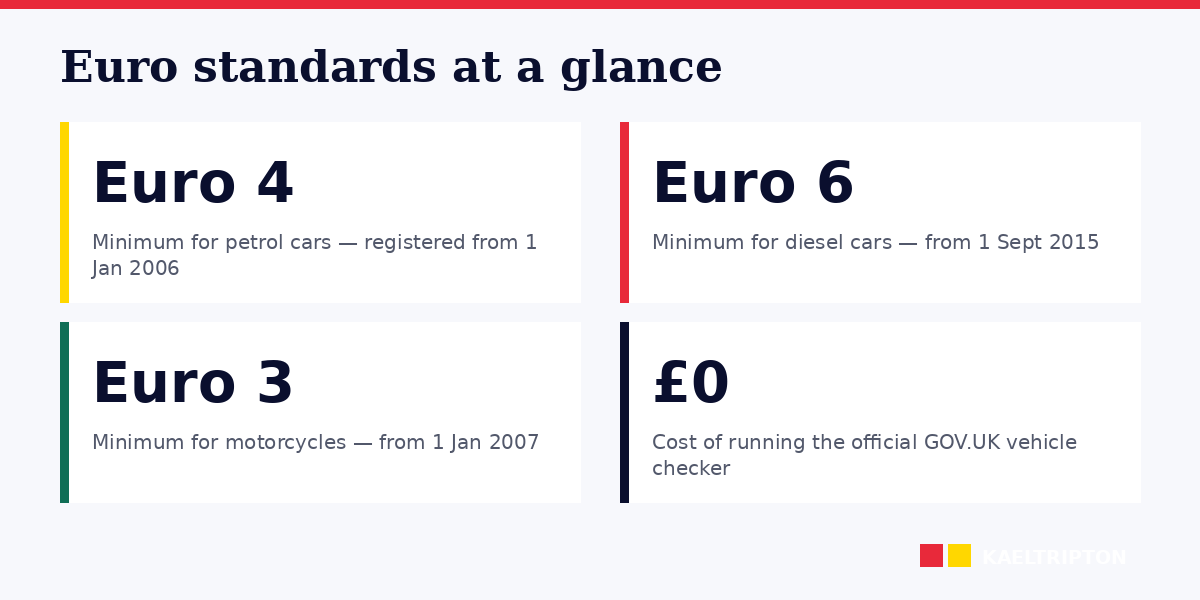
The Clean Air Zone Framework sets a minimum Euro emission standard for each vehicle type. Meet or exceed the minimum, no charge. Fall below it, charge applies. The minimum standards are:
| Vehicle type | Minimum standard (petrol) | Minimum standard (diesel) | Typical registration date threshold |
|---|---|---|---|
| Cars and small vans up to 3.5 tonnes | Euro 4 | Euro 6 | Petrol: from 1 Jan 2006. Diesel: from 1 Sept 2015 |
| Motorcycles and mopeds | Euro 3 | n/a | From 1 Jan 2007 |
| Heavy goods vehicles | n/a | Euro VI | From 1 Jan 2014 (new type approvals) / 1 Jan 2015 (all new registrations) |
| Buses, coaches | n/a | Euro VI | From 1 Jan 2014 (new type approvals) / 1 Jan 2015 (all new registrations) |
The asymmetry between petrol (Euro 4) and diesel (Euro 6) surprises most drivers. A ten-year-old diesel can fail while a twenty-year-old petrol passes. The reason is NOx emissions - the pollutant that CAZs are designed to tackle. Petrol engines hit the 0.08g/km NOx target as far back as Euro 4 in 2005. Diesel engines only reached the same NOx level when Euro 6 was introduced in 2015. For ten years between those two dates, petrol cars were already cleaner than the diesels being sold as new.
Where to find your Euro standard on the V5C
Your vehicle's Euro standard is not always printed in plain English on the V5C registration certificate. There are three places to look:
- Section D.2 - Type Approval Number. A long alphanumeric code that encodes the Euro standard. The fragment "EURO 6" or "*715/2007*692/2008*" (Euro 5) or "*715/2007*459/2012*" (Euro 6) often appears. The regulation number is the giveaway.
- Section V.9 - Level of CO2 emissions. Not the Euro standard itself, but useful as a cross-check. CO2 figures below 95g/km almost always correspond to Euro 6 or later.
- Page 2, bottom - "Exhaust Emissions" field. On older V5C formats, a direct NOx and particulate figure is printed. Matching the numbers to the published Euro standard tables confirms the class.
If your V5C has the field blank - common on grey imports and certain pre-2001 vehicles - the DVLA record that feeds the CAZ checker will also be blank, and the checker will default to "non-compliant". This is the single most common reason for wrongly charged vehicles, and we cover the fix below.
How to predict compliance without the checker
A rule of thumb that catches almost every case:
- Petrol car registered on or after 1 January 2006? Almost certainly Euro 4 or better. Compliant everywhere.
- Diesel car registered on or after 1 September 2015? Almost certainly Euro 6. Compliant everywhere.
- Petrol car registered 2001 to 2005? Usually Euro 3. Compliant in CAZ Class D (if motorcycle/PHV rule applies) but not in London's ULEZ. Run the checker.
- Diesel car registered before September 2015? Usually Euro 5 or earlier. Non-compliant in any Class D CAZ and ULEZ. Run the checker.
- Fully electric or hydrogen? Always compliant. Zero emissions means zero charge.
- Motorcycle registered on or after 1 January 2007? Almost certainly Euro 3. Compliant in every English CAZ (none currently charge bikes) and in London's ULEZ.
Hybrids and plug-in hybrids
Hybrid and plug-in hybrid vehicles are not automatically exempt. The Euro standard applies to the combustion engine, not to the hybrid system. A 2018 Toyota Prius is Euro 6 compliant and drives through every CAZ free. A 2012 Lexus RX450h is only Euro 5 and will be charged in Birmingham, Bristol and any future Class D zone.
The checker handles hybrids correctly - enter the registration and it returns the true compliance status based on the underlying engine. The mistake to avoid is assuming "hybrid" equals "clean": it does not, legally speaking.
When the GOV.UK checker is wrong
The checker is accurate for roughly 99% of UK-registered vehicles, but it fails in three situations:
1. Japanese Domestic Market imports. A Nissan Elgrand, Toyota Alphard or imported Honda Fit was built to Japanese emissions standards, not European. When the DVLA registers the import, the "Euro Status" field on the V5C is frequently left blank because Japan does not publish Euro-equivalent data on its equivalent documents. The checker reads blank as non-compliant. The fix is to obtain the Certificate of Conformity from the original Japanese manufacturer or its UK subsidiary, send it to DVLA vehicle customer services, and request a V5C update. This typically takes six to eight weeks.
2. Pre-2001 cars with no recorded Euro data. Some older Euro 2 and Euro 3 petrol cars have V5C records showing "Not recorded". The ANPR system will sometimes default to charging them. The evidence needed to correct this is the original type approval document or the manufacturer's archived certificate. For cars now twenty-five years old, this can be difficult. In practice, the pragmatic fix is to apply for a local historic vehicle exemption once the car crosses the 40-year threshold.
3. Retrofitted vehicles. A CVRAS-accredited retrofit automatically creates a national exemption, but the DVLA record takes time to update after the retrofit is installed. During the gap, the checker may still show "non-compliant". The fix is to keep the retrofit certificate and a letter from the accredited installer - if charged, dispute the PCN using these as evidence and the council will normally cancel.
A real 2026 scenario: the £5,000 second-hand diesel
A district nurse in Bedminster, Bristol, is looking to replace her 2009 Peugeot 207 diesel. She has £5,000 to spend. The classifieds are full of 2013 and 2014-plate diesels - BMW 116d, Ford Focus 1.6 TDCi, Vauxhall Astra CDTi - for around £4,500. They look like bargains.
Any of them will be charged £9 every working day she commutes into the Bristol CAZ. Forty weeks of commuting at five days a week is 200 days. That is £1,800 a year in CAZ charges on a £4,500 car - the charge will equal the purchase price within thirty months.
The alternative is a 2015 plate 1.2 petrol Corsa at £4,800. Compliant. Zero CAZ charges. Slightly worse fuel economy, but the £1,800 annual saving is thirty-six tanks of petrol. The GOV.UK checker would have flagged this in ten seconds and steered the decision cleanly.
Checking compliance for London (ULEZ), Scotland and Wales
The GOV.UK CAZ checker covers England outside London. For London, use Transport for London's ULEZ vehicle checker at tfl.gov.uk/modes/driving/ulez-find-out-if-ulez-affects-you. The ULEZ rules are the same Euro standards (Euro 4 petrol, Euro 6 diesel, Euro 3 motorcycle) but the enforcement authority and charge amount differ (£12.50 daily for cars and vans, compared with the English CAZ range of £8 to £12.50).
For Scotland, each LEZ has its own checker - Glasgow, Edinburgh, Dundee and Aberdeen use the shared Low Emission Zones Scotland checker at lowemissionzones.scot. Scotland's emissions standards match the CAZ framework, but Scotland does not charge a daily fee for non-compliant vehicles. It issues a penalty notice directly, with doubling-up penalties for repeat breaches.
Wales currently has no charging zones. The Welsh Government has powers under the Environment Act 2021 to create them, but no Welsh local authority has yet taken this route.
Frequently asked questions
Is the GOV.UK CAZ checker free?
Yes. Checking compliance costs nothing. Only paying the charge (if applicable) requires a card. Any website that asks for payment simply to check compliance is not the official service - the government checker is the only authoritative free tool.
Does the Euro standard on my V5C override the checker result?
No. The checker uses DVLA records which are the legal source of truth. If your V5C says Euro 6 but the checker says "non-compliant", there is a mismatch in the DVLA record. Contact DVLA customer services with your Certificate of Conformity to correct it.
How do I check an imported vehicle?
The same way - enter the UK registration. If the checker says non-compliant and you believe the vehicle meets the Euro standard, request the manufacturer's Certificate of Conformity and submit it to DVLA. Never rely on verbal assurances from the importer that the vehicle is "ULEZ ready".
Does a DPF retrofit make my diesel Euro 6?
No. A diesel particulate filter addresses particulate matter but not NOx. A Euro 5 diesel with an aftermarket DPF remains Euro 5 and remains chargeable. Only a full CVRAS-accredited retrofit that includes Selective Catalytic Reduction changes the legal status of the vehicle.
What if my registration is not recognised by the checker?
The GOV.UK checker cannot process foreign-registered vehicles, trade plates, or vehicles that are not on the DVLA database. Foreign-registered vehicles are still liable for CAZ charges when driving in England; the local authority bills them through their national authority. Trade plates are subject to local rules - check with the specific authority before driving.
How often is the checker updated?
The checker pulls live DVLA data, so any update to your vehicle's record - change of keeper, change of tax class, successful retrofit - flows through within a few working days. Local exemptions granted by a council take longer to propagate because each authority's exemption database feeds the checker overnight.
Can I rely on the checker for a vehicle I am thinking of buying?
Yes. The checker works on any UK registration regardless of whether you are the registered keeper. Run the plate before you view the vehicle and you will know the CAZ status immediately.
Sources
- GOV.UK, Drive in a Clean Air Zone and the Clean Air Zone vehicle checker
- DEFRA and DfT, Clean Air Zone Framework for England, updated 6 October 2022
- DVLA, V5C registration certificate guidance
- Clean Vehicle Retrofit Accreditation Scheme, List of accredited retrofit technologies
- Transport for London, Ultra Low Emission Zone - who needs to pay
- Low Emission Zones Scotland, Vehicle compliance
- European Union, Regulation (EC) 715/2007 and subsequent amending regulations defining Euro 5 and Euro 6
|
Related guides
More fines and appeals guides
|


