

|
Part of:
UK Fines and Appeals 2026
|
Newcastle and Gateshead’s joint Clean Air Zone is a Class C scheme - private cars are not charged. Only older taxis, vans, lorries, buses and coaches pay. £12.50 for vans/taxis; £50 for HGVs and buses. This guide covers the boundary (including four Tyne bridges), exemptions specific to Tyneside, and the commercial-vehicle focus that sets this CAZ apart.
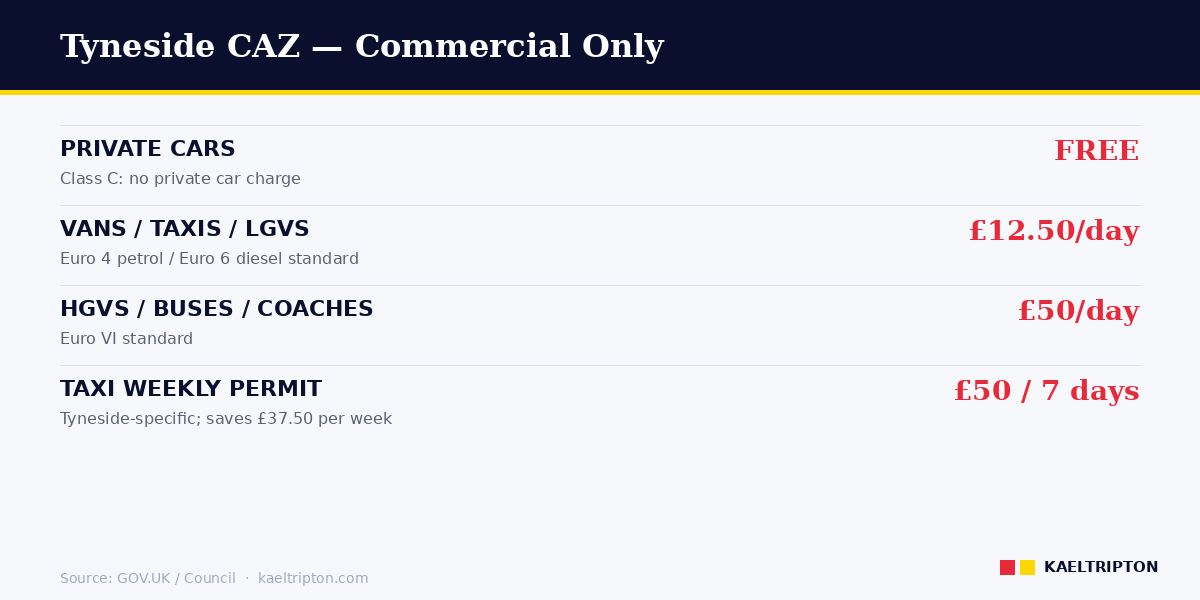
Newcastle and Gateshead’s Class C CAZ charges only commercial vehicles: £12.50/day for vans, taxis and LGVs; £50/day for HGVs, buses and coaches. Private cars and motorcycles are not charged. Unique Tyneside feature: licensed taxis can buy a 7-day permit for £50 (saving £37.50 vs daily payment for full-week drivers). |
Tyneside CAZ in one paragraph
The Newcastle and Gateshead Clean Air Zone is a Class C scheme, meaning private cars and motorcycles are not charged. Charges apply to non-compliant taxis, private hire vehicles, vans, minibuses, buses, coaches and HGVs. Vans/taxis/minibuses pay £12.50 per day; HGVs, coaches and buses pay £50 per day. The zone operates 24 hours a day, 7 days a week, with charges midnight to midnight. Enforcement by ANPR.
The scheme launched on 30 January 2023 for taxis, buses, coaches and HGVs. Van and LGV charging began on 17 July 2023 after a six-month delay to allow time for commercial vehicle upgrades. The CAZ is operated jointly by Newcastle City Council and Gateshead Council, under the Breathe Clean Air campaign brand.
Why private cars are exempt - the Class C model
Unlike Birmingham (Class D) and Bristol (Class D), Tyneside chose the Class C scheme. Class C charges apply to commercial vehicles only: buses, coaches, taxis, HGVs, LGVs and minibuses. Private cars are not included.
The policy rationale: 90%+ of NO2 pollution in Newcastle city centre comes from commercial vehicles (buses in particular, historically). Targeting commercial operators generates the largest air quality improvement while avoiding disruption to private car users. Most Newcastle residents don’t feel the CAZ directly.
For private car drivers visiting Newcastle - no charge, no compliance check needed. Drive in any vehicle, pay nothing. This is the most relaxed CAZ regime of any charging UK city.
Which vehicles pay what
| Vehicle type | Charge if non-compliant | Standard |
|---|---|---|
| Private cars | FREE | Not charged at all |
| Motorcycles, mopeds | FREE | Not charged at all |
| Taxis, private hire vehicles | £12.50/day | Euro 4 petrol / Euro 6 diesel |
| Vans, LGVs, minibuses | £12.50/day | Euro 4 petrol / Euro 6 diesel |
| HGVs (over 3.5t) | £50/day | Euro VI |
| Buses, coaches | £50/day | Euro VI |
Check a specific commercial vehicle at vehiclecheck.drive-clean-air-zone.service.gov.uk.
The boundary and four bridges
The Newcastle and Gateshead CAZ covers most of Newcastle city centre plus routes over four Tyne bridges:
- Tyne Bridge.
- Swing Bridge.
- High Level Bridge.
- Redheugh Bridge.
Inside the zone: the main city centre, Newcastle Central Station, Newcastle University, the Quayside, parts of Gateshead town centre south of the river. Jesmond, Heaton, and the coastal areas are outside. Going to or from Newcastle United’s St James’ Park stadium for a match in a private car incurs no charge.
Commercial vehicles crossing any of the four Tyne bridges pay the charge for that day. This matters for tradespeople, delivery drivers and taxi operators commuting between Newcastle and Gateshead - plan routes if you drive a non-compliant commercial vehicle.
Official map and route checker at breathe-cleanair.com.
The taxi weekly permit - a Tyneside-specific option
A unique feature of the Tyneside CAZ: licensed taxi and private hire drivers registered with Newcastle, Gateshead or North Tyneside Councils can buy a 7-consecutive-day permit for £50 instead of paying the £12.50 daily charge.
Practical maths: 7 days × £12.50 = £87.50. The £50 weekly permit saves £37.50 per week for drivers who work 6-7 days a week. For drivers working 3-4 days a week, daily payment at £12.50 is cheaper.
This permit is specific to Tyneside. Apply through the Breathe Clean Air website before travel.
Scenario - the plumber from Sunderland
Consider a realistic case. A self-employed plumber based in Sunderland drives a 2015 Ford Transit Custom diesel (Euro 5 - not Euro 6 compliant). His customer base is split: 60% in Sunderland (outside any CAZ), 40% in Newcastle/Gateshead (inside the CAZ).
His options:
- Pay £12.50 per day when working in Newcastle. Average 2-3 days a week = £25-37.50/week = £1,300-1,950/year. Add to overhead.
- Upgrade the van. Euro 6 Transits second-hand from around £15,000-18,000. The £1,500/year CAZ cost would take 10+ years to justify the upgrade on CAZ alone - but factoring in expanding CAZs elsewhere and general depreciation, an upgrade within 2-3 years makes sense.
- Decline Newcastle work. Narrows customer base; probably not viable commercially.
Teaching point: for trades and deliveries, CAZ is a cost of doing business. Factor it into quotes for CAZ-area customers. Many Newcastle-area trades have added a small CAZ surcharge to invoices since 2023 - customers are usually accepting.
Newcastle CAZ exemptions
Local exemptions in Tyneside (application-based):
- Financed vehicles: taxis/PHVs registered in Newcastle, Gateshead or North Tyneside, and commercial vehicles of businesses based within the CAZ. Exemption lasts until the date of the last finance payment or two years from the CAZ start date, whichever is earlier.
- Businesses within the CAZ: two-year exemption from CAZ start date, maximum 2 vehicles per company.
- Community transport vehicles: one-year exemption.
- Wheelchair-accessible taxis and PHVs: two-year exemption.
- Non-compliant resident vehicles: two-year exemption for residents inside the CAZ.
National exemptions also apply: historic vehicles (40+ years), military, recovery, fully electric, emergency services, showman’s vehicles.
Apply through breathe-cleanair.com/exemptions. Or call 0191 278 2711 for a paper form.
How to pay and appeal
Pay at gov.uk/clean-air-zones or 0300 029 8888 (Mon-Fri 8am-7pm, Sat 8am-2pm). Payment window: 6 days before, on the day, or up to 6 days after entering the zone.
PCN for non-payment: £120, halved to £60 if paid within 14 days. Appeals go to Newcastle City Council and Gateshead Council initially, with Traffic Penalty Tribunal as the final independent stage. Statutory grounds are the same as other English CAZs.
Vehicle upgrade grants
The Breathe Clean Air scheme has operated vehicle upgrade grant programmes since the CAZ launched. Eligibility varies by vehicle type and has tightened over time. Current schemes (check the Breathe website for latest terms):
- Taxi upgrade grants for drivers licensed in Newcastle, Gateshead or North Tyneside moving from non-compliant to Euro 6 diesel, Euro 4 petrol, hybrid or electric taxis.
- LGV/van upgrade grants for small businesses operating non-compliant vans within the CAZ.
- Retrofit grants for HGV and bus operators upgrading emissions systems to meet Euro VI.
Grant amounts and eligibility windows have varied. The scheme has been well-subscribed - funding closes when budgets are exhausted. If you’re operating a non-compliant commercial vehicle with regular CAZ journeys, check current grant availability at breathe-cleanair.com before committing to continued daily-charge payments.
What Tyneside CAZ has achieved
Newcastle and Gateshead publish joint CAZ performance data through the Breathe Clean Air campaign. Key outcomes since the 2023 launch:
- Significant reduction in non-compliant commercial vehicles entering the zone.
- Measurable improvement in NO2 concentrations at key monitoring sites, with some sites reaching compliance with the legal 40 µg/m³ annual mean.
- Accelerated fleet turnover in the regional bus network, with most operators now running Euro VI-compliant buses.
The Class C model (private cars exempt) has also preserved political acceptability - Tyneside hasn’t faced the pushback Greater Manchester encountered when proposing a Class C CAZ that was eventually abandoned. Private drivers unaffected; commercial operators bearing most of the compliance cost.
Related guides
- UK Clean Air Zones 2026
- Birmingham Clean Air Zone 2026
- Bristol Clean Air Zone 2026
- Glasgow Low Emission Zone 2026
Disclaimer
This guide reflects Newcastle City Council, Gateshead Council and GOV.UK CAZ rules as of April 2026. Charges and exemptions can change. Check current position at breathe-cleanair.com. This article is not legal advice.
Frequently asked questions
Do I have to pay the Newcastle CAZ charge in my private car?
No. Newcastle and Gateshead’s CAZ is a Class C scheme - private cars and motorcycles are not charged regardless of emissions standard. Only taxis, vans, minibuses, HGVs, buses and coaches pay. Drive into the city in any private car at no cost.
How much is the Newcastle CAZ charge for a van?
£12.50 per day for non-compliant vans, LGVs, minibuses, taxis and private hire vehicles. HGVs, buses and coaches pay £50 per day. Compliant commercial vehicles pay nothing. The charge covers one full midnight-to-midnight day with unlimited entries.
What area does Newcastle CAZ cover?
Most of Newcastle city centre plus routes over four Tyne bridges: Tyne, Swing, High Level and Redheugh. Newcastle Central Station, Newcastle University, the Quayside and parts of Gateshead town centre south of the river are inside. Jesmond, Heaton and coastal areas are outside. Official map at breathe-cleanair.com.
Is there a weekly option for Tyneside taxi drivers?
Yes. Licensed taxis and private hire vehicles registered with Newcastle, Gateshead or North Tyneside can buy a 7-consecutive-day permit for £50 instead of £12.50 per day (total £87.50 over 7 days). Apply via breathe-cleanair.com. Worth it for drivers working 5+ days a week in the CAZ.
When did Newcastle CAZ start?
30 January 2023 for taxis, private hire vehicles, buses, coaches and HGVs. Van and LGV charging started 17 July 2023 after a six-month delay for commercial vehicle supply issues. The zone operates 24/7 year-round.
Am I exempt if I live inside the Newcastle CAZ?
Resident vehicles inside the CAZ were given a 2-year exemption from the scheme’s start date. For non-compliant vehicles, check current exemption status with Newcastle City Council - exemptions are time-limited rather than permanent.
How do I check if my van is compliant with Newcastle CAZ?
Use the official GOV.UK vehicle checker at vehiclecheck.drive-clean-air-zone.service.gov.uk. Enter your registration number. The same database covers all UK CAZs - result will confirm Newcastle, Birmingham, Bristol etc. compliance in one check.
Sources
- Newcastle City Council - Newcastle and Gateshead CAZ
- Breathe Clean Air - breathe-cleanair.com (joint Newcastle/Gateshead campaign)
- GOV.UK - Driving in a Clean Air Zone
- Traffic Penalty Tribunal - Newcastle/Gateshead CAZ appeals
- Civil Enforcement of Road Traffic Contraventions (Representations and Appeals) (England) Regulations 2013
|
Related guides
More fines and appeals guides
|


