

Renewing vehicle tax in the UK in 2026 takes five minutes online if the right reference number is at hand and the car has current MOT and insurance on DVLA's records. The standard annual rate rose to £200 on 1 April 2026 (up from £195), and drivers of electric vehicles are now in scope for VED for the first time. For drivers already on Direct Debit, renewal is automatic and the V11 paper reminder no longer arrives.
This guide walks through every renewal scenario in 2026: Direct Debit auto-renewal, one-off card payments, renewal without the V11, what to do if MOT or insurance gaps break the process, how the Expensive Car Supplement behaves on renewal, and what happens when the renewal fails at midnight. All figures and processes reflect the DVLA online service and the V149 rates table in force on 23 April 2026.
|
KEY FACTS (VERIFIED 23 APRIL 2026) Renewal channel: Online at gov.uk/vehicle-tax (24 hours), phone 0300 123 4321, or in person at a Post Office that handles vehicle tax. V11 reference: 16-digit number on the reminder letter. The V5C logbook reference is 11 digits. Either works for renewal. Direct Debit: Auto-renews each year if MOT is valid. No V11 is sent. 2026/27 standard rate: £200 annual (post-April 2017 cars), £110 for 6 months, £210 total on monthly DD, £105 per 6 months on DD. Prerequisites: Valid MOT (if over 3 years old), insurance recorded on the Motor Insurance Database, and the vehicle must have a current registered keeper. |
Renewal routes: which one applies to you
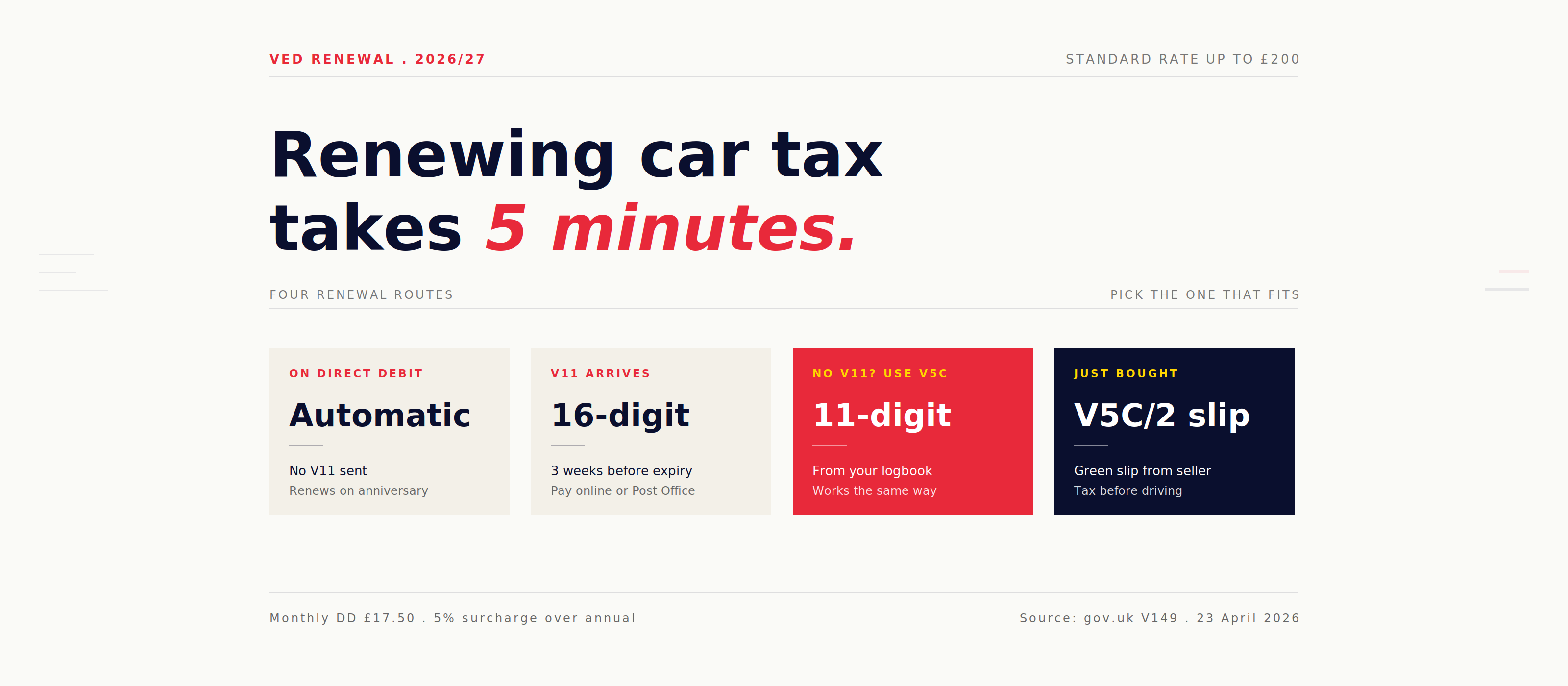
The renewal process depends on how the tax was paid last time. Four scenarios cover nearly every UK driver.
Scenario 1: Direct Debit already active. If the last payment was by monthly, six-monthly, or annual Direct Debit, the DVLA renews automatically. No action is needed from the keeper. No V11 is sent. The DD simply continues at the new rate (£200 standard for 2026/27, or the appropriate banded rate) from the renewal date. The only exception is if the MOT has lapsed: DVLA writes to the keeper explaining that the DD cannot renew until the MOT is current.
Scenario 2: Last paid by card, V11 arrives. The DVLA mails a V11 reminder around three weeks before expiry. The 16-digit reference on the V11 is used to renew online, by phone, or at a Post Office. Standard renewal takes two minutes.
Scenario 3: No V11 received. This happens when an address change has not been updated on the V5C, when the V11 has been lost, or when the DVLA has not issued one. The driver uses the 11-digit reference from the V5C logbook instead. No V11 is required to renew.
Scenario 4: Just bought the car. Vehicle tax does not transfer between keepers. The V5C/2 green slip given by the seller carries an 11-digit reference that is used to tax the car in the new keeper's name. The new keeper must tax before driving; there is no grace period.
Direct Debit auto-renewal: what actually happens
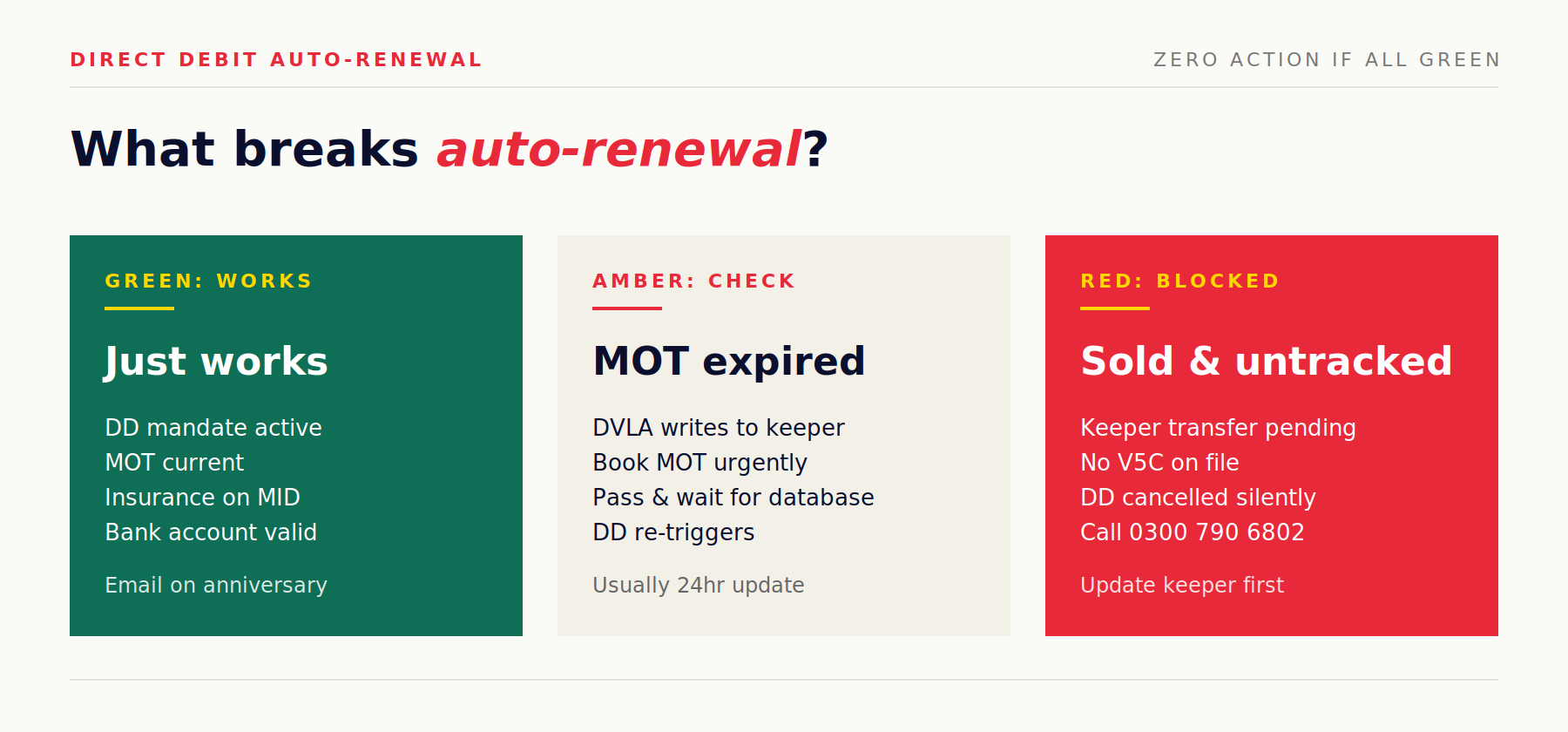
Direct Debit is the cleanest renewal path because the driver does nothing active. DVLA's own guidance at gov.uk/vehicle-tax-direct-debit/renewing is explicit: if a DD is active and the MOT is valid, the tax renews automatically on the date the previous period ran out. No V11 reminder letter is sent. No action from the keeper is needed.
The account holder receives an email confirmation when the DD renews. The new rate applies automatically. In April 2026, many drivers saw their monthly DD increase by roughly 42 pence per instalment (from £17.06 on a £195 annual base to £17.50 on a £200 base) because the standard rate rose. The increase did not require any action from the keeper; DVLA adjusted the DD amount and notified by email.
Two conditions break DD auto-renewal. First, an expired MOT: the DVLA system checks the MOT database at the moment of renewal. If the MOT has expired, the DD cannot renew until a current MOT is on the record. DVLA writes to the keeper explaining the block. Second, the absence of a registered keeper: if the car has been sold but the V5C transfer has not completed, DVLA cannot renew the DD without a current keeper on file. The fix is to update keeper details at gov.uk/sold-bought-vehicle first, then re-tax.
Drivers can opt in to digital DVLA notifications via the Driver and vehicles account at gov.uk/driver-vehicles-account. The account replaces paper reminders with email alerts, and it provides a single place to check tax status, MOT status, and driving licence details. Setup takes about five minutes. For drivers already on Direct Debit it is optional (auto-renewal covers them anyway), but the account also warns of upcoming MOT expiry which is a common cause of DD renewal failure.
Renewing online without a V11: using the V5C logbook
The 16-digit V11 reference number is convenient but not required. Every registered keeper has a V5C logbook, which carries its own 11-digit reference on the front cover. This number works identically to the V11 at gov.uk/vehicle-tax: enter it in the same box, confirm the vehicle details, pay, and the tax is registered within 24 hours.
The V5C reference is valid until DVLA issues a new V5C (typically after a change of keeper, change of vehicle details, or a replacement). A V5C lost in the post or misplaced can be replaced at gov.uk/order-vehicle-registration-certificate for £25; processing takes up to 10 working days, so drivers who lose both V11 and V5C close to renewal date should order the replacement immediately and tax at a Post Office in the meantime.
Post Office renewal requires the V5C (or V5C/2 for new keepers), a valid MOT certificate (paper or electronic), and valid insurance paperwork. The Post Office counter system checks MOT against the DVLA database in real time, so a driver without a current MOT cannot renew at the Post Office either.
What if the renewal fails: the five most common rejection reasons
The DVLA online service rejects a small percentage of renewal attempts each year. The reasons follow a predictable pattern.
No valid MOT on record. A car over three years old (or four years old in Northern Ireland for new cars) must hold a current MOT certificate for its tax to renew. DVLA checks the MOT database in real time. If the MOT has expired or is about to expire during the tax period, the renewal fails. The fix is to book and pass an MOT, wait for the record to update on the DVLA system (usually instant, occasionally up to 24 hours), then retry. A car without MOT cannot legally be driven to an MOT test unless the test is pre-booked; insurance is usually also limited on an untaxed or un-MOT'd vehicle.
No insurance on the Motor Insurance Database (MID). Continuous Insurance Enforcement means every registered vehicle must have insurance unless formally declared off-road via SORN. DVLA cross-checks the MID at the moment of renewal. If the policy has lapsed, the renewal is blocked. The fix is to buy a new policy, wait up to 24 hours for the insurer to add it to the MID, then retry. Some insurers offer instant MID updates on cover inception; budget insurers can take up to 72 hours.
Reference number expired or invalid. The 16-digit V11 number is only valid until the current tax expiry date. After that it lapses. The driver uses the 11-digit V5C reference instead. If the V5C is also missing, order a replacement before attempting further renewal.
Change of keeper not fully processed. If the previous owner sold the car and DVLA has received the sale notification but the new keeper's V5C has not yet been issued, the system may reject a renewal attempt. The V5C/2 green slip normally covers this gap, but occasionally DVLA needs the full V5C to complete processing. Contact DVLA on 0300 790 6802 in this scenario.
Direct Debit mandate problem. A failed first payment on a new DD, an unsigned mandate, or a bank account discrepancy (name mismatch between applicant and account holder) can block renewal. Fix with the bank or re-enter the DD details; the keeper must be able to authorise the DD or appoint a named third party.
The 2026/27 rate card at renewal
The figure on the renewal screen depends on the vehicle's registration date and, for newer cars, list price when new.
| Vehicle group | Annual rate (2026/27) | Monthly DD total |
|---|---|---|
| Post-April 2017 car, standard (petrol, diesel, hybrid, EV year 2+) | £200 | £210 |
| New EV first-year rate (registered from 1 April 2026) | £10 | N/A |
| Expensive Car Supplement (list price >£40k ICE, >£50k new EV) | £200 + £440 = £640 | £672 |
| Mar 2001 - Mar 2017, Band A (up to 100 g/km) | £20 | £21 |
| Mar 2001 - Mar 2017, Band D (121-130 g/km) | £170 | £178.50 |
| Mar 2001 - Mar 2017, Band M (over 255 g/km) | £790 | £829.50 |
| Pre-March 2001, engine up to 1549cc | £220 | £231 |
| Pre-March 2001, engine over 1549cc | £360 | £378 |
| Historic vehicle (40+ years old, registered as historic) | £0 (exempt) | N/A |
The Expensive Car Supplement is payable in years 2 to 6 of ownership. It applies to the car based on its list price when new, regardless of the price the current owner paid. A £60,000 BMW bought used for £35,000 still attracts the supplement if the original list price exceeded £40,000. The threshold for new electric vehicles rose from £40,000 to £50,000 from 1 April 2026.
Scenario: a mid-year sale, a bought-on-forecourt replacement, and three tax events in eight weeks
Nadia sells her 2019 Audi A3 on 14 March 2026 and buys a 2022 Mazda CX-5 from a dealer five days later. Both transactions create work on the DVLA side, and the tax situation looks deceptively simple until she tries to set up a Direct Debit.
Step one happens on the day of sale. Nadia submits the online keeper-change notification at gov.uk/sold-bought-vehicle using her V5C reference on 14 March. DVLA acknowledges by email within the hour and marks her Audi as "new keeper pending." The unused tax refund for her Audi covers four full months (April, May, June, July), at £16.25 each from the £195 2025/26 annual rate she had paid in March 2025. Total refund: £65. A cheque arrives on 8 April 2026 at her registered address.
Step two is the Mazda. The dealer hands her the V5C/2 green slip on 19 March with an 11-digit reference. The Mazda's list price when new in 2022 was £38,750, just below the £40,000 Expensive Car Supplement threshold, so no supplement applies. Nadia taxes the Mazda that evening at gov.uk/vehicle-tax using the V5C/2 reference. She chooses monthly Direct Debit. The first payment of £16.25 (£195 2025/26 rate split over 12) will leave her account on 28 March.
Step three, the twist, lands on 1 April 2026. The standard rate rises to £200. DVLA adjusts Nadia's DD to £17.50 starting with the April payment. She notices the 75p change on her bank statement and nearly queries it; the DVLA adjustment email lands in her spam folder and she fishes it out. This is the sort of micro-event no one warns about: Direct Debits taken out in March 2026 at the old rate automatically re-price on 1 April with no re-authorisation step. The driver does not lose money; the rate they actually pay matches the tax year they are inside.
The wider lesson is about sequencing. Nadia did three things in the right order: notified DVLA of the sale first, taxed the new car before driving it off the forecourt, and set up Direct Debit for future auto-renewal. A driver who taxed the new car before notifying DVLA of the old sale would have created a window where both vehicles showed as registered to them, with no refund trigger on the old car. A driver who took delivery of the Mazda and drove it home before taxing it risked an ANPR flag on the short journey. Small sequence errors compound in tax-adjacent processes.
Switching from card to Direct Debit at renewal time
Drivers currently renewing by one-off card payment can switch to Direct Debit at the next renewal. The process is the same as first-time DD setup at gov.uk/vehicle-tax: enter the V11 or V5C reference, select "12 months by Direct Debit" or "6 months by Direct Debit" or "monthly Direct Debit", then provide the UK bank account details.
The DD takes effect from the next renewal date. The driver can cancel at any time through their bank or at gov.uk/cancel-vehicle-tax-direct-debit. Cancellation does not terminate the current paid-up tax; it just prevents future auto-renewal.
Switching back from DD to card at renewal means cancelling the DD before the current tax expires, then paying the card rate on gov.uk/vehicle-tax. A driver in this situation should diarise the renewal date carefully; letting the DD cancel without re-taxing leaves the vehicle untaxed and exposed to enforcement.
What happens when MOT expires mid-tax
Tax and MOT are separate but linked systems. A car can be taxed with a long MOT remaining, and an MOT can be current when tax expires. The systems collide at renewal time: DVLA will not renew tax on a car without current MOT.
DVLA writes to the keeper if the MOT is due to expire before the tax renewal date. The letter explains that the DD will not auto-renew until a new MOT is on record. The driver must book the MOT, pass it, wait for the database to update, then confirm the tax renewal either by waiting for the DD to re-trigger or by manually re-taxing at gov.uk/vehicle-tax.
A gap where the car has neither MOT nor tax makes it illegal to drive on public roads. The only legal movement is to a pre-booked MOT test, and even that requires valid insurance and ideally a booked appointment. Some insurers will not cover a car without MOT, so check the policy wording before driving. The simplest strategy is to align MOT and tax expiry within the same month and renew both together.
Renewing after SORN
A vehicle declared off-road via SORN (Statutory Off Road Notification) is not taxed. To put it back on the road, the keeper re-taxes at gov.uk/vehicle-tax. SORN status is automatically cancelled the moment the tax renewal completes. There is no separate "end SORN" step.
The vehicle must have valid MOT and insurance before the tax renewal will succeed. Re-taxing a SORN'd vehicle with lapsed MOT follows the same route as any MOT gap: book an MOT, pass it, tax.
The V11 reminder is not issued for SORN'd vehicles, so the keeper uses the V5C reference number to re-tax. If the vehicle has been SORN'd for a long time and the V5C is lost, order a replacement V5C first.
Address changes, keeper changes, and the V5C
The V5C logbook is the single source of truth for who owns the vehicle and where tax reminders are sent. It must stay current or the renewal system fails at the first step.
A change of address must be updated on the V5C within 14 days of moving. The update is free at gov.uk/change-address-v5c. Failing to update can result in a £1,000 fine, and more practically, the V11 reminder will go to the old address so the driver never sees it. Drivers on Direct Debit are cushioned because renewal is automatic, but a missed MOT notification or DVLA enforcement letter can still cause problems at the old address.
A change of name (for example after marriage or deed poll) also requires a V5C update; this is done by post using the existing V5C and a covering letter. Allow six to eight weeks.
When a vehicle is sold, both parties must update DVLA within strict deadlines. The seller completes section 2 (or section 6 for keeper change) of the V5C, detaches the V5C/2 green slip for the buyer, and sends the main V5C to DVLA. The seller is then entitled to an automatic refund of full remaining months of tax. The buyer uses the V5C/2 to re-tax before driving. If neither step is taken promptly, both parties remain partially liable: the seller on DVLA's records and the buyer exposed to enforcement action on an untaxed vehicle.
Renewing for company cars and business fleet vehicles
Vehicles registered to a company or sole trader follow the same renewal rules as private cars. DVLA does not distinguish between personal and business use for VED purposes. A sole trader's van taxed in their name uses the V5C and V11 routes described above. A company car registered to a limited company requires one of the company's named officers or an authorised representative to set up and manage the Direct Debit.
Many fleet operators use a fleet management service (Arval, LeasePlan, Lex Autolease, and similar providers) that handles tax renewal alongside MOT, servicing, and insurance as part of a monthly fee. In these cases the fleet provider is typically the registered keeper of the vehicle even though the lessee is the driver, and the provider's systems handle renewal automatically. Drivers on business contract hire schemes do not normally receive V11 reminders because the fleet provider receives them instead.
Small businesses running their own fleet can set up multiple Direct Debits, one per vehicle, under a single company bank account. Each vehicle needs its own V5C reference or V11 reminder, but the DD authorisation can be bulk-processed. Some businesses prefer to pay annually by BACS to keep renewal visible on the accounting ledger; others prefer DD for the auto-renewal convenience.
WHAT TO DO NEXT Tax expires soon and you pay by Direct Debit: do nothing. DVLA auto-renews on the anniversary provided MOT is valid. Check your email around the renewal date for confirmation. Tax expires soon and you pay by card: log in at gov.uk/vehicle-tax with the 16-digit V11 reference or the 11-digit V5C reference. Pay annually to avoid the 5% surcharge, or switch to Direct Debit for peace of mind. MOT expires before tax renewal: book an MOT immediately. The Direct Debit will not re-trigger until the MOT is current. Wait up to 24 hours after passing for the DVLA database to update, then the auto-renewal proceeds. |
This article is for informational purposes only and does not constitute financial advice. Always verify rates with official sources before making any financial decision.
Frequently asked questions
How do I renew my car tax online?
Go to gov.uk/vehicle-tax. Enter the 16-digit reference from your V11 reminder or the 11-digit reference from your V5C logbook. Confirm the vehicle details. Choose payment method (card or Direct Debit) and term (annual, 6-month, or monthly). Pay. The tax is registered on the DVLA database within 24 hours.
Does my car tax renew automatically?
Yes, if you pay by Direct Debit. DVLA renews the DD each year on the anniversary of the original tax date, provided the vehicle has a valid MOT. No V11 reminder is sent because no action is required. Card payments do not auto-renew; the driver must actively re-tax before the current period expires.
What do I do if I did not receive a V11 reminder?
Use the 11-digit reference from your V5C logbook instead. Go to gov.uk/vehicle-tax and enter that number in the same field. The V11 is a convenience, not a requirement. If your V5C is also missing, order a replacement at gov.uk/order-vehicle-registration-certificate (£25, up to 10 working days).
Can I renew my car tax without an MOT?
No. DVLA checks the MOT database at the moment of renewal. If the MOT has expired or is about to expire during the tax period, renewal is blocked. Book and pass an MOT first, wait for the database to update, then retry the tax renewal.
Why did my car tax renewal fail?
The five most common reasons are: no valid MOT on DVLA's database, no insurance on the Motor Insurance Database, an expired V11 reference number, a change-of-keeper issue not yet processed, or a Direct Debit mandate problem (failed payment, unsigned mandate, or name mismatch). Fix the underlying issue and retry. Call DVLA on 0300 790 6802 if the problem persists.
How much is the 2026/27 tax renewal for a standard car?
£200 per year for most cars registered after 1 April 2017 (up from £195 in 2025/26). Monthly Direct Debit totals £210 over 12 months (a 5% surcharge). Six-monthly renewal is £110 by card or £105 per six-month block by Direct Debit. Cars over £40,000 list price pay an extra £440 per year supplement in years 2 to 6.
Can I renew six months at a time instead of annually?
Yes. The 6-month option is available at gov.uk/vehicle-tax for card payment (£110 for a standard car) or Direct Debit (£105 per six-month block, total £210 annually). The 5% surcharge applies to any payment spread beyond annual.
How do I cancel auto-renewal on my car tax?
Either cancel the Direct Debit through your bank, or use the DVLA online form at gov.uk/cancel-vehicle-tax-direct-debit. Cancellation takes effect immediately; the current paid-up tax remains valid until its expiry date. If you want to keep the car on the road, re-tax it manually before the current period ends, or set up a new DD.
Sources and verification
All rates, processes, and enforcement details reflect the DVLA online service and gov.uk V149 rate tables as of 23 April 2026.


