

Since October 2014, UK car tax has not transferred between owners. The seller gets an automatic refund; the buyer must tax the vehicle before any road use. That’s the entire rule, and it’s responsible for a huge share of £80 late licensing penalties hitting first-time used car buyers. This guide shows how to tax in under a minute using the V5C/2 green slip - before your wheels touch the road.
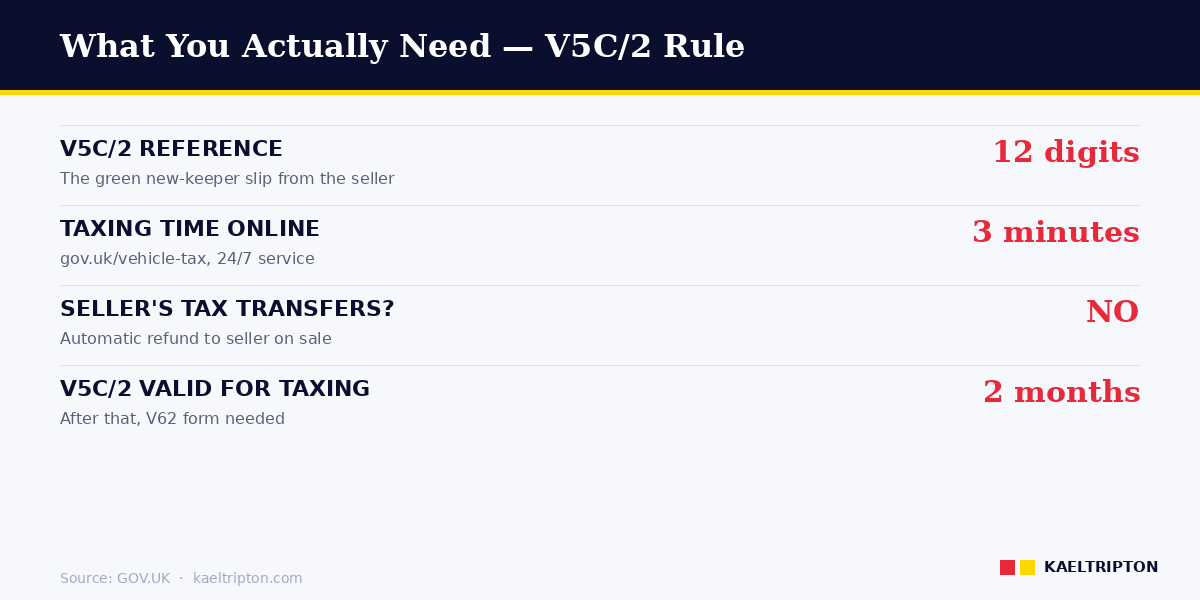
When you buy a used car in the UK, the seller’s tax does not transfer to you. Tax the vehicle in your own name online at gov.uk/vehicle-tax using the 12-digit V5C/2 new-keeper slip before you drive home. Three minutes. 24/7. No minimum-journey exemption - ANPR flags within seconds of the sale being recorded at DVLA. |
The 60-second rule
When you buy a used car in the UK, the seller’s tax does not transfer to you. The seller receives an automatic refund for whole remaining months, and the buyer must tax the vehicle before driving it away - even for the journey home. Taxing takes minutes online using the 12-digit V5C/2 reference number. This rule has applied since 1 October 2014, when the paper tax disc was abolished.
The mechanic is straightforward. At point of sale, the seller completes the V5C transfer sections and submits the change of keeper to DVLA online. DVLA immediately cancels the seller’s tax and issues the refund. The vehicle is now untaxed in the database. The buyer must tax it in their own name before any road use.
Why tax doesn’t transfer - the 2014 rule change
Before October 2014, car tax came with the vehicle. The paper tax disc in the windscreen was visible evidence of cover, and it transferred with the car on sale. In practice this created problems: discs were forged, stolen, transferred incorrectly, and enforcement was patchy.
The 2014 reform abolished the paper disc and tied tax strictly to the registered keeper. The seller’s tax ends at the moment of sale; the buyer’s begins only when they tax in their own name. This closed the transfer loophole and aligned tax status with DVLA’s computerised records. It also created the enforcement window this article is about - the gap between “bought” and “taxed” during which a car is technically untaxed and ANPR-detectable.
How to tax in three minutes using the V5C/2
The seller hands you the V5C/2 - a green slip torn from the back of the V5C logbook. It carries a 12-digit reference number. That number is everything you need.
- Go to gov.uk/vehicle-tax on your phone or laptop.
- Enter the 12-digit V5C/2 reference.
- Confirm the vehicle details.
- Pay by credit card, debit card, or set up a direct debit (monthly, six-monthly or annual).
- DVLA confirms tax is in force immediately.
The service runs 24/7. Start to finish: three minutes on a decent connection. Alternatively, call 0300 123 4321 for the automated 24-hour phone service (no direct debit option by phone), or visit a Post Office that handles vehicle tax.
The V5C/2 is valid for taxing purposes for two months from the date of sale. After that window you need to apply for a replacement V5C using a V62 form (£25, unless you’re a new keeper still inside the free-replacement window).
What to check before you buy
Two minutes at gov.uk/check-vehicle-tax saves headaches. Enter the registration and you see:
- Tax status - whether the current keeper has valid tax, and when it expires.
- MOT status - whether a valid MOT is in force and when it expires. A valid MOT is required to tax a post-3-year-old vehicle.
- SORN status - whether the vehicle is currently declared off-road.
A SORN’d vehicle cannot legally be driven on a public road regardless of what the seller tells you. If a seller says “I’ll take the SORN off when you pay”, be cautious - the SORN ends on transfer of ownership automatically, but the car is still untaxed until you tax it.
Also check the MOT history at gov.uk/check-mot-history. A vehicle with a failed recent MOT cannot be taxed until it passes.
Scenario one - the private sale on a Saturday
A first-time buyer in Leicester buys a 2019 Ford Focus on a Saturday afternoon. The seller hands him the V5C/2 green slip and completes section 2 of the V5C to submit to DVLA. Because it’s Saturday evening, he assumes he’ll tax on Monday morning. He drives 18 miles home on the A46.
An ANPR camera flags the car at 6:43pm. Two days later, an £80 LLP arrives at his address. He pays £40 within the 33-day window and taxes the car online. Total cost: £40 plus one month of back-tax - roughly £57 on a £200-per-year standard rate.
Teaching point: tax immediately at gov.uk/vehicle-tax from the V5C/2 reference number before leaving the seller’s driveway. The service is 24/7. There is no weekend grace period and no minimum journey exemption.
Scenario two - the dealer trade-in
A couple in Brighton trades in their 2018 Volkswagen Golf at a franchised dealer for a used Tiguan. The dealer takes the old V5C and gives them the V5C/2 green slip for the Tiguan. They drive the Tiguan home 11 miles that afternoon.
This is legal - dealers use the trade section of the V5C to move vehicles between stock and road-ready status, and the buyer’s immediate drive home is accepted practice. But the buyer’s own tax obligation is identical: they must tax before further personal use. They tax online the same evening using the V5C/2 reference.
Teaching point: trade-in paperwork differs slightly from private sales (the dealer handles some of the DVLA notification), but the buyer’s tax obligation is no different. If the dealer doesn’t hand you a V5C/2, ask before leaving the forecourt. Some dealers offer to tax the vehicle on your behalf as part of the handover; confirm this in writing.
Scenario three - the auction buy with missing V5C
A garage owner in Newcastle buys a 2016 BMW 320d at auction. The car comes without a V5C - only the V5C/2 green slip and a bill of sale. He applies for a replacement V5C using a V62 form (£25, paid by cheque or postal order to DVLA, Swansea), but taxes the vehicle immediately at a Post Office using the V5C/2 while he waits.
Teaching point: you can tax with the V5C/2 for two months from purchase even if the physical V5C is outstanding. The V62 route takes 4 to 6 weeks by post; online replacement (where eligible) arrives in 5 working days. Since April 2025, DVLA offers a single-journey service letting you apply for a replacement V5C and tax the vehicle at the same time online - confirmed in DVLA’s own Digital blog post of 8 April 2025.
When you don’t have a V5C or V5C/2
If the seller can’t produce either document, stop the sale. DVLA advice on this is unambiguous: don’t buy a vehicle without a V5C logbook. A missing V5C often correlates with stolen vehicles, outstanding finance, insurance write-offs, or cloned number plates.
If you’ve already completed a sale and neither document is available, you can still apply for a new V5C yourself using a V62 form. The £25 fee applies unless you’re a new keeper who never received the V5C within six weeks of sale. Send the V62 to DVLA, Swansea, SA99 1DD along with the cheque. Processing takes 4 to 6 weeks. During that time you cannot tax the vehicle and therefore cannot drive it on a public road.
Dealer sales vs private sales - paperwork differences
| Type of sale | Seller’s responsibility | Buyer’s responsibility |
|---|---|---|
| Private sale | Complete V5C section 2 (new style) or section 6 (old style); submit change of keeper to DVLA online or by post; hand V5C/2 to buyer | Tax before driving; confirm details on V5C; wait 2-4 weeks for new V5C by post |
| Dealer sale (buying) | Handle DVLA notification as part of trade process; provide V5C/2 at handover | Tax before further use; confirm dealer has submitted the change to DVLA |
| Dealer sale (trade-in) | Complete V5C section 9 and send to DVLA; hand whole V5C to dealer | N/A (the trade-in side) |
| Auction buy | Auction house issues bill of sale and paperwork pack | Apply for V5C via V62; tax using V5C/2 if available |
The seller’s side - what they have to do
This article is for buyers, but the seller’s duties affect what happens to you. The seller must:
- Fill in the new-keeper section of the V5C accurately (your name, your address, date of sale).
- Submit the change to DVLA immediately - either online at gov.uk/sold-bought-vehicle or by posting section 2 of the V5C.
- Hand you the V5C/2 green slip.
- Retain nothing from the V5C beyond what they’ve sent to DVLA.
If the seller fails to submit the change, you remain a ghost keeper - DVLA records still show them as responsible, but your V5C/2 is valid for taxing and insuring the car in your name. The mismatch usually resolves within a few weeks when the new V5C arrives. If it doesn’t, contact DVLA directly with your V5C/2 as evidence.
Common mistakes that trigger penalties
- Assuming the seller’s tax covers you. It doesn’t. The refund is automatic to the seller the moment DVLA processes the change. The car is untaxed in the database from that moment.
- “I’ll tax it tomorrow.” ANPR works 24/7. The detection window is seconds, not days. Tax before you drive, full stop.
- Using the seller’s phone or laptop to tax at handover. Works fine, but make sure the payment card is in your name and the confirmation email goes to your address - otherwise the audit trail is confusing.
- Forgetting to confirm the MOT is valid. A vehicle without a current MOT cannot be taxed (except for the drive to a pre-booked MOT). Check MOT history at gov.uk/check-mot-history before handing over money.
- Not keeping the V5C/2 after taxing. Keep it until your new V5C arrives by post. If DVLA loses the change of keeper, the V5C/2 is your proof of purchase.
Related guides
- How to Tax Your Car Online UK 2026
- How to Check If a Car Is Taxed UK 2026
- V5C Logbook Lost or Stolen UK 2026
- SORN Statutory Off Road Notification UK 2026
Disclaimer
This guide reflects DVLA processes published on GOV.UK and the DVLA Digital blog as of April 2026. Procedures and fees can change. Always verify the current position on gov.uk/vehicle-tax before making a used-car purchase. This article is not legal advice.
Frequently asked questions
Does car tax transfer when I buy a used car in the UK?
No. Since October 2014, car tax does not transfer between owners. The seller receives an automatic refund for whole remaining months, and the buyer must tax the vehicle in their own name before driving it - even for the journey home from the seller’s address.
How do I tax a car I’ve just bought?
Use the 12-digit reference number on the V5C/2 green slip the seller hands over. Go to gov.uk/vehicle-tax, enter the reference, confirm the vehicle details, and pay. The service takes three minutes and runs 24/7. Alternatively call 0300 123 4321 or visit a Post Office that handles vehicle tax.
Can I drive the car home from the seller?
Only if you’ve taxed it first. There is no minimum-journey exemption. ANPR cameras operate 24/7 nationwide. Tax online using the V5C/2 reference before leaving the seller’s driveway. For dealer sales, confirm whether the dealer has taxed the vehicle on your behalf; otherwise tax before departure.
What if the seller hasn’t given me a V5C/2?
Ask for it before money changes hands. If the V5C is available but the V5C/2 section has been detached, the seller may need to complete the new-keeper section on the whole V5C instead. If neither is available, DVLA advises not to buy the vehicle - missing V5Cs often correlate with stolen or finance-owing cars.
How long does the V5C/2 remain valid for taxing?
Two months from the date of sale. After that you need to apply for a replacement V5C using a V62 form (£25 postal fee) before you can tax. For a car you’ve bought and plan to keep off-road, you can also declare a SORN using the V5C/2 reference, which preserves your position without cost.
Do I need insurance before I can tax a used car?
In Northern Ireland, yes - you must show evidence of insurance to tax at a Post Office. In England, Scotland and Wales, DVLA does not require insurance evidence to tax online, but the Motor Insurance Database cross-checks untaxed and uninsured vehicles automatically. Arrange insurance before you drive, regardless of taxing route.
What happens to the seller’s tax when I buy the car?
DVLA cancels the seller’s tax automatically when the change of keeper is processed. The seller receives a refund for any full remaining months by cheque or to the original payment method within six weeks. The seller does not need to do anything beyond notifying DVLA of the sale - the refund is automatic.
Sources
- GOV.UK - Tax your vehicle
- GOV.UK - Register a new or used vehicle
- GOV.UK - Tax your vehicle without a reminder
- GOV.UK - Check if a vehicle is taxed
- GOV.UK - Tell DVLA you’ve sold, transferred or bought a vehicle
- GOV.UK - Check the MOT history of a vehicle
- DVLA Digital - Apply for a new log book and tax your vehicle in one journey (8 April 2025)


