

The UK’s historic vehicle tax exemption is generous but procedurally fiddly. The 40-year rule is rolling, the eligibility date isn’t the birthday, and the exemption does not apply automatically. This guide covers the primary-source rules, the six-area substantial-change test that decides borderline cases, and how to actually apply at a Post Office.
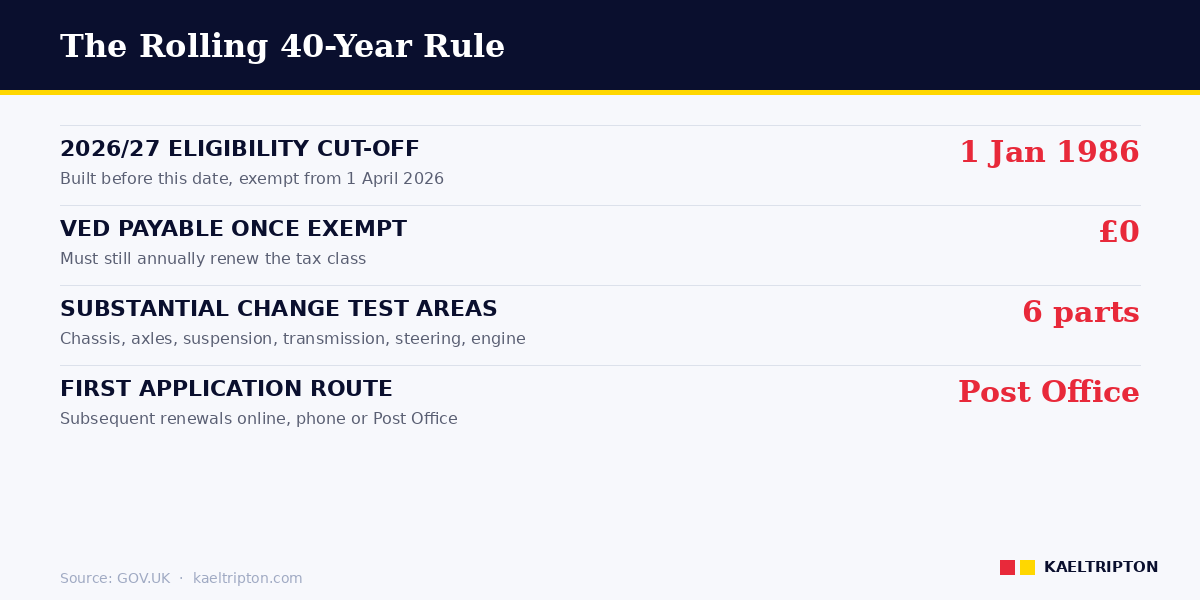
UK vehicle tax exemption for classics applies from 1 April in the year following the 40th anniversary of construction. Vehicles built before 1 January 1986 qualify from 1 April 2026. Apply at a Post Office with V5C, V11 and V112 (for MOT self-declaration). The substantial-change test covers 6 main component areas - chassis, axles, suspension, transmission, steering and engine. Period-correct modifications typically pass; modern swaps typically fail. |
The one-sentence rule, then everything else
A UK-registered vehicle becomes eligible for the historic vehicle tax class, paying £0 VED, from 1 April in the year following its 40th anniversary of construction, provided the vehicle has not been substantially changed in the previous 30 years. For the 2026/27 tax year, this means vehicles built before 1 January 1986 qualify from 1 April 2026 onwards. The exemption must be applied for - it does not happen automatically.
The statutory basis sits in the Finance Act 2014, which reintroduced the rolling exemption after it had been frozen in 1997 at the 1 January 1973 line. Since 2014, each 1 April brings a new cohort of vehicles into the historic class - one year’s worth at a time.
The April-next-year timing trap
The single most common mistake: assuming exemption applies on the 40th birthday. It doesn’t. Eligibility is assessed in the April following the 40th anniversary. So:
- A car built on 15 November 1985 - 40 years old in November 2025 - becomes eligible from 1 April 2026.
- A car built on 3 January 1986 - 40 years old in January 2026 - does not qualify until 1 April 2027.
- A car built on 31 December 1985 - 40 years old on 31 December 2025 - becomes eligible from 1 April 2026.
GOV.UK confirms this plainly at gov.uk/historic-vehicles: vehicles built before 1 January 1986 can stop paying vehicle tax from 1 April 2026. For vehicles whose exact build date is unknown but which were registered before 8 January 1986, GOV.UK accepts first-registration date as the trigger.
Build date vs first registration date
The two dates are not the same and it matters. A vehicle built in 1984 in Japan, imported second-hand and first registered in the UK in 1995, has a build date of 1984 and a first-registration date of 1995. The exemption uses build date where known. If build date isn’t recorded on the V5C, first-registration date is used.
Check your V5C. Page 2 shows “Date of first registration.” The front cover may show “Declared manufactured in” a specific year - that is the build year, used in preference to first registration when present. If you’re unsure, DVLA leaflet INF34 sets out the rules. For imported cars missing build-date records, a dating letter from the manufacturer or a recognised marque specialist can establish the build year.
The substantial-change test - six main component areas
A vehicle otherwise eligible for historic status loses that eligibility if it has been substantially changed within the previous 30 years. Substantial change is defined by the Department for Transport guidance Vehicles of Historical Interest (VHI): Substantial Change Guidance, available on GOV.UK. The test looks at six main component areas:
| Component | What counts as a change |
|---|---|
| Chassis or monocoque bodyshell | Replacing the chassis or monocoque; kit conversions that add a new body to an existing vehicle or vice versa |
| Axles or running gear | Changes that alter the method of steering or propulsion |
| Suspension (front and rear) | Changes to type or design |
| Transmission | Changes that alter the number of gears or fundamental layout |
| Steering | Changes from manual to power or vice versa, or type changes |
| Engine | Changes to an alternative type or capacity |
Changes that would have been made to vehicles of that type during production or within 10 years of production are acceptable and do not count as substantial. Period-correct modifications - a 1978 Mini upgraded to Cooper S spec using period parts - generally pass. Modern turbo swaps, engine transplants into a different marque’s shell, or bespoke kit conversions generally fail.
The DVLA does not inspect vehicles. The declaration is made by the keeper on the V112 form (for MOT exemption) at the time of taxing. DVLA relies on honest self-declaration; the penalty for dishonest declaration is driving a vehicle that technically requires an MOT without one, which carries its own enforcement risk.
How to apply - the Post Office route
First-time applications for the historic tax class must be made in person at a Post Office that handles vehicle tax. You cannot do this online on the first application. Subsequent annual renewals can be done online, by phone or at a Post Office.
Documents required at the Post Office:
- V5C registration certificate (logbook) in your name. If you’ve just bought the vehicle, the V5C/2 green slip plus a V62 application for a new V5C.
- V11 tax reminder if you have received one, or your V5C details otherwise.
- Proof of valid MOT, or a completed V112 declaration of MOT exemption if claiming MOT exemption under the 40-year rule. V112 is the form that records the substantial-change self-declaration.
- Insurance certificate or cover note (required in Northern Ireland only).
The counter staff member changes the vehicle’s tax class from its current class (typically Private Light Goods or Private/Heavy Goods) to Historic Vehicle. You pay £0 VED but you still “tax” the vehicle annually - an administrative no-charge renewal confirming the vehicle is still being kept and used legitimately. Your V5C will later be reissued by post showing the new tax class.
The practical timing scenario
Consider a realistic case. A retired engineer in Bristol owns a 1985 Jaguar XJ6 Series III, built in October 1985 and first registered in December 1985. He has been paying VED in the pre-2001 CO2-band system - around £790 a year because it’s a large-engined car. He realises in February 2026 the car is coming up for exemption.
His current VED runs to 31 March 2026. He declares a SORN for March 2026 to avoid the final month of VED. On 1 April 2026 he visits his local Post Office that handles vehicle tax with his V5C, his current insurance certificate, and a V112 form declaring the car has not been substantially changed (original chassis, original 4.2-litre inline six, original transmission, period-correct suspension upgrade done in 1988). The counter processes the change to Historic Vehicle tax class. He pays nothing. His V5C is returned a few weeks later showing “Historic Vehicle” as the tax class.
Teaching point: the SORN-then-re-tax strategy for a car approaching historic status in April can save the final month or two of VED. Time the SORN declaration to match the month the tax expires - you cannot backdate a SORN, but you can have it start on the first day of the next month.
What the exemption doesn’t cover
Historic vehicle status gives you zero VED and - if you declare on the V112 - exemption from the annual MOT test. It does not exempt you from:
- The legal requirement to keep the vehicle roadworthy. GOV.UK states explicitly that a vehicle’s owner remains responsible for roadworthiness regardless of MOT exemption. Using a dangerous vehicle on the road carries fines up to £2,500 and 3 penalty points under the Road Traffic Act 1988.
- Insurance. Every vehicle used on a public road must have at least third-party motor insurance. Historic vehicle insurance policies exist as a specialist segment - often cheaper because classic cars typically cover fewer miles and have adult, careful drivers - but cover is still required.
- ULEZ and Clean Air Zone charges. These are separate from VED. That said, most historic vehicles (over 40 years old) are exempt from London ULEZ on a different basis - the ULEZ historic vehicle exemption is tied to the DVLA historic tax class. Once your vehicle is in the historic class, the ULEZ system reads that status automatically and you don’t pay the daily charge.
- Commercial use restrictions. Historic vehicles used for hire, reward, or commercial purposes (wedding hire, film work, paid event appearances) may be assessed under different rules and may lose the exemption. Check with DVLA if you plan to use a classic commercially.
What if you’ve overpaid historic-eligible VED
If your vehicle was eligible for historic status but you continued paying VED in the wrong class, you can reclaim the overpayment. The mechanism is the same as any change-of-tax-class: apply at a Post Office with the documents above, and DVLA refunds any unused months of VED automatically when the tax class changes.
Refunds are limited to unused months in the current licence period. DVLA does not refund years of historic-car VED that you paid before realising eligibility. If you’ve been paying £200 a year for five years on a 1983 car that should have been exempt from 1 April 2024, you cannot claim those five years back. The lesson: check eligibility against the current April cutoff each year if you own a near-40-year vehicle.
Imported classics - the registration-date rule
Classics imported second-hand into the UK present a paperwork wrinkle. If you imported a 1982 BMW 635CSi in 2020 and first registered it with DVLA that year, the vehicle is 44 years old by build but was first registered only 6 years ago in the UK.
GOV.UK accepts build date where it can be evidenced. Bring documentation from the country of origin (original registration papers, a letter from BMW Classic, a dating certificate from an FIA-recognised marque specialist) to the Post Office. If build date can be proven, historic tax class applies. If only UK first-registration date is available on the V5C, and that date is less than 40 years ago, you’re not eligible until 40 years from UK registration.
Substantial change - the acceptable-changes exception
A few changes are explicitly acceptable under DfT guidance:
- Alternative fuel conversions (LPG, propane) where the original engine is retained.
- Changes to engine components for better compatibility with modern fuels (unleaded conversion of a leaded-fuel engine).
- Replacement of a component with one of the same specification from the same vehicle or a model within the same range - for example, fitting a 1.8 from a later Mk1 Escort to an earlier 1.6 Mk1.
- Changes made to meet a disability requirement (hand controls, disability-related seat changes).
- Changes made under manufacturer recalls or safety directives.
The core test: would these changes have been made during production or within 10 years of production of this vehicle? If yes, they’re acceptable. If no, they may constitute substantial change.
Motorcycles with a ‘Q’ prefix
Motorcycles issued with a registration number beginning ‘Q’ - meaning the vehicle’s identity or origin could not be verified at first registration - are automatically treated as substantially changed. A Q-plated motorcycle cannot claim the 40-year MOT exemption regardless of apparent age or condition. The tax-class historic exemption may still be accessible in some cases but the MOT exemption is off the table.
Similarly, vehicles (motorcycles or cars) assembled from components of different makes and models - “special builds” or bitsa bikes - are treated as substantially changed and are not exempt from MOT under the 40-year rule.
Commercial vehicles - a tighter test
For large goods vehicles (over 3.5 tonnes) and public service vehicles (8 or more passenger seats used commercially), the exemption rules are different. These vehicles are only exempt from MOT if they are pre-1960 and used unladen, and they must not have been substantially changed. The rolling 40-year rule does not apply to commercial fleet vehicles used commercially.
A 1972 ex-British-Gas Bedford TK used privately for classic-vehicle events may qualify under the goods-vehicle exemption despite being 54 years old, but a 1972 Bedford TK used for commercial haulage does not. The distinction is real use, not paper status. If DVLA challenges and you cannot show the vehicle is kept for private enthusiast use only, expect reclassification.
Buying a classic - the pre-purchase tax-class check
If you’re buying a vehicle that should already be in the historic tax class, verify before you pay. Go to gov.uk/check-vehicle-tax and enter the registration. The tool confirms current tax status and class.
Common seller claims to verify independently:
- “It’s historic, no tax needed” - check tax status on gov.uk. If the previous keeper never applied for historic class, the vehicle is still in Private Light Goods or similar and you’ll need to make the application yourself after purchase.
- “It’s MOT-exempt” - check MOT history at gov.uk/check-mot-history. MOT exemption is a self-declaration, not an inspection. If the seller hasn’t MOT’d the vehicle in years on the basis of exemption, and the vehicle has known roadworthiness issues, you’re inheriting those issues.
- “No modifications” - don’t take this at face value. Inspect the engine bay, chassis, and any obviously non-standard items. A car sold as “historic-eligible” with a modern engine swap is not eligible, and you’d be self-declaring falsely if you went ahead.
The hidden value of historic tax class - insurance and ULEZ
Zero VED is the headline saving. Two less-obvious benefits often matter more:
Insurance. Specialist classic vehicle insurers quote significantly lower premiums than mainstream insurers on vehicles in the historic tax class. The class signals to insurers that the vehicle is used lightly, typically well maintained, and the driver is statistically lower-risk. Annual premiums under £200 are common for classics covered by policies with agreed-value terms and limited mileage (often 3,000-5,000 miles per year).
London ULEZ exemption. The ULEZ exempts vehicles in the DVLA historic tax class from the daily charge. You do not pay the £12.50 per day for driving a 1985 car through Central London once it’s in the historic class. This exemption is automatic from the tax class - no separate application. For London-area classic owners, the ULEZ exemption can be worth more than the VED saving on its own.
Related guides
- UK Car Tax 2026: Vehicle, MOT and Tax
- How to Tax Your Car Online UK 2026
- SORN Statutory Off Road Notification UK 2026
- UK Clean Air Zones 2026
Disclaimer
This guide reflects DVLA and DfT rules published on GOV.UK and assets.publishing.service.gov.uk as of April 2026. The rolling 40-year rule is a government policy that has been frozen and reinstated before; always check the current position on gov.uk/historic-vehicles before making decisions. For borderline substantial-change questions, consult a marque specialist listed by the Federation of British Historic Vehicle Clubs. This article is not legal advice.
Frequently asked questions
When does my classic car become tax-exempt in the UK?
From 1 April in the year following the vehicle’s 40th anniversary of construction. For 2026/27, vehicles built before 1 January 1986 qualify from 1 April 2026. Exemption is not automatic - you must apply for the historic tax class, first time at a Post Office, with the V5C, a valid MOT (or V112 declaration), and the V11 reminder if you have one.
What counts as a “substantial change” that disqualifies my classic?
Changes to any of six main component areas: chassis or monocoque, axles/running gear, suspension, transmission, steering, or engine. Changes that would have been made during production or within 10 years of production don’t count. Period-correct upgrades typically pass; modern engine swaps into a different marque’s shell typically fail.
Is the 40-year historic exemption at risk of being scrapped?
No proposal is currently before Parliament. The Federation of British Historic Vehicle Clubs has confirmed there is no active plan to remove the rolling 40-year rule. Tabloid claims of an imminent Budget crackdown have not matched government statements. The rule has been frozen and reinstated before (frozen in 1997, reinstated in 2014) but is currently stable.
Do I still need to tax my historic vehicle every year?
Yes, though you pay £0. “Taxing” a historic vehicle is an annual administrative renewal confirming the vehicle is still on the road and in the historic class. If you don’t renew, DVLA treats the vehicle as untaxed and the usual £80 late licensing penalty applies.
Can I apply for historic vehicle status online?
Not for the first application. You must attend a Post Office that handles vehicle tax with the documents listed above. Once the tax class is switched to Historic Vehicle, subsequent annual renewals can be processed online at gov.uk/vehicle-tax or by phone on 0300 123 4321.
What’s the difference between MOT exemption and tax exemption for classics?
Tax exemption is automatic in the sense that a historic-class vehicle pays £0 VED. MOT exemption is a separate self-declaration on the V112 form, confirming the vehicle meets the “not substantially changed in 30 years” test. Some classics are tax-exempt but keepers choose to still MOT them voluntarily. The two exemptions can be claimed independently.
My imported classic was first registered in the UK only 5 years ago. Does the 40-year rule apply?
GOV.UK accepts build date where documented. Bring original-country registration papers, a dating letter from the manufacturer, or a certificate from a recognised marque specialist. If build date is proven to be pre-1986, historic status applies. If only UK first-registration date is documented and that date is less than 40 years ago, you’re not eligible until 40 years from UK registration.
Sources
- GOV.UK - Historic (classic) vehicles: MOT and vehicle tax
- GOV.UK - Historic vehicle tax exemption
- GOV.UK - Historic (classic) vehicles: MOT exemption criteria
- GOV.UK (DfT) - Vehicles of Historical Interest: Substantial Change Guidance
- GOV.UK - DVLA leaflet INF34 (historic vehicle tax class)
- Legislation.gov.uk - Finance Act 2014 (rolling exemption reinstatement)


