

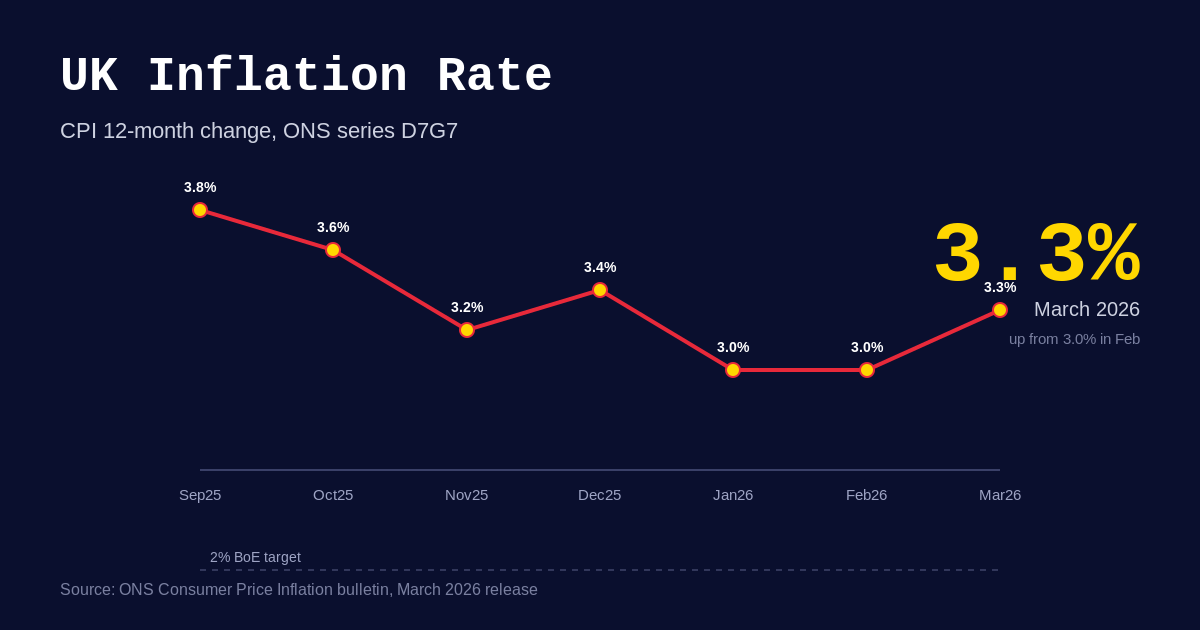
The headline UK Consumer Prices Index inflation rate climbed to 3.3 percent in the 12 months to March 2026, the highest reading since December 2025 and a sharp reversal from the 3.0 percent reading in each of the two preceding months. The Office for National Statistics points to motor fuel prices as the single largest upward contributor, reflecting the oil price shock that followed the late February conflict in the Middle East. The Consumer Prices Index including owner occupiers housing costs, often referred to as CPIH, rose to 3.4 percent over the same period, while core CPIH (excluding energy, food, alcohol and tobacco) eased slightly to 3.3 percent. Services price inflation, closely watched by the Bank of England, accelerated to 4.5 percent. This live tracker page summarises the latest official figures, the underlying drivers and what the Bank of England has signalled for Bank Rate. Key figures at a glance
What is the UK inflation rate todayThe Consumer Prices Index rose by 3.3 percent in the 12 months to March 2026, according to the Office for National Statistics release published on 22 April 2026. That is the headline figure most commonly quoted in the press and the one used by the Bank of England Monetary Policy Committee when assessing whether to change Bank Rate. The broader Consumer Prices Index including owner occupiers housing costs, the ONS preferred measure, rose by 3.4 percent over the same 12 months, up from 3.2 percent in the year to February. The Retail Prices Index, still used to uprate certain rail fares and student loans although no longer a National Statistic, stood at 4.3 percent. All three measures are above the Monetary Policy Committee 2 percent target. Before the Middle East conflict broke out in late February 2026, the Bank of England had expected CPI to fall back to around 2 percent from April. That projection has since been revised: on 19 March 2026 the Bank stated that CPI is now likely to run between 3 percent and 3.5 percent through the second and third quarters of 2026, due to higher energy prices. Why has inflation gone up in March 2026Motor fuels were by far the largest single contributor to the rise. Petrol prices rose by 8.6 pence per litre between February and March, while diesel rose by 17.6 pence per litre, according to the ONS detailed briefing. Transport division inflation jumped from 2.4 percent in the year to February to 4.7 percent in the year to March, the steepest annual rate since December 2022. A second major contribution came from domestic heating oil, where prices rose by 95.3 percent over the year, the largest annual rise since September 2022. Both effects trace back to the rise in global oil prices that followed the late February outbreak of conflict in the Middle East and disruption to shipping through the Strait of Hormuz. Food and non-alcoholic beverages inflation also picked up, rising from 3.3 percent in February to 3.7 percent in March. Services inflation, which the Bank of England views as a key indicator of underlying domestic price pressures, accelerated from 4.3 percent to 4.5 percent. Clothing prices fell by 0.8 percent, the steepest decline since March 2021, providing a small offset. What does this mean for the Bank of England base rateThe MPC voted unanimously on 19 March 2026 to hold Bank Rate at 3.75 percent, citing the inflation risks from the oil price shock. Before the conflict, markets had priced in two quarter-point cuts during 2026. After the March meeting, traders briefly priced in two interest rate hikes by year end, although that has since eased back to expectations of one cut. The next scheduled MPC announcement is at 12 noon on Thursday 30 April 2026. Economists at Berenberg, Oxford Economics and Pantheon Macroeconomics had previously called for a cut at the April meeting, but the renewed inflation pressures may push that back. ING and Goldman Sachs now expect rates to remain unchanged through the rest of 2026. Mortgage rates have already responded. The average 2-year fixed mortgage rate rose from 4.83 percent at the start of March to 5.84 percent by mid-April, according to Moneyfacts data, before easing slightly as the Middle East ceasefire took effect. How is UK inflation measuredThe ONS measures consumer price inflation by tracking the prices of approximately 730 representative goods and services across the country every month. The basket is updated annually and currently includes everything from a pint of milk to a streaming service subscription, weighted by household spending patterns derived from the most recent National Accounts. The Consumer Prices Index uses internationally standardised methodology and is the headline measure adopted by the Bank of England for its 2 percent target. The CPIH adds in owner occupiers housing costs (about 18 percent of the basket) and is the ONS most comprehensive measure of household price change. RPI uses a different formula and includes mortgage interest payments and council tax. ONS no longer designates RPI as a National Statistic because of known technical deficiencies in the formula, but it remains in legislation for certain price-uprating purposes. When is the next UK inflation releaseONS publishes the next Consumer Price Inflation bulletin covering April 2026 on Wednesday 21 May 2026 at 7am. Releases follow the same monthly pattern: figures for the previous month are published on the third or fourth Wednesday of the current month. The full release schedule is available on the ONS releases calendar. The release includes the latest CPI, CPIH and RPI annual rates, monthly change figures, contributions by spending category, and detailed sub-indices. The associated detailed briefing note covers reconciliation between the indices and identifies notable price movements. Inflation data feeds directly into the Bank of England Monetary Policy Report, which is published quarterly alongside the February, May, August and November MPC decisions. Wage data from the ONS Labour Market overview, also published monthly, is the other primary input into the MPC inflation analysis. UK inflation measures compared
This article is for informational purposes only and does not constitute financial, legal, or immigration advice. Always verify with official sources before making decisions. Frequently asked questionsWhat is the current UK inflation rate?The headline UK CPI inflation rate was 3.3 percent in the 12 months to March 2026, up from 3.0 percent in February. The CPIH measure was 3.4 percent. Source: ONS Consumer Price Inflation bulletin, released 22 April 2026. Why has UK inflation gone up?The main driver was a sharp rise in motor fuel prices, with petrol up 8.6 pence per litre and diesel up 17.6 pence per litre between February and March 2026. This followed the late February conflict in the Middle East that pushed global oil prices higher. Domestic heating oil also rose by 95.3 percent over the year. When will UK inflation come back down to 2 percent?The Bank of England said on 19 March 2026 that CPI is likely to remain between 3 percent and 3.5 percent through the second and third quarters of 2026 because of higher energy prices. The MPC has not given a date for returning to the 2 percent target. What is the difference between CPI and CPIH?CPI tracks prices of a basket of goods and services excluding owner occupiers housing costs. CPIH adds in those housing costs, which make up about 18 percent of the basket, making it the more comprehensive measure. ONS designates CPIH as its preferred measure of consumer price inflation. When is the next UK inflation release?The ONS publishes the next Consumer Price Inflation bulletin, covering April 2026 data, on Wednesday 21 May 2026 at 7am. Subsequent releases follow the monthly pattern of the third or fourth Wednesday of each month. How does inflation affect mortgage rates?Higher inflation typically delays Bank of England rate cuts and can prompt rises, both of which feed through to fixed mortgage rates priced from swap rates. Average 2-year fixed mortgage rates rose from 4.83 percent at the start of March 2026 to 5.84 percent by mid-April, according to Moneyfacts. What is the Bank of England 2 percent target?The MPC has a remit from HM Treasury to keep CPI inflation at 2 percent over the medium term. The remit was last reaffirmed in March 2024. If inflation moves more than 1 percentage point either side of target, the BoE Governor must write an open letter to the Chancellor explaining why. Sources and verification
|
Update, 21 October 2026: CPI inflation 3.5% in September The Consumer Prices Index (CPI) rose by 3.5% in the 12 months to September 2026, up from 3.1% in August 2026, the Office for National Statistics said on 21 October 2026. On a monthly basis CPI rose by 0.4% in September 2026, compared with little change in September 2025, the ONS said. CPIH, which includes owner occupiers' housing costs, rose by 3.6% in the 12 months to September 2026, up from 3.3% in August, while core CPI, which excludes energy, food, alcohol and tobacco, rose by 2.8%, up from 2.6%, according to the ONS. The ONS said CPI goods inflation rose from 2.7% to 3.2% and CPI services inflation rose from 3.4% to 3.7%. Transport, particularly motor fuels, made the largest upward contribution to the monthly change, while restaurants and hotels made the largest partially offsetting downward contribution, the ONS said. The next CPI figures, for October 2026, are due on 18 November 2026. |


