

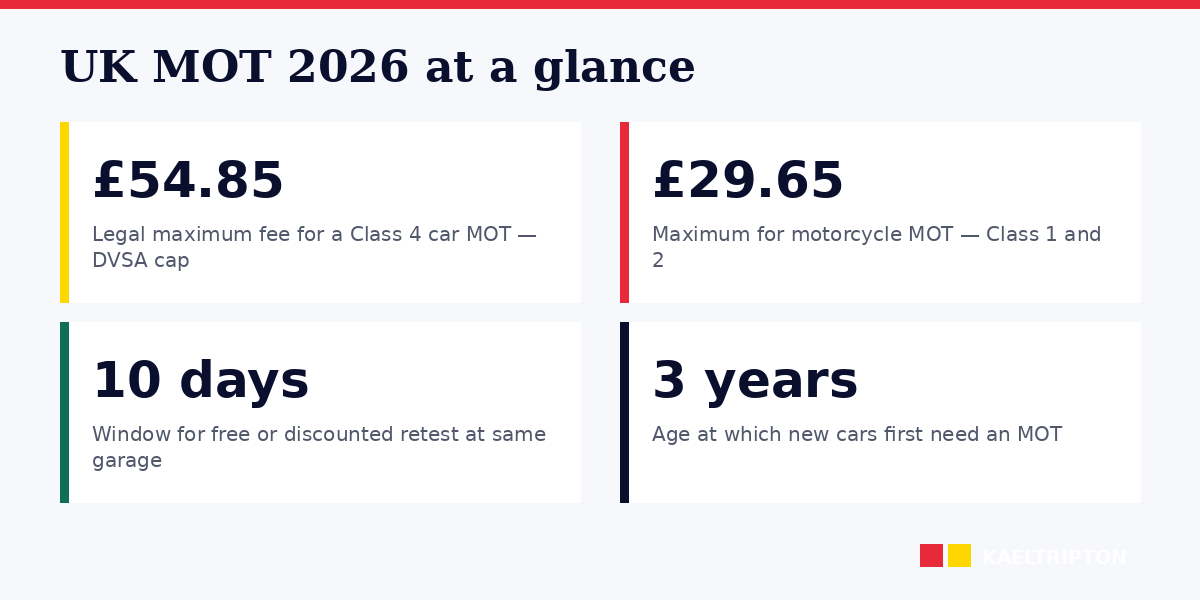
The MOT test fee is capped by law at £54.85 for a standard car in 2026, £29.65 for a motorcycle, and £58.60 for a van up to 3,500 kg. Garages cannot legally charge more. What most drivers do not realise is that the test fee is the smallest part of the bill - the real money goes on repairs if your car fails, and that is where the variation between garages matters. This guide covers the 2026 DVSA fee caps, what an MOT actually checks, how to book, and how to avoid the most common ways drivers overpay.
| ★ EDITOR'S VERDICT £54.85 cap. Everything else is garage margin. |
The DVSA capped MOT fee is legally binding - £54.85 car, £29.65 bike, £58.60 van to 3.5t. Most drivers pay considerably less through independents or national chains running promotional rates. The real money in an MOT is in repairs, not the test itself. The £29 promotional MOT becomes expensive only if the driver accepts every subsequent repair quote without comparing. Check MOT history online before booking, fix the cheap stuff yourself, and remember the 10-day free-retest rule at the same garage. |
The 2026 DVSA maximum fees
The Driver and Vehicle Standards Agency sets a legal maximum test fee for each vehicle class. Any DVSA-authorised garage charging above the cap is breaking the law. The 2026 caps:
| Vehicle class | Vehicle type | Maximum fee |
|---|---|---|
| Class 1 | Motorcycles up to 200cc | £29.65 |
| Class 2 | Motorcycles over 200cc (including with sidecars) | £29.65 |
| Class 3 | Three-wheeled vehicles up to 450kg | £37.80 |
| Class 4 | Cars, taxis and small vans up to 3,000kg | £54.85 |
| Class 5 | Minibuses and private passenger vehicles (13-16 seats) | £59.55 (plus £4.40 per seat above 16) |
| Class 7 | Vans 3,001kg to 3,500kg | £58.60 |
In practice, most drivers pay considerably less than the cap. Independent garages routinely run MOT-only prices at £30 to £45 to compete, and the national chains such as Halfords Autocentres, Kwik Fit and ATS Euromaster frequently offer promotional rates under £30, particularly when combined with a service. The test is identical regardless of what you pay - the DVSA inspection standard does not change based on price.
What an MOT actually checks
The MOT inspects roughly 20 different systems and takes 45 to 60 minutes for a standard Class 4 car. The DVSA's 2026 manual groups the checks into safety and emissions categories:
- Lights - headlights, side lights, brake lights, indicators, fog lights, reflectors, number plate lights
- Steering and suspension - play in the steering wheel, condition of shock absorbers, ball joints, track rod ends
- Brakes - efficiency, balance, pedal feel, handbrake, ABS warning light behaviour
- Tyres and wheels - tread depth (minimum 1.6mm across the central three-quarters of the tyre and around the entire circumference), sidewall damage, correct fitment
- Seat belts - condition, anchor points, retraction mechanism
- Windscreen, wipers and washers - cracks, chips in the driver's line of sight, wiper condition, washer jet function
- Body and structure - corrosion affecting strength, sharp edges, secure bumpers and trim
- Exhaust and emissions - catalyst or DPF integrity, smoke test, NOx reading within the vehicle's Euro standard
- Fuel system - no leaks, secure fuel cap
- Horn, mirrors, number plate - audible horn, secure mirrors with adequate field of view, correctly formatted and legible plate
- Warning lamps - airbag, engine management, ABS, brake fluid level warning lights checked for "on" state at test start
Not checked: engine condition beyond emissions, clutch condition, gearbox condition, service history, oil condition. These are service items, not MOT items. A car can pass an MOT with a failing clutch or contaminated oil; passing an MOT is not a clean bill of health.
When your car needs its first MOT
New cars do not need an MOT until their third anniversary of first registration. A car first registered in April 2023 needs its first MOT by April 2026. After the first test, an MOT is required every 12 months.
You can have the MOT up to one month before the current certificate expires without losing any of the remaining validity - the new certificate runs for 13 months in that case. Leave it to the last day and you have no buffer if the car fails.
Vehicles first registered before 1 January 1986 are exempt from MOT testing altogether under the historic vehicle rule (a rolling 40-year cut-off). The exemption is automatic once the DVLA records the vehicle in the historic vehicle tax class. Owners still have a legal duty to keep the vehicle roadworthy; the exemption removes only the annual test, not the underlying safety obligation.
How to book
The simplest way is directly with a DVSA-authorised garage. The blue three-triangles logo is the visual marker of an authorised test centre; if a garage advertises MOTs but does not display the logo, walk away.
Booking options in rough order of usage:
- Direct with the garage - phone or walk-in booking at your local independent or national chain. Often the cheapest route in smaller towns where online booking platforms charge a margin.
- Online comparison platforms - Bookmygarage.com, MOT.co.uk and similar sites list local prices and let you book a slot. Useful for comparing quotes across several garages at once, though the platforms take a small cut.
- National chain websites - Halfords Autocentres, Kwik Fit and ATS Euromaster run their own booking systems with frequent promotional rates and same-day availability.
- Council-run test centres - a handful of local councils operate test-only centres that do not carry out repairs. These are particularly useful if you want an impartial pass/fail without the garage having any incentive to find repair work.
You will need the vehicle registration number and the 11-digit V5C reference at booking. The garage handles the DVSA system from there. You do not need to carry the V5C to the test itself.
Pass, advisory, fail: what the three outcomes mean
Every MOT result sits in one of three bands under the 2018 DVSA categories:
- Pass - the vehicle meets all minimum standards and is legally roadworthy. A new MOT certificate is issued, valid for 12 months.
- Advisory - a fault is noted but is not yet serious enough to fail the test. Worn tyres still above 1.6mm, minor corrosion, a slightly leaking shock absorber. Advisories are warnings, not failures. You can legally drive the car but should plan for repair before the next MOT.
- Fail - the vehicle has a dangerous, major or minor fault that breaches the minimum standard. The car cannot legally be driven on public roads after the current MOT certificate expires until the faults are fixed and the retest is passed.
A dangerous fault (the most serious category) means the vehicle cannot be driven away from the garage at all, including to take it home - even if the current MOT has not yet expired. Typical dangerous-fault items: brake failure, steering failure, visibility issues, a tyre with the steel cord showing.
Retests and the 10-day rule
If your car fails and you leave it at the testing garage for repair, the partial retest is usually free or heavily discounted. The rule: if the retest is carried out within 10 working days at the same garage that conducted the original test, and only the failed items are being retested, no new full test fee is charged.
If you take the car away and have repairs done elsewhere, or return after 10 working days, a full retest at the standard MOT fee applies. This is the single most valuable piece of MOT knowledge for anyone with an older car - leaving the car for same-day repair at the test garage often saves £40 to £50 versus driving away and coming back.
A real 2026 scenario: the £29 MOT that costs £340
A driver in Sheffield books a £29 promotional MOT at a local independent garage. The car is a 2014 Ford Focus with 78,000 miles. The test turns up four failures: a blown rear brake light bulb, a worn front tyre below 1.6mm tread, a leaking shock absorber on the nearside front, and a fail on the emissions test.
Repair bill at the test garage: £8 for the bulb, £95 for a budget replacement tyre fitted, £180 for the shock absorber (including the matching one the garage recommends to balance the car), £30 for a diagnostic on the emissions issue. The emissions fail turns out to be a dirty EGR valve; the garage quotes £180 to clean it. The total bill reaches £493 including labour and VAT.
A more experienced driver would do three things differently. First, check the MOT history online at check-mot.service.gov.uk before booking, which shows past advisories (in this case, the shock absorber had been flagged the previous year). Second, fix the brake bulb at home for £3 before presenting the car. Third, get a second quote on the shock absorber and EGR cleaning - independent mechanics outside the test garage routinely charge 30 to 40 percent less for the same work.
The same failures managed with preparation and comparison quotes typically settle at around £250 total instead of £493. The £29 MOT does not become a rip-off because of the test itself; it becomes a rip-off when the customer accepts every repair quote without alternatives.
MOT and road tax together
You cannot tax a vehicle in the UK without a valid MOT. The DVLA system checks the MOT database automatically when you try to tax a car online or at the Post Office. A car whose MOT has expired cannot be taxed until the MOT is renewed.
The practical sequence for most drivers: book the MOT first, pass it, then immediately tax the car for the next 6 or 12 months using the V11 reminder or V5C reference number. Vehicles that are MOT-exempt (pre-1986 historic vehicles, electric vehicles under three years old) still need a valid tax record but do not need the MOT step.
Frequently asked questions
Can a garage legally charge more than £54.85 for a car MOT?
No. The £54.85 cap is set by the DVSA and is legally binding. Any garage charging more than this for a Class 4 MOT is breaking the law. You can report overcharging to the DVSA via GOV.UK. Note that the cap covers only the test itself - consumables, repairs and additional checks are priced separately.
Is an MOT retest always free?
Only if the retest is at the same garage and within 10 working days of the original test. Miss either condition and you pay the full MOT fee again. If the garage finds an additional fault during the retest (not on the original failure list), they can charge for that section.
How long does an MOT test take?
A standard Class 4 car test takes 45 to 60 minutes. Larger vehicles take longer. You do not have to wait at the garage - most offer to text or call when the vehicle is ready. Some DVSA test centres have viewing windows so you can watch the test if you prefer.
Can I drive my car to its MOT if the current certificate has expired?
Yes, but only directly to a pre-booked MOT appointment. Keep the booking confirmation email or text as evidence if stopped by police. Driving without a valid MOT for any other purpose risks a £1,000 fine (up to £2,500 plus penalty points if the vehicle has a dangerous fault).
Does the MOT test check the engine?
Only for emissions. The MOT does not check engine compression, cooling-system condition, oil quality or internal wear. A full service covers those items. Many drivers book MOT and service together so the garage catches service-related issues that might otherwise worsen and cause an MOT failure later.
Are electric cars tested the same way?
Largely yes, minus the emissions test. Electric vehicles are tested for brakes, tyres, lights, steering, suspension, seatbelts and structural integrity in exactly the same way as petrol or diesel cars, but with the emissions check replaced by inspection of the EV-specific safety systems (high-voltage warning labels, cable condition, regenerative braking function). The fee cap is the same £54.85 for Class 4.
What happens if I fail my MOT on something I think is wrong?
You can appeal to the DVSA within 28 days for a mechanical dispute, or within three months for a corrosion-related failure. The DVSA carries out an independent inspection. If the appeal succeeds the original garage issues a pass certificate and refunds the retest fee. If the appeal fails the DVSA charges an appeal fee (around £65 for Class 4).
Sources
- GOV.UK, Getting an MOT and MOT fees
- Driver and Vehicle Standards Agency (DVSA), MOT inspection manual and MOT test fees and refunds
- Road Traffic Act 1988, sections relating to vehicle testing
- The Motor Vehicles (Tests) Regulations 1981 (as amended)
- GOV.UK MOT history service, check-mot.service.gov.uk
- Department for Transport, MOT classes and class definitions


