

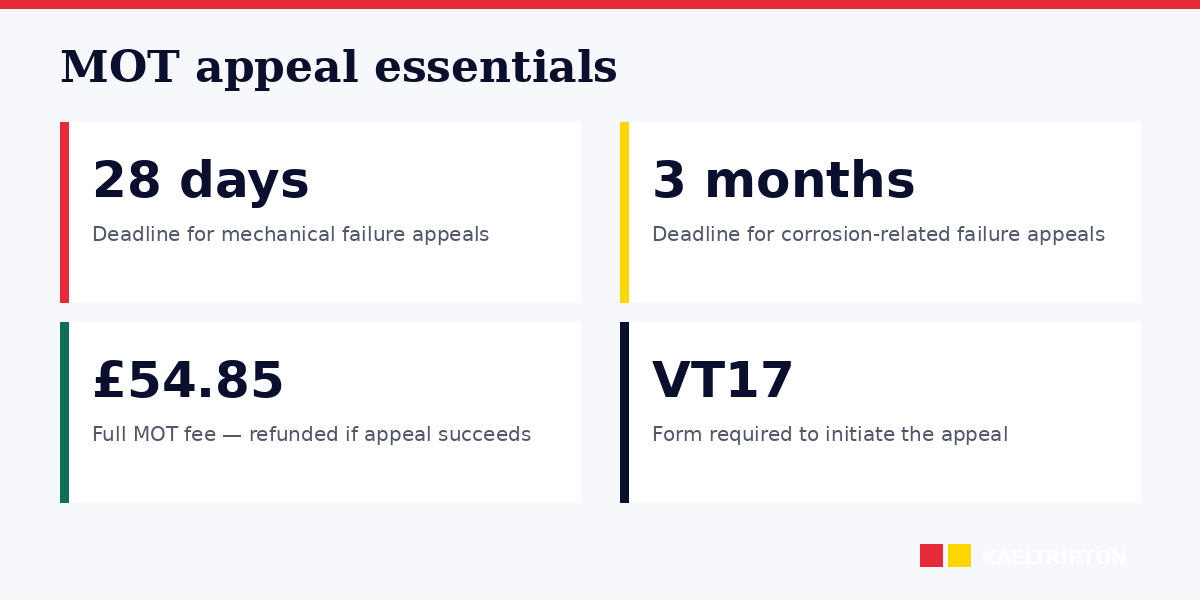
Disagree with a failed MOT result? You can appeal to DVSA within 28 days for most mechanical failures, or 3 months for corrosion-related failures (except brakes, brake lines, and exhaust system, which remain on the 28-day timeline). The appeal uses form VT17 plus the full MOT fee paid upfront - refunded if your appeal succeeds. DVSA conducts an independent inspection at a different test centre. Roughly 25-30% of appeals succeed, though success rates vary significantly by category. This guide covers the appeal process, what succeeds and what doesn't, the specific items worth appealing, and the alternative of a second-opinion test at another station.
| ★ EDITOR'S VERDICT Appeals take weeks but save hundreds when they succeed. Alternative: second opinion test. |
Challenge a failed MOT by filing VT17 within 28 days (3 months for non-safety corrosion). Pay the full £54.85 MOT fee upfront - refunded if you win. DVSA conducts an independent inspection at a different test centre. Roughly 25-30% of appeals succeed, higher for corrosion judgements. Alternative for urgent situations: a second opinion test at another MOT station. Costs the same £54.85 (non-refundable) but produces same-day result. Pursue both in parallel if you want fast resolution AND accountability for the original tester. |
When to appeal (and when to reapply)
First question: is appeal the right route, or should you simply have the problem re-assessed elsewhere?
Appeal makes sense when:
- You believe the tester incorrectly applied the Inspection Manual criteria
- Borderline calls that could have gone either way (e.g., corrosion depth judgements)
- A component you know is sound was recorded as faulty
- You have evidence (photos, documentation) that supports your position
- The fail is causing significant cost or time to fix
Appeal is NOT the right route when:
- The failed item clearly is defective - fix and retest
- You want a faster resolution than 4-8 weeks
- You're prepared to accept the fail and move on
- The cost of the appeal approaches or exceeds the cost of repair
Alternative to formal appeal: take the vehicle to a different MOT test station for a second opinion. Legal and often faster. The second test is a fresh MOT, not an appeal, so you pay another full MOT fee and the first test's paper trail remains in the DVSA record.
The 28-day vs 3-month rule
Appeal deadlines depend on the specific fail category:
28 days from test date
For most mechanical items and safety-critical systems:
- Brakes, brake pads, brake discs, brake pipes, brake fluid leaks
- Steering (alignment, free play, components)
- Suspension (shock absorbers, springs, bushes)
- Lights and signalling (bulbs, aim, reflectors)
- Tyres and wheels (tread, sidewall, speed rating)
- Emissions (smoke test, gas analysis)
- Seat belts, airbags, warning lights
- Exhaust system (pipes, mountings, leaks)
- Visibility (windscreen damage, wipers, washers)
3 months from test date
For corrosion failures specifically on the vehicle's body and non-safety structural elements:
- Corrosion on load-bearing body panels
- Corrosion on structural members (chassis, sills, floor pans)
- Non-safety structural rust
The 3-month rule recognises that corrosion assessments can be subjective - the line between "advisory" (noted but not failing) and "fail" (unsafe) isn't always clear. DVSA allows more time for appeal so the vehicle owner can get second opinions or specialist assessments.
Critical exception: corrosion on brake lines, brake discs, or exhaust system reverts to the 28-day rule because these are safety-critical. The 3-month rule only applies to non-safety corrosion on body and structural panels.
The appeal process step by step
Step 1: Obtain form VT17
Form VT17 (Application for an MOT Appeal) is available from:
- gov.uk/government/publications/mot-appeal-application (download)
- DVSA customer services - 0300 123 9000
- Any MOT test station (they have paper copies)
The form requests: vehicle registration, test date, test station reference, specific items being appealed, your reasons, and payment details.
Step 2: Submit with MOT fee
You must submit the VT17 with the full MOT fee:
- Class 4 (cars, light vans): £54.85 (2026)
- Motorcycle classes: £29.65
- Other classes: as appropriate
This fee is refunded if your appeal succeeds - otherwise DVSA keeps it as cost-recovery for the independent inspection.
Submit via post to: Vehicle Registration and Inspection Centre, DVSA, [Regional centre]. Your specific region's address is on the VT17. Online submission is not currently available for MOT appeals - paper VT17 is required.
Step 3: DVSA arranges independent inspection
Within 5-10 working days, DVSA contacts you with an appointment at a DVSA Approved Test Centre that was NOT involved in the original test. The inspection is typically at an independent DVSA-operated facility or a designated neutral third-party station.
The vehicle must be delivered in the same condition as at the original test. If you've already repaired the failed item, the appeal becomes moot - the inspection can only verify the fail status as it existed. Many appellants keep the vehicle unrepaired during the appeal to preserve the position.
Step 4: Independent DVSA inspector examines
A DVSA-employed vehicle examiner inspects the appealed items specifically. They do not re-do the full MOT - only the items in dispute. Their assessment is based on the same Inspection Manual criteria the original tester used.
Four possible outcomes:
- Appeal succeeds fully: DVSA confirms the original fail was incorrect. MOT pass certificate reissued. Your fee is refunded. DVSA may take action against the original tester/station for incorrect diagnosis.
- Appeal succeeds partially: some items confirmed as fails, others withdrawn. Certificate may be reissued for items that pass. Fee may be partially refunded.
- Appeal fails: DVSA confirms original fail was correct. Fee not refunded. Vehicle remains failed - you need repairs and retest.
- Additional defects found: DVSA inspector may identify other items the original tester missed. These become new fails added to the record, though they don't invalidate the original pass of other items.
What the numbers show on success
DVSA publishes some data on appeal outcomes but doesn't regularly release detailed statistics. Industry analysis and historical data suggest:
- Overall appeal success rate: approximately 25-30% of appeals result in the fail being overturned
- Corrosion appeals (3-month window): higher success rates (~35-40%) because of judgmental nature of assessments
- Mechanical appeals with photographic evidence: higher success rates
- Lighting and emissions appeals: lower success rates - these are typically more objective measurements
- Tyre tread appeals: very low success - tread depth is measurable
The investment: £54.85 fee + time commitment (reaching the appeal centre, waiting for inspection) vs the cost of repair. For a £300 brake pad and disc replacement you believe was unnecessary, appeal is worthwhile. For a £10 bulb replacement, appeal makes no economic sense.
When DVSA takes action against the test station
If your appeal succeeds, DVSA can take disciplinary action against the original test station:
- Penalty points on the tester's licence: for minor infringements
- Cessation of tester's authorisation: 2-year or 5-year ban for serious or repeated breaches
- Station authorisation withdrawn: for egregious or pattern breaches
- Civil or criminal proceedings: in fraud cases (typically ghost MOTs, which are different from appeal disputes)
The 9 January 2026 disciplinary rule changes tightened these penalties. Testers receiving 2-year or 5-year cessations are now banned from all MOT roles for the full duration - they cannot continue operating indirectly at another garage.
DVSA also cannot pursue compensation on your behalf. If you believe you've been charged for unnecessary repairs by the failing MOT station, you pursue that through Trading Standards or small claims court separately - DVSA's role is purely regulatory.
A real 2026 scenario: contested brake pad fail
A 52-year-old in Leeds has her 2019 Volkswagen Golf fail its MOT on "front brake pads approaching minimum thickness - wear indicator active". The garage quotes £285 for replacement pads and discs.
Her assessment: she had the brakes professionally inspected 3 months ago at a specialist, who confirmed pads had 4mm remaining - well above the 1.6mm minimum. She has the inspection sheet.
Within 28 days: downloads form VT17. Files appeal citing: (a) specialist inspection confirmed pads over 4mm, (b) photographic evidence of pad thickness, (c) wear indicator not active at pre-MOT check. Pays £54.85 fee. Keeps vehicle unrepaired.
7 days later: DVSA arranges inspection at a different DVSA centre 12 miles away. Attends appointment with specialist's inspection sheet and photos.
Inspection finding: DVSA inspector measures pad thickness at 3.8mm remaining - above the 1.6mm minimum. Confirms wear indicator is not active. Overturns the fail.
Outcome: new MOT pass certificate issued dated original test day. £54.85 refunded. DVSA notes the case against the original test station for incorrect diagnosis; second such case in 12 months triggers a disciplinary review.
Her total cost: £54.85 refunded + travel time to appeal centre. Saved £285 on unnecessary brake work.
When appeal vs second opinion makes sense
Both options have merits:
| Factor | Formal appeal | Second opinion test |
|---|---|---|
| Cost | £54.85 (refundable) | £54.85 (non-refundable) |
| Time | 4-8 weeks for outcome | Same day or next day |
| Binding outcome | Yes - forces original fail re-evaluation | Just a new test - original fail stays on record |
| Regulatory action | DVSA may penalise original tester | No regulatory consequence |
| Useful for | Disputing principle, forcing accountability, corrosion judgements | Fast pass to get vehicle back on road |
Many owners pursue both in parallel: book a second opinion test for fast resolution, while filing the appeal to pursue accountability with the original station. The appeal continues independently of the second test.
Frequently asked questions
How much does a successful appeal save?
Potentially hundreds of pounds if repair quotes were high. For a brake job worth £300, successful appeal saves you £300 in unnecessary repair + £54.85 fee refund + forces accountability on the test station. For minor items (bulbs, wiper blades), the fee often exceeds any saving.
Can I drive the car while my appeal is pending?
Only if you have other valid MOT (e.g., previous certificate not yet expired). If the failed test replaced your previous certificate, you need repairs and a pass certificate before driving on public roads - except directly to/from the appeal inspection centre.
What if my appeal fails - can I appeal again?
Not to DVSA. The independent inspection is generally final. In rare cases of clear procedural error or new evidence, DVSA may review again, but usually the inspection outcome stands. You can take the original test station to small claims court for repair costs if you believe they were fraudulent.
Does DVSA inspect all failed items or only what I appeal?
Only the items listed on your VT17 form. If you appeal just the brakes but the original test also failed on tyres, the tyres are not reviewed in the appeal - those fails stand. Make sure to list every item you dispute on the form.
Can I appeal an advisory?
No. Advisories are not fails - they're informational notes. DVSA appeals only address items categorised as fails (Reasons for Rejection). Advisories can be challenged through the test station's own complaint process but not DVSA formal appeal.
What if I need my car back urgently?
The formal appeal takes 4-8 weeks - not suitable for urgent needs. For urgent situations: get a second opinion test at another MOT station the same day, get a pass, continue driving. Pursue the appeal in parallel for accountability if you want. The second test creates a new valid certificate.
What does the DVSA inspector actually do at the appeal?
Re-inspects the appealed items against the Inspection Manual criteria. This is not a full re-MOT - just the disputed items. Inspection is typically 15-40 minutes depending on complexity. The inspector provides their findings in writing, with reasoning that cites the Inspection Manual paragraphs.
Sources
- GOV.UK, MOT appeals - gov.uk/complain-about-mot-test
- DVSA, Form VT17 - MOT appeal application
- DVSA, MOT Inspection Manual
- Motor Vehicles (Tests) Regulations 1981 (as amended)
- DVSA Customer Services - 0300 123 9000
- Department for Transport (DfT), MOT testing enforcement policy 2026
- DVSA, MOT Testing Guide (updated 1 April 2026)


