

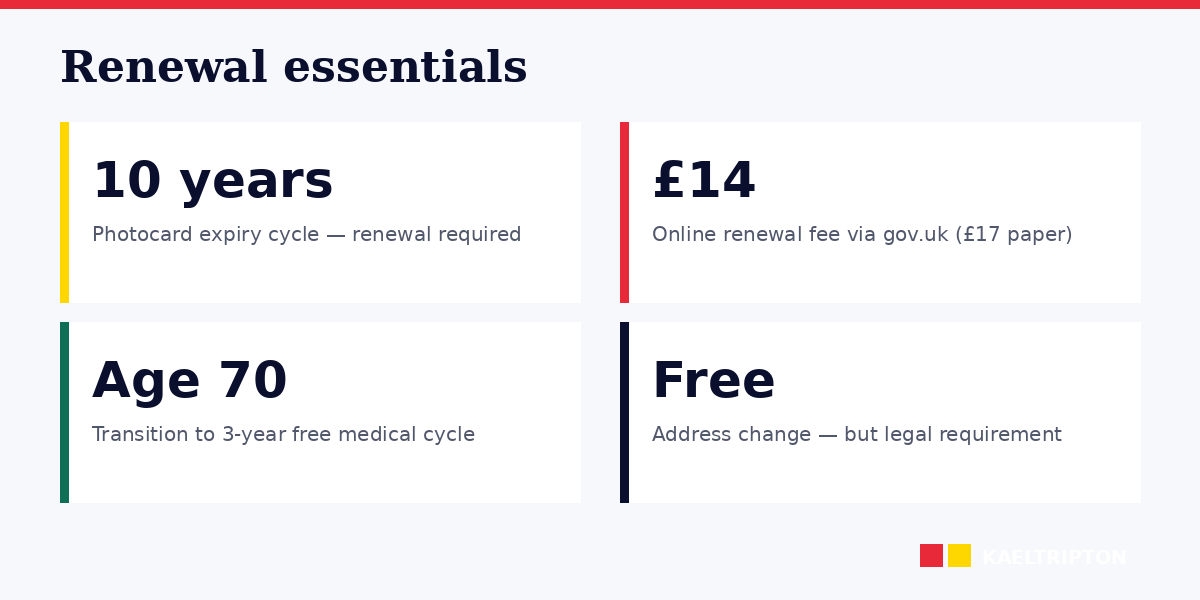
UK photocard driving licences expire every 10 years and must be renewed to remain valid. Online renewal at gov.uk/renew-driving-licence costs £14 in 2026 (£17 by paper D1). Address changes are free and required by law when you move. From age 70, licences are renewed every 3 years with a medical declaration - still free after the initial fee-paying period ends. Photocard renewal doesn't usually require a new photo unless your existing one is over 20 years old. Driving without a valid licence exposes you to £1,000 fines and 6 penalty points. This guide covers the full 2026 renewal process - online, paper, address changes, the age-70 medical cycle, and what to do when renewal is refused.
| ★ EDITOR'S VERDICT Photocard expires every 10 years. Free address change is legally required. |
UK photocard driving licences expire after 10 years and must be renewed - £14 online at gov.uk (£17 paper). Most renewals require no new photo. Address changes are free and mandatory by law - failure to update DVLA is a £1,000 potential fine. From age 70, the cycle switches to every 3 years with a free medical declaration - DVLA sends form D46P automatically. Driving with an expired photocard (even if your underlying entitlement is valid) is an offence - keep the date on your radar or set a calendar reminder 3 months before expiry. |
The 10-year photocard expiry rule
UK photocard licences expire 10 years from issue date. Your current licence shows two dates:
- Expiry date of the photocard (typically 10 years from issue) - this is what must be renewed
- End date of driving entitlement (lifetime for most licence holders, or age-based for older drivers) - separate concept; your entitlement to drive doesn't expire at the photocard's 10-year mark, just the photo-identity element
DVLA sends a reminder (form D798) approximately 10 weeks before the photocard expires, addressed to the registered licence holder. Many drivers miss the reminder because of address changes, so check your photocard's printed expiry date periodically.
The 10-year cycle started with the introduction of photocard licences in July 1998. Legacy paper licences issued before July 1998 were converted over time - most have now been replaced with photocards, but a handful of holders may still have the old paper.
How to renew online (fastest route)
Apply at gov.uk/renew-driving-licence:
- Have ready: driving licence number (on the front of your photocard), National Insurance number, payment card for £14
- Start the online service - confirms your identity via DVLA records
- Review your current details and confirm or update: name, date of birth, address
- Choose whether to update your photo (usually not necessary unless existing photo is old or poor quality)
- Pay £14 by debit or credit card
- Confirmation email arrives immediately
- New photocard posted typically within 1 week (3-5 working days)
If your photo needs updating: upload a digital photo meeting the standards (unobstructed face, neutral background, passport-quality). Some renewals require a fresh photo - the online service tells you.
When a fresh photo is required
- Current photo is over 20 years old
- Your appearance has changed significantly
- Current photo doesn't meet modern standards (from old licence types)
- Previous licence photo was physical (not digital) and DVLA doesn't have a digital image on file
For the small number requiring a fresh photo, DVLA accepts digital photos uploaded via the online service or Post Office PassPhoto service that sends a digital image directly to DVLA.
Paper renewal via form D1
If you can't use online (for example, you don't have a current UK passport to verify identity), use paper D1:
- Collect D1 from any Post Office or download from gov.uk
- Complete with your details and signature
- Enclose your current photocard (you'll need to send it in)
- Include a recent passport-style photograph (or get one via Post Office PassPhoto)
- Include cheque or postal order for £17 made out to DVLA
- Post to: Drivers Customer Services, DVLA, Swansea SA99 1BA
- Processing typically 3 weeks
The £3 paper premium reflects the additional manual processing required. Most drivers use online.
Address changes
You must notify DVLA of any change of address while holding a UK driving licence. Not doing so is an offence - potential £1,000 fine.
The change is free if you're updating only the address:
- Apply at gov.uk/change-address-driving-licence
- Complete the online form with your driving licence number and new address
- No payment required
- New photocard with updated address posted within 3 weeks
You can change the address any number of times - there's no limit. If you also need to change name (after marriage or deed poll) at the same time, use the paper D1 process and include supporting certificate.
Alternative: some drivers update just the DVLA record without requesting a new photocard (fee-free, valid, though the photocard shows the old address until renewal). This is allowed but creates a mismatch that can complicate other administrative tasks.
The age-70 cycle
From the driver's 70th birthday, licences switch to a 3-year renewal cycle with medical declaration:
- First renewal at age 70: required regardless of existing photocard validity
- Every 3 years thereafter: up to and beyond age 100
- Fee: free - DVLA waives the £14 charge for age 70+ renewals
- Medical declaration: must declare any conditions affecting driving
- Vision: must confirm able to read a number plate from 20 metres
The 3-year cycle is a policy response to age-related fitness changes. Most drivers continue driving well into their 80s and 90s - the cycle ensures conditions are reviewed periodically rather than left unchecked.
Renewal forms for age 70+ arrive automatically before each 3-year anniversary. Some drivers also request earlier medical review voluntarily if conditions change.
Medical conditions and restrictions
Certain medical conditions affect licence validity and must be declared:
- Epilepsy or seizures: seizure-free period required (6 months typically, 1 year for some categories)
- Diabetes: mostly compatible but specific treatment regimens need review
- Heart conditions: case-by-case; major events (heart attack, pacemaker, stroke) usually require assessment
- Sleep disorders: narcolepsy, severe sleep apnea require assessment
- Mental health: severe conditions affecting judgment require review
- Vision: progressive conditions (cataract, glaucoma, macular degeneration) need monitoring; acute loss in one eye requires assessment before continued driving
- Substance dependency: active dependency is a barrier
- Alzheimer's and dementia: progressive conditions requiring regular assessment
DVLA's approach: the "safe to drive" test is based on specific medical evidence. A GP or specialist letter confirming fitness typically allows continued licensing. The DVLA Medical Group (0300 790 6806) coordinates assessments - they'll request medical reports where needed.
Declaration honesty is critical. Non-declaration of known conditions that affect driving is a criminal offence, and any accident linked to an undeclared condition can void insurance and lead to prosecution.
What if renewal is refused?
Refusal is rare but does happen:
- Medical condition makes driving unsafe: DVLA may refuse or issue a restricted licence. Appeals go to Magistrates' Court within 6 months.
- Identity verification failure: usually resolvable by providing additional documents. Contact DVLA directly.
- Outstanding enforcement issues: unpaid penalties can affect licence. Resolve the penalties first, then reapply.
- Fraudulent application: deliberate falsification results in refusal and potential prosecution.
If your renewal is refused, DVLA provides written reasons. Use these to understand your options: appeal, provide additional evidence, address the underlying issue.
A real 2026 scenario: 45-year-old renewing photocard
A 45-year-old in Cambridge has a photocard licence issued July 2016, expiring July 2026. She receives DVLA reminder in May.
May 2026: checks online that nothing else has changed (same address, no medical conditions, no name changes). Applies online at gov.uk/renew-driving-licence. Uses existing photo (still a reasonable likeness). Pays £14.
Late May 2026: new photocard arrives, valid to July 2036.
No action needed: address unchanged, entitlements unchanged, full licence status unchanged. Purely a photocard refresh.
Total time: 12 minutes online + 5 days postal wait.
A real 2026 scenario: 70-year-old first medical renewal
A 70-year-old in Brighton receives the D46P form from DVLA before his 70th birthday (renewal required at 70 regardless of photocard expiry).
Completes D46P: declares vision is corrected by glasses (confirmed 20-metre number plate test achievable). Declares Type 2 diabetes controlled by medication. No other conditions. No recent falls or medical events.
Returns form to DVLA: free of charge.
3 weeks later: new photocard arrives. 3-year validity - must renew again at 73. DVLA records his medical declaration. Medical Group did not require specific examination because conditions were stable and well-managed.
Next 3 years: drives normally. Continues to drive with confidence into his mid-70s.
Frequently asked questions
Do I need to renew my licence every 10 years?
Yes, the photocard expires every 10 years. Your underlying entitlement to drive is typically lifetime (until age 70 cycle begins), but the photocard as identity document expires. Renew before the printed expiry date.
What happens if I drive with an expired licence?
Same as driving without a licence - up to £1,000 fine and 6 penalty points on renewal. Insurance may be voided. If you hold valid entitlement but just an expired photocard, penalties are typically lower, but still classed as an offence.
Is address change really required by law?
Yes. Failure to notify DVLA of your current address is an offence under the Road Traffic Act. Maximum fine £1,000. DVLA relies on accurate addresses for enforcement, insurance, and official correspondence. Update whenever you move - the online service is free and takes 5 minutes.
Can I renew early?
Yes. DVLA accepts renewals up to 90 days before the current photocard expires. Earlier than that typically isn't processed until within the 90-day window. Your new photocard's start date will be from when the old one expires (or now, if renewing after expiry).
What about the age 70 medical declaration?
Self-declaration on form D46P covers most conditions. DVLA Medical Group may request a GP or specialist report for specific declared conditions. Most drivers renewing at 70 do so without issue - the declaration is routine, and continued driving is typical.
Can I renew without a photo update?
Usually yes. DVLA keeps your existing photo on file and reuses it. Fresh photo required only if the existing one is over 20 years old, significantly out-of-date, or was on a pre-1998 paper licence. Online renewal flags if a new photo is needed.
What if I lose my licence before renewing?
Apply for a replacement first at gov.uk/apply-online-to-replace-a-driving-licence (£20 fee). Once replacement arrives, renew as normal at the expiry date. Alternatively, combine the renewal with replacement for a single £20 fee - the online service handles this.
Sources
- GOV.UK, Renew your driving licence - gov.uk/renew-driving-licence
- GOV.UK, Change the address on your driving licence - gov.uk/change-address-driving-licence
- DVLA, Renew your driving licence from 70 - form D46P guidance
- DVLA Drivers Customer Services - 0300 790 6801
- DVLA Medical Group - 0300 790 6806
- GOV.UK, Medical conditions, disabilities and driving
- Road Traffic Act 1988 (as amended), driving licence provisions


