

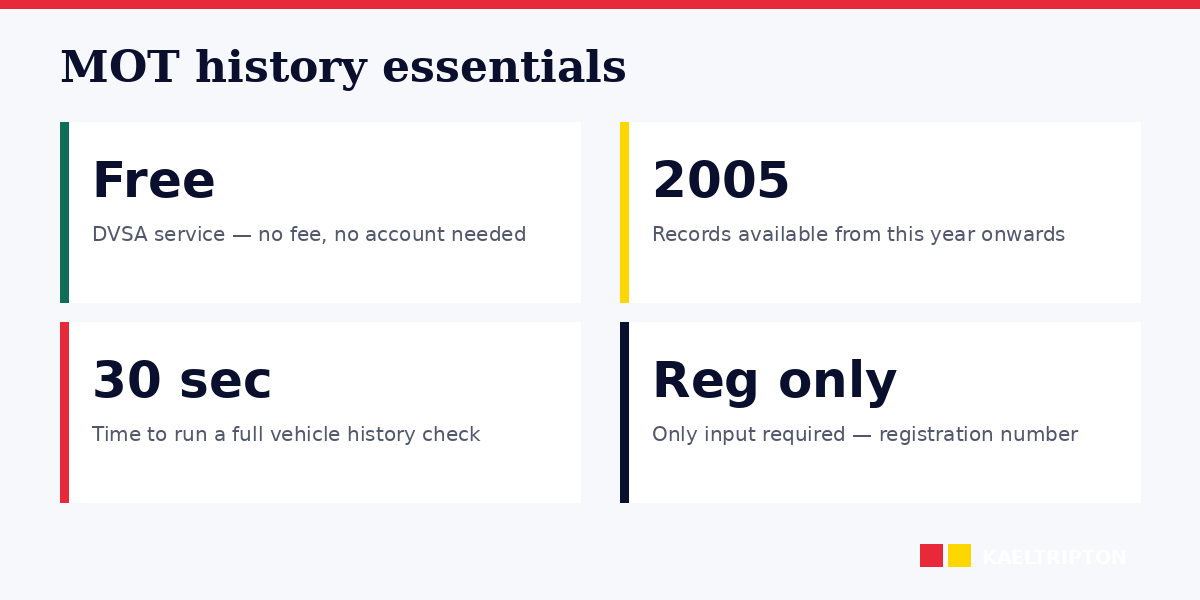
Check any UK vehicle's full MOT history for free at check-mot.service.gov.uk. Enter just the registration number and your vehicle's MOT record since 2005 appears instantly: every test, pass or fail, every advisory item recorded by testers, and the mileage declared at each test. The service is free, takes 30 seconds, and is the single most useful tool for anyone buying a used car. It also confirms whether your own car's current MOT is valid. 2026 updates include the cross-reference to DVSA's photo evidence database (fraudulent "ghost MOTs" are now flagged) and better advisory-item categorisation. This guide covers how to use the service, what the output means, and how to spot mileage fraud and hidden problems.
| ★ EDITOR'S VERDICT Free, 30 seconds, and catches mileage fraud instantly. Use it before any used car purchase. |
check-mot.service.gov.uk is the DVSA's free public MOT history service. Enter the registration, see every test since 2005 - pass/fail, advisories, and recorded mileage. Mileage progression is the gold standard for spotting odometer fraud. A 2024 reading lower than the 2023 reading means the odometer was wound back. Advisory items across years reveal maintenance patterns - addressed items = good owner, persistent items = bad sign. Never buy a used car without running this check first. Third-party paid services mostly repackage the same free DVSA data. |
How to run an MOT history check
- Go to check-mot.service.gov.uk (the official DVSA service - not a third-party website)
- Enter the vehicle registration number (letter-number format, no spaces required)
- The service displays:
- Make and model
- First used (registered) date
- Current MOT status (valid, expired, or never tested)
- Next test due date if currently valid
- Full history since 2005 with test dates
- Click on any individual test to see:
- Pass or fail
- Odometer reading at test
- Advisory items noted
- Reasons for Rejection if failed
- Test station (usually anonymised)
The service is deliberately simple - no login, no account, no fee. It's the same database that insurance brokers and used car dealers use to verify vehicle records.
What the output tells you
Pass/fail pattern
Look at the overall pattern across years:
- Consistent passes first time: well-maintained car, positive signal
- Regular fails then passes: typical - owner uses the MOT as a diagnostic, fixes what's flagged. Not a red flag if the repairs happen.
- Multiple tests in same month: could indicate the owner shopping around for a pass after a refusal. Sometimes legitimate (moved house, changed garage), sometimes concerning.
- Very long gaps between tests: could indicate SORN period (car off-road legitimately) or an ownership gap. Check whether mileage jumps are consistent with the gap.
- Tests in geographically distant stations: unusual and worth asking the seller about.
Mileage progression
This is the gold standard for spotting mileage fraud. Each MOT records the odometer reading. A 2018 car with these MOTs:
- 2021 (age 3): 14,500 miles
- 2022: 28,000 miles (normal 13,500 annual)
- 2023: 41,200 miles (normal 13,200 annual)
- 2024: 52,800 miles (normal 11,600 annual)
- 2025 (now): 38,000 miles (??)
The 2025 reading is lower than 2024. This is mileage clocking - the odometer has been wound back. The MOT history proves it. Never buy a car where the mileage progression is inconsistent.
Legitimate scenarios that cause apparent irregularities:
- Odometer replacement after dashboard damage - documented in service history
- Imported car with different original units (kilometres converted to miles)
- Car off-road for extended period - low mileage is plausible
Any of these should be supported by documentation. No documentation = walk away.
Advisory items pattern
Advisories are tester comments that don't fail the car but flag imminent issues. Track them across years:
- Advisory items appearing, then disappearing at next test - the owner fixed them (positive)
- Advisory items appearing and persisting across multiple tests - the owner ignored the warnings (concerning)
- "Brakes worn" advisory for 3+ years with no replacement - the owner has been running on wear-minimum brakes indefinitely (serious concern)
- Complex advisory items that escalated to fails in later years - shows the owner's maintenance pattern
A car with advisory items that were addressed promptly is better than a car with a clean history that never got a critical look.
Reasons for Rejection
When a car has failed, the reasons are publicly available. Look for:
- Single issues: "rear brake pad thin" - repaired, passed retest - normal
- Multiple serious issues on one test: suggests deferred maintenance, possibly bigger issues beneath
- Category: Dangerous: the most serious fail classification - raises questions about how the car got to the test in that state
- Structural or corrosion issues: particularly concerning in older vehicles - can be expensive or impossible to rectify permanently
Using MOT history when buying a used car
The structured pre-purchase check:
- Get the registration from the seller via ad or text. A seller who refuses to provide it before inspection is a red flag.
- Run the MOT history check. 30 seconds at check-mot.service.gov.uk.
- Note the next MOT date. If the current MOT expires within a month, factor £50+ into the purchase price.
- Assess the mileage progression. Consistent and linear? Good. Irregular jumps or drops? Ask questions.
- Review advisory items. Any recurring themes? Any that predict upcoming expenses (brake work, suspension replacement)?
- Check last test location relative to seller's location. Sellers using out-of-area test stations for recent MOTs sometimes do so to hide issues.
- Cross-reference with V5C. Number of previous keepers should be consistent with ownership gaps in MOT records.
If you use paid HPI-style checks, MOT history is usually included. But for free-of-charge, quick assessment, the DVSA service is perfect. Many HPI-style checks layer additional paid-for data on top of the same free DVSA MOT history.
What the MOT history does NOT show
- Service history - servicing by non-MOT-centre garages, oil changes, timing belt replacements. These require separate records (service book, garage invoices).
- Accident history - minor bumps, write-offs, category damage (A, B, N, S). Requires HPI check or insurance data via ABI Claims and Underwriting Exchange.
- Outstanding finance - HPI check required.
- Stolen status - HPI / police databases required.
- Mileage before 2005 - DVSA didn't digitally record mileage in MOT records before 2005.
- Ownership details - personal data protected, V5C shows previous keeper count but not names.
- Foreign registration history - only UK MOT records appear. Imported vehicles show MOT history from the date they were UK-registered onwards.
Using MOT history for your own car
Beyond used car shopping, check your own car's MOT history to:
- Confirm current MOT validity if you've lost the paper certificate
- See the next test due date (also shown on vehicle tax renewal pages)
- Review past advisories as a planning tool for upcoming maintenance
- Check if a previous owner declared mileage that doesn't match your service history - useful if you bought the car used and want to verify
- Download the MOT record for your files (many insurers accept this as proof of MOT for claims or valuations)
2026 improvements to the service
- Photo evidence integration: Since 2025, testers photograph the vehicle during testing. These photos are stored in the official digital record and available to DVSA investigators. The public MOT history service doesn't show photos directly but the backend cross-references them to flag suspected ghost MOTs.
- Clearer advisory categorisation: 2026 updates to how advisories are displayed - structural issues flagged more prominently, expiring components (tyres, brakes) highlighted for visibility.
- Mobile-responsive design: the check-mot service has been optimised for phone use during viewings.
A real 2026 scenario: spotting mileage fraud on a used Mondeo
A buyer in Leeds views a 2018 Ford Mondeo 2.0 TDCi advertised at £9,500 with 45,000 miles. Seller claims one careful owner since 2019.
At home: runs MOT history check. The record shows:
- 2021 test: 28,000 miles (pass)
- 2022 test: 47,500 miles (pass)
- 2023 test: 64,800 miles (fail on tyres, retest pass at 64,900)
- 2024 test: 81,200 miles (pass)
- 2025 test: 45,000 miles (pass) - at a different test station 80 miles away
The 2025 reading of 45,000 miles contradicts the 2024 reading of 81,200 miles. Either the odometer was wound back or replaced. The 80-mile distance to the test station is also unusual.
Buyer decision: confronts seller with the MOT history. Seller claims odometer was replaced after dashboard failure. Asks for the receipt from the repair. Seller cannot produce it. Buyer walks away.
Post-script: two days later the ad is removed. Likely fraudulent - mileage wound back to present the car as lower-mileage. Without the MOT history check, this buyer would have paid £9,500 for a 95,000+ mile car worth approximately £5,500.
Frequently asked questions
Is the MOT history check really free?
Yes. The DVSA service at check-mot.service.gov.uk is completely free, no account needed, no fee. Third-party sites charging for "MOT history reports" typically just repackage the free DVSA data. Always use the official service first.
How far back does the MOT history go?
Digital records start from 2005 when the MOT system was computerised. Tests before 2005 exist on paper records at the test station but are not publicly accessible. For most purposes, 2005-onwards history is more than sufficient.
What if a car has no MOT history?
Possible explanations: new car under 3 years old (no MOT needed yet), imported car recently registered in the UK, vehicle declared SORN for extended period. A 5+ year old car with no MOT history whatsoever would be very unusual and warrants questions.
Can I see who tested my car?
The service shows the test station identification but the individual tester is usually not publicly visible. For serious concerns (suspected fraud, inappropriate test outcome), contact DVSA directly - they have the full audit trail.
What if the mileage looks wrong on my own MOT record?
Errors do happen. If you spot an incorrect odometer reading on your own record, contact the test station first - they can correct minor entry errors. For significant discrepancies, contact DVSA directly at 0300 123 9000.
Does MOT history affect my car's valuation?
Yes - significantly for used cars. A clean MOT history with consistent passes and mileage adds to value. Recurring fails, mileage irregularities, or advisory items that were ignored all reduce value. Professional buyers (trade, dealers) rely heavily on MOT history in making purchase decisions.
Can I check MOT history before I buy from an online auction?
Yes. Always run the MOT history check on the registration before bidding on auction sites (eBay Motors, Copart, BCA). The 30-second check can save you thousands. Auctions showing vehicles with concerning MOT history typically have limited warranties - the risk is yours.
Sources
- DVSA, Check the MOT history of a vehicle - check-mot.service.gov.uk
- GOV.UK, MOT history - gov.uk/check-mot-history
- DVSA, MOT testing statistics and reports
- Motor Vehicles (Tests) Regulations 1981 (as amended) - MOT record retention provisions
- Open Data License - DVSA MOT records made publicly available under OGL v3.0
- Office of Product Safety and Standards (OPSS), Used car market enforcement and mileage fraud reporting


