

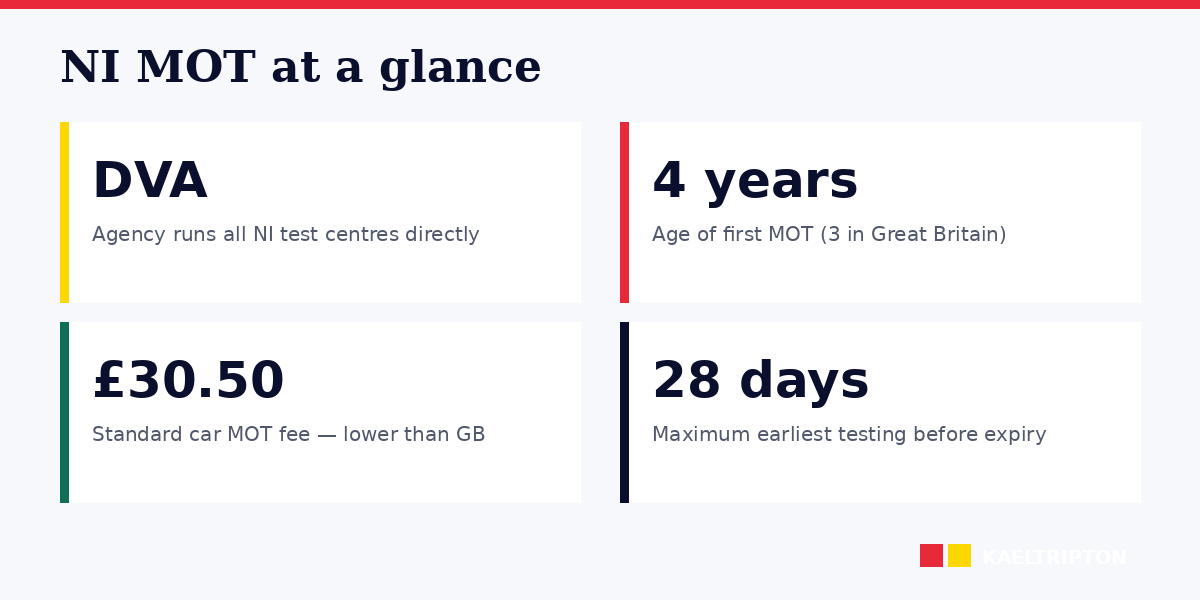
Northern Ireland MOTs are run directly by the DVA, not DVSA, with a 4-year first test and a £30.50 Class 4 fee versus GB's £54.85 cap. Booking is via nidirect.gov.uk only, and tests cannot occur more than 28 days before the due date. Certificates remain mutually recognised across the UK.
Northern Ireland's MOT system differs from Great Britain in several material ways. NI tests are run exclusively by the Driver and Vehicle Agency (DVA) at government-operated test centres - around 70 centres across Northern Ireland - rather than by the 23,500+ private authorised garages used in England, Scotland, and Wales. The first MOT is required at 4 years old in NI, not 3. The 2026 fee is £30.50 for cars (much lower than GB's £54.85 cap). Booking is centralised through nidirect.gov.uk. You cannot book more than 28 days before the test due date in NI - unlike GB's 1-month-minus-1-day early booking rule. This guide covers every practical difference for UK movers and for NI drivers comparing their system to GB's.
| ★ EDITOR'S VERDICT Northern Ireland MOT is cheaper, stricter on timing, and government-run only. |
DVA operates all NI test centres directly - no licensed private garages. 4-year first test (not 3). £30.50 Class 4 fee versus GB's £54.85 cap. Book via nidirect.gov.uk only. Cannot test more than 28 days before the due date - unlike GB's 1-month-minus-1-day window. Capacity has improved since the 2020-2022 backlogs but Belfast centres still run 10-14 weeks. Omagh and Enniskillen are fastest. GB and NI MOT certificates are mutually recognised - valid across the whole UK. |
DVA vs DVSA: the administrative split
The United Kingdom's road safety framework has two parallel agencies since devolution:
- DVSA (Driver and Vehicle Standards Agency) - operates in Great Britain (England, Scotland, Wales). Licences private garages to conduct MOTs. Publishes the MOT Inspection Manual for cars and passenger vehicles.
- DVA (Driver and Vehicle Agency) - operates in Northern Ireland only. Runs all MOT test centres directly - no private authorisation system. Issues paper MOT certificates (historically displayed as discs, now paper-only since 2015).
Both use substantially the same inspection standards and both are governed by the Department for Transport (DfT) in London, so the actual test content is very similar. The administrative and operational differences are what matter in practice.
The 4-year first test rule
In GB, the first MOT is required at 3 years old. In NI, it's 4 years. This difference has been consistent for decades - NI's rule was set when the scheme began and hasn't changed.
Practical consequence for vehicles moved from GB to NI:
- A 3-year-old car MOT-tested in GB remains valid when moved to NI until the certificate expires
- If the car would be nearing its next test at GB's 3-year first-test schedule, in NI it gets another year's grace until the 4-year mark
- For pre-2005 imports or vehicles moved across internally, DVA accepts GB MOT certificates as valid until expiry
When the first NI test is needed, it follows the 4-year anniversary of first registration. So a car registered on 15 June 2022 has its first MOT due by 15 June 2026 in NI.
The 28-day rule: no early booking
In GB, you can book your MOT up to 1 calendar month minus 1 day before the current MOT expires without losing any valid time. This gives flexibility - you can test 26 days early if it suits.
In NI, the rule is stricter: you cannot legally test more than 28 days before the current MOT expiry date, or before the 4-year anniversary for first-time tests. Testing more than 28 days early is refused by DVA test centres.
The reason: NI's centralised testing system has booking slot capacity pressures, and the 28-day rule helps manage demand. It also preserves the continuous 12-month validity period from the previous expiry.
Booking: nidirect.gov.uk only
MOT booking in NI is centralised:
- Online: nidirect.gov.uk/services/book-motvehicletest - this is the official booking system
- By phone: 0345 247 2471 (DVA MOT booking line) - for those without internet access or complex cases
- Walk-in: not available - all slots must be booked in advance
Historical context worth knowing: DVA had severe capacity issues from 2020-2022 due to a combination of inspection lift gear cracks discovered in January 2020 (temporary closures) and the COVID-19 pandemic from March 2020. By August 2022, Belfast-area drivers reported 6-month waits. Capacity has significantly improved since mid-2023. Most centres now operate within the DVA target of about 28-day waits, though Belfast still has longer queues than outlying centres.
Popular NI test centres and typical waits (early 2026)
- Belfast (Mallusk, Balmoral): 10-14 week waits typical
- Omagh: under 5 weeks - often fastest
- Enniskillen: 4-6 weeks
- Newry: 6-10 weeks
- Coleraine: 5-8 weeks
- Derry/Londonderry: 6-10 weeks
Waits vary seasonally - spring and autumn peaks add 2-4 weeks to typical durations. The strategic move: book the earliest appointment at an outlying centre rather than wait for Belfast slots.
Fees and retest rules in NI
DVA MOT fees for 2026 are substantially lower than GB caps because DVA is not run commercially:
- Car (Class 4 equivalent): £30.50
- Motorcycle: £21.00
- Motor home: £43.50
- Light goods vehicle: £30.50
- Medium goods vehicle (DVA Class 5 equivalent): varying
- PSV (public service vehicle): higher rates - commercial
Compared to GB's £54.85 Class 4 cap, NI's £30.50 is a real saving for NI residents. Many GB drivers near the border look at this with envy.
Retests:
- Partial retest within 21 days at same centre: reduced fee (£15 typical) if only minor items failed
- Full retest within 60 days: same full fee as original test
- Beyond 60 days or different centre: treated as fresh test
Emissions testing differences
A notable historical anomaly: DVA does not conduct emissions testing on diesel cars during MOT, despite this being a legal requirement. This gap has persisted since 2006 and was still unresolved as of 2018 reports. Petrol diesel cars in NI effectively don't get diesel-specific emissions verified at MOT.
Petrol vehicles do receive smoke testing and visual emissions checks. The gap specifically affects diesel particulate emissions - relevant to DPF-equipped vehicles and those with potentially tampered emission systems. DfT policy statements have indicated intent to resolve but no confirmed implementation date as of early 2026.
MOT history: not publicly available in NI
A significant practical difference from GB: NI does not have a public MOT history check service equivalent to check-mot.service.gov.uk in GB. DVA test records exist but are not publicly accessible online.
To obtain MOT history for a NI vehicle:
- Contact DVA Customer Services: 0300 200 7862
- Email: dva.customerservices@infrastructure-ni.gov.uk
- Provide: vehicle registration, your own identity, reason for request (usually: vehicle owner or prospective buyer)
- Processing: 3-10 working days typically
This makes private used-car purchases in NI materially riskier than in GB. Buyers should insist the seller demonstrate a clean MOT history via their own records, or request DVA confirm via email - a step many private sellers find inconvenient.
MOT exemptions in NI
Same major categories as GB:
- Vehicles under 4 years old (not 3 years as in GB)
- Vehicles of historical interest - registered over 40 years ago, no longer in production, not substantially modified in last 30 years (NI-specific wording)
- Vehicles on Northern Ireland's Rathlin Island (small-island exemption)
- Vehicles declared SORN
The "of historical interest" definition in NI is slightly stricter than GB's "historic vehicle" class. NI requires the vehicle to be no longer in production (a manufacturing criterion) as well as the age criterion. GB's 40-year rolling rule doesn't have this production-status requirement.
Cross-border considerations
NI shares a land border with the Republic of Ireland (ROI). Some cross-border considerations:
- NCT (National Car Test) in ROI is the ROI equivalent. Not recognised in NI or UK generally for permanent residence - UK-registered cars need DVA MOT certificates.
- UK-registered cars visiting ROI can use a valid UK MOT for tourist purposes
- Moving a car from ROI to NI permanently requires re-registration with DVA and first MOT within 6 months of re-registration
- Frontier traffic - daily commuters across the border for work continue using their home-country registration and MOT
A real 2026 scenario: Belfast resident's first MOT on a 2022 car
A 34-year-old in Belfast bought a new 2022 Ford Kuga. First registered 10 March 2022. First MOT required by 10 March 2026 - exactly 4 years after first registration.
January 2026: DVA sends reminder letter approximately 6-8 weeks before the due date.
Mid-February 2026: He goes online to nidirect.gov.uk to book. Mallusk test centre (Belfast area) has 11-week wait. Omagh centre has 4-week slot but involves 70-mile round trip. He chooses the Mallusk slot for convenience despite the wait.
9 March 2026: attends Mallusk test centre at booked time. Test takes approximately 55 minutes including emissions, brake test, and lift inspection. Passes with one minor advisory (windscreen chip in non-critical zone).
10 March 2026: new MOT valid until 9 March 2027. Paper certificate received. Paper record retained at DVA - no online history database for NI.
Fee: £30.50 paid at booking.
Frequently asked questions
Why does Northern Ireland have different MOT rules?
Devolution and separate legislative history. Transport functions for NI are devolved to the NI Executive and administered by the Department for Infrastructure. The MOT scheme in NI developed with centralised government-run test centres rather than private authorisation, reflecting different policy choices from Great Britain's DVSA-run licensed-garage model.
Can I use a GB MOT certificate in Northern Ireland?
Yes. UK MOT certificates are valid across all UK nations. A GB-issued MOT is recognised in NI for the duration of its validity. If your car was MOT-tested in England and you move to NI, the certificate remains valid until expiry. Subsequent tests must be at DVA centres.
Is NI MOT cheaper than GB?
Yes. 2026 DVA car MOT fee is £30.50 versus GB's £54.85 maximum (many GB garages discount to £35-£45, but DVA is at the low end of the range). The saving reflects the government-run rather than private-operated model.
How early can I test my car in Northern Ireland?
Up to 28 days before the current MOT expires, or 28 days before the 4-year anniversary for first-time tests. Testing earlier than this is not accepted by DVA. This differs from GB's "1 calendar month minus 1 day" window.
Where can I check an NI vehicle's MOT history?
There's no public online service equivalent to GB's check-mot.service.gov.uk. Contact DVA Customer Services on 0300 200 7862 or email dva.customerservices@infrastructure-ni.gov.uk with the vehicle registration and your reason for requesting. Processing takes 3-10 working days.
Do NI MOT centres offer repair services?
Government-run DVA centres do not repair vehicles - only test them. If your vehicle fails, you take it to an independent garage for repairs, then return to DVA for retest. This is a key difference from GB where many private MOT garages also offer repairs on-site.
What happens if my MOT expires before I can get a booking?
If your MOT expires because of DVA capacity issues and you cannot drive legally, DVA offers a "certificate of exemption" in limited hardship cases. Contact DVA Customer Services to discuss. Alternatively, declare SORN to stop the tax obligation until you can test.
Sources
- nidirect.gov.uk, MOT scheme and booking service
- DVA Northern Ireland, Driver and Vehicle Agency services
- GOV.UK, Getting an MOT - gov.uk/getting-an-mot (GB rules for comparison)
- Department for Infrastructure (NI), MOT scheme policy and administration
- Wikipedia, MOT test (general history and cross-UK comparisons)
- DVA Customer Services - 0300 200 7862
- MOT and Vehicle Test Services (Northern Ireland) Order 1981 (as amended)
Common questions: Mot northern ireland
Checked against primary sources on 23 September 2026
When does a car need its first MOT in Northern Ireland?
In Northern Ireland, a car needs its first MOT when it is 4 years old. This differs from Great Britain, where the first MOT is required at 3 years old. The rule applies to cars in Northern Ireland and is set by the Driver and Vehicle Agency (DVA), which runs MOT testing there.
Where are MOT tests done in Northern Ireland?
MOT tests in Northern Ireland are carried out at DVA test centres. They are not done at private garages, which is how testing works in Great Britain. The Driver and Vehicle Agency (DVA), not DVSA, runs MOT testing in Northern Ireland, and all tests take place at its own centres.
How do I book an MOT in Northern Ireland?
You book an MOT in Northern Ireland online through nidirect. The same service lets you change or cancel your test. Booking, changing and cancelling are all handled through nidirect, which is the online route provided for MOT appointments in Northern Ireland.
What is a Temporary Exemption Certificate?
A Temporary Exemption Certificate is issued by the DVA when it could not test a vehicle in time. It covers the vehicle in that situation. The Driver and Vehicle Agency (DVA) has issued these certificates when it was unable to carry out a test before the existing MOT expired.
Can I check MOT history for a Northern Ireland car?
Yes. Past MOT results for vehicles tested in Northern Ireland can be checked online through nidirect. The service covers vehicles tested in Northern Ireland, so you can look up the MOT history for a Northern Ireland car using nidirect's online checking facility.
Sources: nidirect: MOT and vehicle testing · nidirect: book your MOT online


