

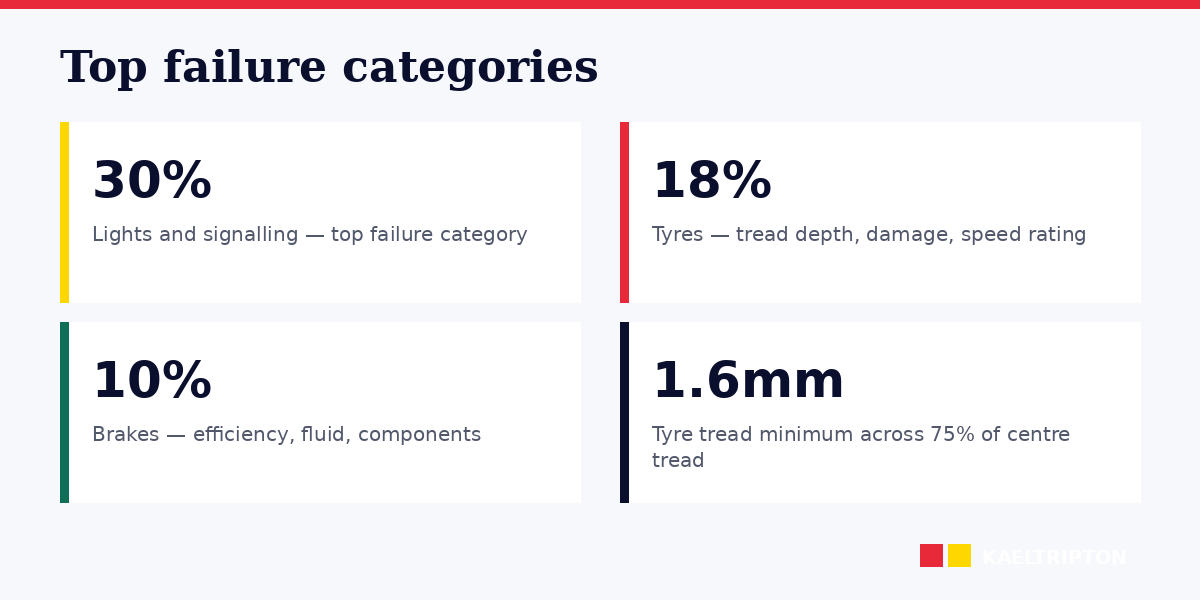
Over 30% of UK vehicles fail their first MOT on initial test - a figure that has stayed remarkably stable year-on-year in DVSA statistics. 2024 data (published mid-2025) shows the top failure categories in order: lights and signalling around 30% of fails, tyres around 18%, brakes around 10%, plus suspension, visibility (windscreen), and steering making up most of the rest. 1.5 million vehicles failed on dangerous faults in 2024 alone. The good news: most failures are entirely preventable with 15 minutes of pre-test checks. This guide covers the 2026 top failure categories with specific rules, typical costs to fix, and the pre-MOT checklist that catches 80% of common fails before you even book the test.
| ★ EDITOR'S VERDICT 30% of cars fail first MOT. 15 minutes of prep prevents most of it. |
Top failure categories: lights and signalling (30%), tyres (18%), brakes (10%), suspension (9%), visibility (8%). Most failures are preventable with basic pre-test checks - bulbs, tyre tread with a 20p coin, wipers and washers, windscreen chips in the driver's view. Spending £10-£50 on bulbs, wiper blades, and a windscreen chip repair the day before the test routinely saves £200+ in failure-related repairs. Advisories are not a fail but predict upcoming expense - treat them as a 3-6 month planning signal. |
The top failure categories in 2024-2025 DVSA data
DVSA publishes MOT outcome statistics quarterly. The consistent top categories:
| Category | % of first-test fails | Typical fix cost |
|---|---|---|
| Lights and signalling | ~30% | £5-£100 (bulbs to full unit replacement) |
| Tyres | ~18% | £50-£120 per tyre |
| Brakes | ~10% | £100-£500 (pads and discs) |
| Suspension | ~9% | £60-£400 (per component) |
| Visibility (windscreen, wipers, washers) | ~8% | £20-£400 (chip repair to full replacement) |
| Steering | ~5% | £80-£300 |
| Body, structure, general (inc. emissions) | ~12% | highly variable |
| Emissions (diesel and petrol combined) | ~5% | £100-£1,500+ (DPF replacement at high end) |
| Other categories | ~3% | - |
Percentages sum to more than 100% because individual vehicles often fail on multiple items. The median failed vehicle has 2-3 Reasons for Rejection on the same test.
Lights and signalling - why this category tops every year
30% of MOT fails involve lights because there are so many different items and bulbs that need to work:
- Headlights (main beam and dipped)
- Sidelights (front and rear)
- Brake lights (including high-level third lamp)
- Indicators (front, rear, side repeaters)
- Hazard lights (all four flashing simultaneously)
- Rear fog light (required, must work, must not be permanently on)
- Number plate lamp
- Reversing lights if fitted
- Reflectors (front and rear, amber side if fitted)
Any single bulb out = fail. Beyond bulbs, failures include:
- Incorrect colour bulb fitted (e.g. blue-tinted bulb in headlight)
- Headlight aim incorrect (tester's aligner check)
- Cracked or damaged lens letting water in
- Reflector corroded or damaged
- Wiring visible or exposed
Pre-test check: 5 minutes with a friend. One person works the controls while the other walks around the vehicle confirming each light functions. Check indicators both sides, brake lights (foot on pedal), reversing lights. Replace any non-functional bulb before the test - H7 halogen bulbs cost £3-£15 and most are DIY-replaceable in 10 minutes.
Tyres - 18% of fails, highest single item
Within tyres, the top fail reasons:
- Tread depth under 1.6mm across 75% of centre tread width
- Cuts or bulges on sidewall - including parking-kerb damage
- Wrong speed rating for the vehicle
- Mixed tyre construction (crossply and radial on same axle)
- Exposed cord or ply
- Damaged tread deeper than the structural layer
- Insufficient inflation during test
The 1.6mm rule is commonly misunderstood. Legal minimum is 1.6mm over the central 75% of the tread, around the full circumference. A tyre that's 1.6mm in the centre but 2mm at the edges can still fail if the centre wear is irregular. A well-worn tyre reads 1.6-2mm is at the end of its useful life - book replacement before the MOT.
Pre-test check: 20p coin test. Insert a 20p coin into the main tread grooves - if you can see the outer band of the coin, your tread is below 3mm and close to legal limit. Proper check is with a tread depth gauge (£3 on Amazon). Check all four tyres including spare - spare isn't MOT-tested but should be roadworthy.
Brakes - 10% of fails, serious consequences
Brake fail categories:
- Service brake efficiency below 50% on the roller test
- Brake imbalance across axles (one side much weaker than other)
- Parking brake below 16% efficiency
- Brake fluid leaks
- Brake pedal travel excessive
- ABS warning light on
- Worn brake pads below minimum thickness
- Damaged brake pipes, hoses, or corroded metal lines
- Seized caliper
Brake failures are often not obvious in normal driving. A brake pedal that feels fine on the road can still fail the roller test if efficiency drops below threshold under sustained braking.
Pre-test check: listen for grinding during braking (metal-on-metal = pads worn through), check for pulling to one side, check for sponginess in the pedal. If any of these, book a brake inspection before the MOT - it'll cost £30-£50 for the inspection vs possible £400+ for discovered issues in the test.
Suspension - 9% of fails, often invisible
Suspension fails typically involve:
- Worn shock absorbers - fluid leaks or excessive bounce
- Track rod end play - steering joint worn
- Anti-roll bar bushes perished
- Ball joint excessive play
- Coil spring broken or damaged
- Wheel bearing play or noise
- Broken or severed mounting points
Suspension issues rarely present symptoms until advanced. Many drivers are surprised by suspension fails despite the car driving "normally".
Pre-test check: bounce test on each corner - push down firmly, release, car should settle within 1-2 bounces. Listen for clunks over speed bumps. Look for fluid leaks from shock absorber bodies. If uncertain, any independent mechanic can inspect for £30-£40 before the MOT.
Visibility - 8% of fails, often a simple fix
Windscreen and visibility failures:
- Windscreen chip or crack in driver's view zone over 10mm diameter or 40mm total length
- Chip outside zone A over 40mm
- Wiper blades torn, split, or ineffective
- Windscreen washers not spraying or spraying incorrectly
- Rear view mirror missing or broken
- Stickers obstructing driver's view (satnav holders, window stickers, phone mounts)
- Excessive tinting on front side windows or windscreen
Zone A is the area directly in the driver's forward sight line - roughly 290mm wide from centre of the steering wheel. Zone B is the rest of the wiped area. Chips outside the wiped area at all don't fail.
Pre-test check: inspect windscreen for damage. A chip repair (£60-£100 at a specialist like Autoglass) fixes most stone damage and saves a £400+ screen replacement. Top up washer fluid. Replace wiper blades if they're streaking - £10-£25 per set.
The pre-MOT checklist that prevents 80% of fails
15 minutes the evening before your MOT, in order:
- All lights working - walk around with engine running, someone in the car working controls
- Tyre tread above 2mm all round (20p coin test)
- Tyre pressures correct per manufacturer plate (in door jamb)
- Windscreen clear of cracks and chips in driver's view
- Wiper blades not split or torn
- Washer fluid topped up and spraying
- Horn works
- Brake lights and indicators work (have someone watch)
- Dashboard warning lights: check none are on (engine management, ABS, airbag)
- Number plates clean and fully legible
- Seat belts all function and retract
- Fuel in the tank (need at least 1/4 tank for emissions test)
- Vehicle clean enough for the tester to inspect clearly
This catches the most common failures. More technical issues (brake efficiency, suspension wear, emissions) need a mechanic's inspection - some garages offer free pre-MOT checks to win business.
Retest rules
If you fail the MOT, three retest scenarios:
- Partial retest at the same station within 10 working days - free (or very small fee), covers only the failed items. The vehicle stays at the test station.
- Partial retest at same station after leaving - free within 10 working days if the vehicle left the test station and returned. Limited item scope - not all failures qualify for free retest.
- Full retest - required if the vehicle leaves the station and more than 10 working days elapse, or if the repairs affect multiple systems.
Specific retest fees depend on the garage. Most charge nothing for a same-day partial retest; some charge a nominal admin fee (£10-£15). Always clarify retest policy before committing to repairs at the test station.
A real 2026 scenario: prepared owner vs unprepared owner
Prepared owner - Lisa in Bristol with a 2017 Renault Clio:
The evening before her MOT, Lisa runs through the checklist. Finds front-left bulb out (15-minute £8 fix) and driver's wiper blade split (£12 for new pair). Confirms tread above 2mm on all tyres. Washer fluid topped up.
At MOT the next morning: passes first time at £45. Zero additional costs.
Unprepared owner - Mark in Leeds with a similar 2017 Renault Clio:
Books the MOT on a Friday without pre-checking. Arrives, hands over keys.
Fails on: front bulb out (bulb £8 + £15 fitting), wiper blades split (£25 fitted), windscreen chip in driver's view (needs £80 chip repair before retest), rear tyre at 1.4mm (£95 fitted).
Repairs done at the garage, retest Monday free. Total cost: £45 MOT + £223 repairs = £268 for what could have been £65 with 15 minutes of preparation.
Frequently asked questions
Can I drive to the MOT test without a valid MOT?
Only directly to a pre-booked MOT appointment. Keep the booking confirmation accessible (email, text, app). Driving anywhere else without valid MOT is an offence: £1,000 fine and 3 penalty points on your licence.
What's the difference between a fail and a dangerous fail?
Both are Reasons for Rejection. A "dangerous" category fail means the item poses immediate safety risk - such as tyres below 1mm, brake lines corroded through, or a suspension component ready to fail. You cannot drive the vehicle away except for repair or another test. Standard "fail" items let you drive home if the problem is less severe, then return for repair.
If I fail, do I have to use the same garage for repairs?
No. You can drive to any garage for repair (subject to dangerous-fail restrictions). Some drivers get a second opinion after an unexpected fail - legitimate, and protects you from unnecessary work. Retest must usually be at the original station within 10 working days for the free partial retest.
What percentage of MOT fails are for "dangerous" items?
Around 10-15% of all fails fall into the "dangerous" category according to DVSA data. The majority are "major" fails (require repair but not immediately dangerous) or "minor" fails plus advisory items.
Does my car need an MOT if I barely drive it?
Yes, if the car is used on public roads - annual MOT is mandatory regardless of mileage. If you genuinely don't drive it, declare SORN and keep it on private land. SORN vehicles don't need MOT while declared off-road.
Can I get a free pre-MOT check?
Many garages offer free pre-MOT checks as a customer acquisition tool. They'll identify issues that would fail and quote for repairs. Independent garages are often more flexible than chain operators. Ask at your usual garage before booking the actual MOT.
What about advisory items from a previous test?
Advisories are informational - they don't force action but flag items approaching fail. Address them before the next MOT or they'll become actual fails. Many owners treat advisories as a "fix within 3-6 months" planning signal.
Sources
- DVSA, The MOT Inspection Manual: Cars and Passenger Vehicles
- DVSA, MOT test statistics and outcomes quarterly report
- DVSA, MOT Testing Guide (updated 1 April 2026)
- GOV.UK, Getting an MOT - gov.uk/getting-an-mot
- Motor Vehicles (Tests) Regulations 1981 (as amended)
- DVSA, Check MOT history - check-mot.service.gov.uk
- Department for Transport, Road Safety statistics


