

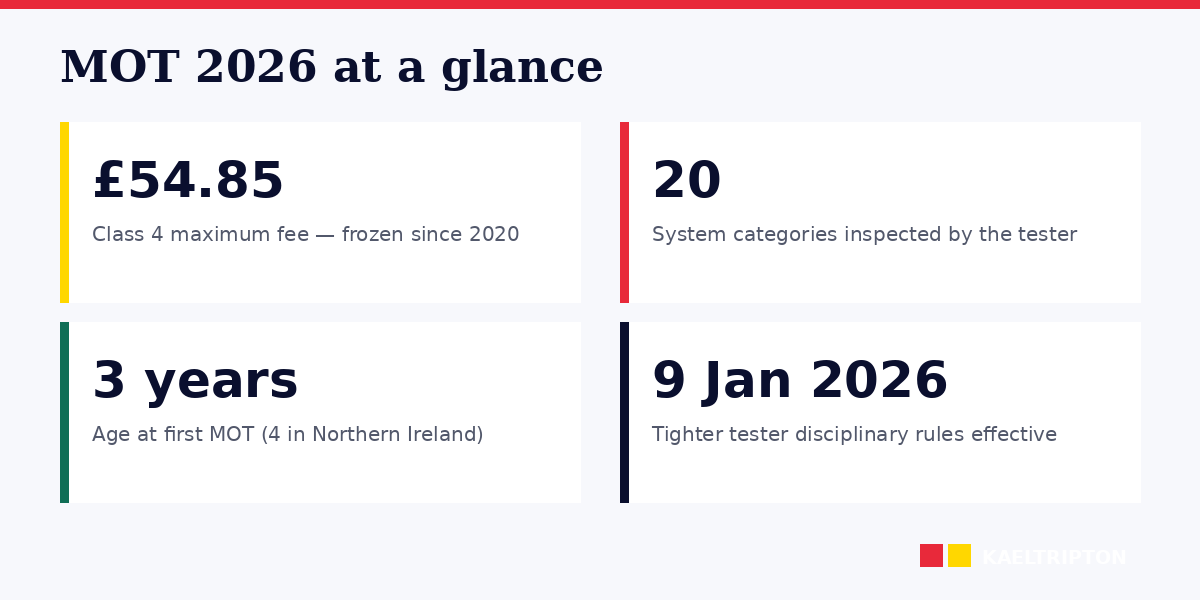
The UK MOT test covers roughly 20 vehicle systems - brakes, tyres, lights, steering, suspension, emissions, visibility, seat belts, body and structure - against standards set out in the DVSA MOT Inspection Manual. Annual testing is required for most vehicles over 3 years old in Great Britain (4 years in Northern Ireland). 2026 brought updates confirmed by DVSA: stricter visual checks on electric vehicle high-voltage systems (9 January 2026), mandatory photo evidence to combat ghost MOTs, new 2-tonne lifting equipment requirements for testing centres from 1 April 2026, and tougher disciplinary rules for testers. The £54.85 Class 4 fee cap for cars and light vans remains frozen. This guide covers everything the MOT tester inspects.
| ★ EDITOR'S VERDICT The MOT is a safety check, not a service. Know what's tested. |
The MOT covers roughly 20 system categories - brakes, tyres, lights, steering, suspension, emissions, visibility, seat belts, body and structure. 2026 brought stricter tester discipline rules from 9 January and new 2-tonne lifting equipment requirements from 1 April. Photo verification of vehicles in the test bay dramatically reduces ghost MOTs. The £54.85 Class 4 fee cap has been frozen since 2020 - many garages discount to £35-£45. EVs and hybrids have new high-voltage checks. |
The headline: what the test actually checks
Since major 2012 reform, the MOT covers around 20 system categories. Each has a set of Reasons for Rejection (RfR) in the DVSA Inspection Manual - the defect list testers use to decide pass/fail. Major categories and typical items:
- Lights - headlights (full/dipped beam), sidelights, rear lights, brake lights, indicators, hazard lights, registration plate lamps, reflectors, fog lights, headlight aim, and headlight levelling where fitted
- Steering and suspension - steering alignment and free play, suspension components, shock absorbers, power steering, wheel bearings, track rod ends
- Brakes - braking performance (measured on a roller brake tester), balance across axles, parking brake, brake pedal travel, ABS warning light, brake fluid condition, pipes and hoses for damage and corrosion
- Tyres and wheels - tread depth (1.6mm minimum across 75% of centre tread width), sidewall damage, tread cuts or bulges, wheel condition, correct fitment (speed rating)
- Seat belts - condition, function, correct fitment, airbag warning light, all seat belts present
- Bodywork and structure - corrosion on load-bearing members, insecure fixtures, damage affecting safety, door locks, bonnet/boot catches
- Exhaust and emissions - exhaust system condition (no leaks, secure mountings), smoke (diesel), CO and HC levels (petrol), Euro emission standards compliance
- Fuel and exhaust system - fuel lines, no leaks, secure fuel cap, catalytic converter present (where required), DPF present and unmodified for diesels
- Visibility - windscreen damage (specific rules on chip size and location), wipers, washers, driver's view unobstructed
- Electrical equipment - battery security, wiring condition, no exposed wires
- Number plates - correctly fitted, legible, correct character spacing, correct colour (white front, yellow rear)
- Horn - present and audible
- Vehicle Identification Number (VIN) - matches records, not tampered with, visible
- Mirrors - driver-side and nearside mirror present and working
- Driver's seat - adjustment mechanism, security of mountings
- Warning lights - MIL (engine management), airbag, SRS, ABS, ESC, TPMS - any illuminated warning fails the test
- Tyre Pressure Monitoring System (TPMS) - functional for vehicles with factory-fitted TPMS (post-November 2014)
- Advanced Driver Assistance Systems (ADAS) - from 2026 inspection manual updates, autonomous emergency braking, lane departure warning, adaptive cruise control checks where fitted
- High-voltage system (EVs and hybrids) - new 2026 emphasis: orange cable integrity, charging port condition, battery housing security, no damage or leaks
- Towing equipment - towbar security if fitted
The full Inspection Manual details every item's specific failure criteria. Testers follow a defined sequence - typically exterior walkaround, interior checks, under-bonnet inspection, under-vehicle inspection (on a ramp), emissions test (on diesel/petrol), and brake test (on rollers).
2026 changes worth knowing
9 January 2026 - tester discipline rules tightened
DVSA closed loopholes that let sanctioned testers continue MOT work indirectly. Testers and Authorised Examiner Principals (AEPs) receiving a 2-year or 5-year disciplinary cessation are now banned from ALL MOT roles for the full duration - no continuing behind the scenes at another garage. For drivers, this means more reliable testing standards but no direct impact on the test itself.
1 April 2026 - new equipment requirements for testing centres
Class 4 MOT bays (cars and light vans) need jacking beams with 2-tonne minimum safe working load and 1700mm wider lifting pad distance, to safely handle heavier modern vehicles including EVs. Applies to newly-opened sites, sites undergoing ownership change, or those restarting testing after a pause.
Photo verification against ghost MOTs
From 2025 through 2026, DVSA requires most garages to upload "proof of life" photos of the vehicle in the test bay during testing, stored in the official digital record. Ghost MOTs (fraudulent certificates issued without real testing) accounted for 80% of all MOT fraud pre-reform. The photo requirement dramatically reduces fraud capacity.
Inspection manual updates
The MOT Inspection Manual (the definitive DVSA document) continues evolving through 2026 with clarifications on:
- Brake testing for all-wheel-drive and electric vehicles
- Clearer TPMS guidance
- ADAS assessment methodology
- Updated vehicle classifications
- Electronic safety system inspection procedures
First MOT stays at 3 years (not moving to 4)
The government scrapped plans to delay the first MOT until 4 years, following consultation showing 1-in-10 cars fail their first MOT on dangerous faults. The 3-1-1 rule continues: first test at 3 years, annually thereafter in Great Britain. Northern Ireland retains 4-year first test.
Fee cap frozen
MOT fee caps frozen at 2020 levels for 2026:
- Class 4 (cars and light vans): £54.85 maximum
- Class 1 (motorcycles up to 200cc): £29.65 maximum
- Class 2 (motorcycles over 200cc): £29.65 maximum
- Class 3 (three-wheeled vehicles up to 450kg): £37.80 maximum
- Class 5 (motor caravans and 13-16 passenger vehicles): £64.35-£80.00 depending on size
- Class 7 (goods vehicles 3,000-3,500kg): £58.60 maximum
These are maximums. Many garages discount to £35-£45 for Class 4 to attract custom. DVSA monitors for testers who don't charge any fee (sometimes used as fraud indicator).
Common fail items in 2026
Despite evolving standards, the most common MOT failures remain the same categories year-on-year:
- Tyres (illegal tread or sidewall damage)
- Brakes (below performance threshold or fluid leaks)
- Lights and signalling (bulb out, aim wrong, reflector damaged)
- Steering and suspension (worn components, play in joints)
- Emissions (failed gas analysis or smoke test)
- Windscreen damage (chip in driver's view zone over 10mm)
- Wiper condition
Category 1 (tyres) alone accounts for roughly 25% of all MOT fails in DVSA statistics. The 1.6mm tread depth rule across 75% of centre tread width catches many vehicles that feel fine to the driver.
MOT exempt vehicles in 2026
Specific categories remain MOT-exempt:
- Vehicles under 3 years old (from first registration in GB; 4 years in NI)
- Historic vehicles over 40 years old with no substantial modifications
- Kit cars using V5C class 4 registration with age-appropriate use
- Some invalid carriages used by disabled drivers
- Vehicles exported for use only abroad
- Vehicles declared SORN that are not being driven on public roads
- Electric goods vehicles from certain manufacturing dates (narrow categories)
Historic vehicle owners must register their exemption via form V112. The 40-year rolling cutoff in 2026 means vehicles first registered before 1 January 1986 are now historic-class eligible.
A real 2026 scenario: routine MOT on a 2018 Ford Focus
A 45-year-old in Leeds takes her 2018 Ford Focus 1.5 TDCi for its 5th annual MOT in March 2026. Booked online with a local Kwik Fit for £45 (below the £54.85 cap).
9:00 AM - arrival. Drops car off. Tester photographs car in the test bay at 9:03 for the DVSA fraud system.
9:15 AM - exterior checks. Lights all working. Tyres: front left at 1.8mm - borderline but legal. Rear right at 3.2mm. Body: minor surface rust on sill, no structural issues. Numberplates clean and legible. Windscreen: small chip in passenger side, outside driver's view - noted as advisory, not fail.
9:25 AM - interior. Warning lights clear on startup. Seat belts function. Mirrors secure. Horn works.
9:35 AM - under bonnet and under vehicle. Engine bay clean, no fluid leaks. Brake pipes sound. Exhaust system intact. No corrosion on structural members.
9:50 AM - emissions test. Diesel smoke test: passes comfortably, below the Euro 6 threshold. DPF presence verified via visual inspection.
10:00 AM - brake test. On rollers: service brake performs at 72% efficiency (threshold 50%), parking brake 18% (threshold 16%). Balance good. Passes.
10:05 AM - result. Pass certificate issued. Advisories logged: front tyre approaching wear limit, small windscreen chip. VT20 pass certificate sent via email, logged on DVSA database.
Total time on site: ~65 minutes. She plans to replace the front tyres within 3 months before they become failing items.
Frequently asked questions
How often does my car need an MOT?
Annually once it reaches 3 years old in Great Britain, 4 years in Northern Ireland. First MOT must be booked within a month of the third anniversary of first registration. Miss it and driving becomes illegal immediately - except for driving directly to a pre-booked MOT appointment.
Can I book the MOT early?
Yes. You can book up to 1 calendar month minus 1 day before the expiry date without losing any time. For example, if your MOT expires on 20 September, you can test it from 21 August. The new certificate runs to the same renewal date next year, so you don't lose any valid days. Most people wait until the last few weeks.
What is the maximum an MOT can cost?
The Class 4 cap for cars and light vans is £54.85 in 2026 (frozen since 2020). Many garages discount to £35-£45. Shop around - some offer free retests, winter MOT deals, or combined MOT + service packages. A very low price (under £25) can indicate issues with the garage's practices.
What is the difference between a fail and an advisory?
A fail (Reason for Rejection) means the vehicle does not meet the minimum legal standards and cannot be driven until rectified (except directly to repair or another test). An advisory is a flagged item that's not yet a fail but needs attention soon - typically tyres near the wear limit, brake wear approaching threshold, or minor body corrosion. Advisories don't affect the pass but appear on your certificate for reference.
Can I drive to the MOT test without a valid MOT?
Yes, only to a pre-booked MOT appointment. You must have the booking confirmation (email, text, app) to evidence this. Driving to any other destination (repair shop not part of the booking, supermarket, home) without valid MOT is an offence carrying £1,000 fine and 3 points on your licence.
What do I do if I disagree with a fail?
Appeal to DVSA within 28 days for mechanical failures, 3 months for corrosion failures (except brakes/exhaust which follow the 28-day rule). DVSA conducts an independent inspection. Fee is the full MOT price, refunded if your appeal succeeds. Appeal details are printed on the reverse of the VT30 failure notice.
Does my electric car need an MOT?
Yes. EVs follow the same MOT schedule as petrol/diesel - first at 3 years, annually thereafter. The test covers all the safety-critical items plus EV-specific high-voltage system checks from 2026. EVs don't have emissions tests but still have brakes, tyres, lights, body, and structural checks.
Sources
- DVSA, The MOT Testing Guide (updated 1 April 2026)
- DVSA, MOT Inspection Manual: cars and passenger vehicles (April 2025 update with 2026 clarifications)
- GOV.UK, Getting an MOT - gov.uk/getting-an-mot
- Motor Vehicles (Tests) Regulations 1981 (as amended)
- DVSA, MOT fee caps for 2026
- DVSA, MOT class definitions and testing categories
- DVSA, Changes to MOT testing from 9 January 2026 and 1 April 2026


