

Driving your UK car to Europe in 2026 requires more preparation than pre-Brexit. EES biometric registration (live since October 2025), mandatory equipment varying by country, headlight beam adjustment for right-hand-drive UK cars in right-hand-drive continental Europe, and the 2021 change from "GB" to "UK" identifier stickers all need to be handled. This checklist covers everything: documents to carry, equipment required, vehicle preparation, insurance confirmation, and country-specific rules for the main destinations. Spend 30 minutes the week before departure going through this — it saves stress at borders and in traffic stops.
★ Featured Partner · Sponsored
Compare Insurance Quotes
Search and compare quotes from leading UK insurers. Quotezone's panel includes specialist insurers not always on the four major comparison sites.
Compare Quotes →| ★ EDITOR'S VERDICT Three essentials: UK identifier (not GB), headlight deflectors, and allow time for EES. |
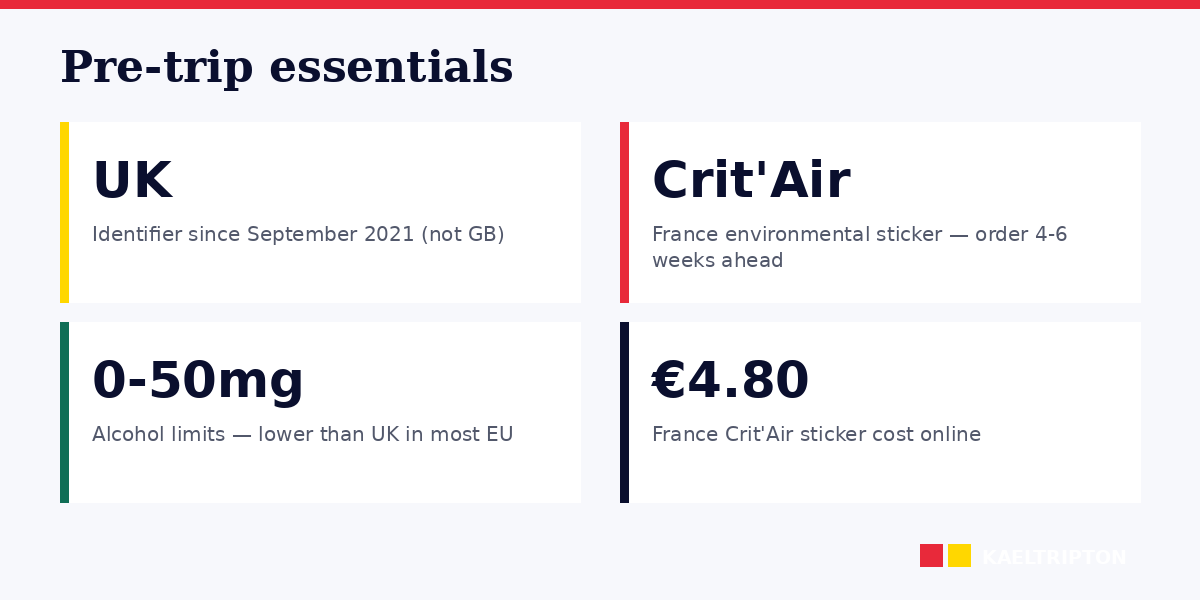
Since 28 September 2021, UK cars need a 'UK' identifier in Europe — not 'GB'. Check your number plate or buy a £2-5 sticker. Headlight beam deflectors on right-hand-drive UK cars are mandatory when driving in right-hand-traffic continental Europe. Most modern cars have a switch. Country-specific mandatory equipment (warning triangles, high-vis jackets, first aid kits) varies — a universal kit covers most destinations for £25-50. France Crit'Air and Germany Umweltplakette environmental stickers needed for many cities — order 4-6 weeks before travel. |
Documents to carry (all of these)
- Passport — valid for at least 3 months beyond your intended departure from Schengen, in good physical condition
- UK photocard driving licence (both parts 1 and 2 if you have old paper variant)
- V5C registration certificate — showing current registered keeper details
- Current insurance certificate — the single-page certificate, not the full policy document
- VE103 Vehicle on Hire form if driving a company car, lease car, or finance car
- Green card (insurance green card) — only if heading to non-EU European countries (Albania, Moldova, Ukraine, etc.)
- International Driving Permit (IDP) — only if going to specific non-EU European countries that require one
- Breakdown cover documents — European breakdown policy certificate and emergency contact numbers
- EHIC or GHIC card — for reciprocal healthcare in EEA countries
- Travel insurance — covering medical, cancellation, lost baggage
Keep physical originals in a waterproof folder in the vehicle. Store digital copies on your phone as backup. Some countries accept digital versions; others require originals.
Vehicle preparation
UK identifier sticker
Since 28 September 2021, UK-registered cars driving in Europe must display a "UK" identifier — NOT "GB". This change was part of the UK's decoupling from the old GB-EU road traffic arrangements. Options:
- UK number plate with UK identifier: number plates showing "UK" in the blue flag-style box are compliant — no separate sticker needed
- Separate UK sticker: required if your number plate shows the old Euro symbol with GB, or has no flag identifier
- Both: acceptable, not required
Old GB stickers on modern UK-registered cars can incur fines in some EU countries (typically €30-€100). Cheap UK stickers are available from petrol stations and motor factors for £2-£5.
Headlight beam deflectors
UK right-hand-drive cars have headlights designed to illuminate the nearside kerb (left side) for left-hand traffic. In continental Europe (right-hand traffic), this aim directly dazzles oncoming drivers.
- Cars with manual headlight adjusters: most modern cars have a "for driving on the right" setting — engage via dashboard switch or within the headlight unit
- Older cars without manual adjustment: use stick-on beam deflector kits — £5-£15 at Halfords, petrol stations, motor factors
- Xenon or LED headlights: check your manual. Some require dealer adjustment; others self-adjust via sensors
Driving with improperly aimed headlights at night in the EU is an offence in most countries. Fines typically €50-€150.
Tyres and spare
- Winter tyres required in some Scandinavian and Alpine countries during winter (typically 1 November to 15 April). Check destination-specific rules.
- Tyre tread — below the 1.6mm UK minimum is illegal in UK and most EU countries
- Spare or puncture repair kit — most continental European countries require one, enforced at roadside checks
- Snow chains — mandatory in some Alpine regions during winter declarations
Country-specific mandatory equipment
Different countries require different equipment. Carrying the full UK/EU kit from the start covers most destinations:
Standard EU kit (commonly required)
- Warning triangle: for breakdowns or accidents
- High-visibility jacket: for driver (and sometimes all passengers)
- First aid kit: required in several countries
- Fire extinguisher: required in some
- Breathalyser: required in France (law not enforced since 2020 but kit still recommended)
Country-specific highlights
- France: reflective jackets for driver and all passengers, warning triangle, breathalyser (recommended). Crit'Air environmental sticker in many cities.
- Germany: warning triangle, first aid kit, warning vest. Umweltplakette (environmental zone sticker) required for many cities.
- Spain: two warning triangles (one for each end of the car), warning vest, spare tyre, spare set of bulbs
- Italy: warning triangle, high-visibility jacket
- Portugal: warning triangle, high-visibility jacket
- Austria: first aid kit, warning triangle, warning vest. Vignette (motorway sticker) required.
- Switzerland: vignette (motorway sticker) required, warning triangle, warning vest
- Netherlands: warning triangle
- Belgium: warning triangle, warning vest, first aid kit
Kit bundles sold at Halfords, Eurotunnel, and major motor factors typically include all items for £25-£50. Specific country packs are more expensive but targeted.
Environmental zones and low-emission stickers
Many European cities now operate low-emission zones requiring environmental stickers:
- France Crit'Air: required in Paris, Lyon, Strasbourg, Lille, Toulouse and other cities. €4.80 online at certificat-air.gouv.fr. Takes 4-6 weeks to arrive — order well before travel.
- Germany Umweltplakette: required in Berlin, Munich, Hamburg, Frankfurt, Köln, Stuttgart, and 50+ cities. Cost varies, from local TÜV stations €6-€10.
- Austria: various regional environmental stickers
- Spain: limited city-specific schemes (Madrid ZBE)
- Portugal: Lisbon low-emission zone
- Belgium: Brussels, Antwerp, Ghent low-emission zones
Without the sticker, fines for entering the zone can be €90-€180. Some schemes flag number plates automatically — you can't slip through unnoticed.
EES biometric registration
The EU Entry/Exit System has been in phased operation since 12 October 2025 and fully operational across Schengen external borders since 10 April 2026. All UK travellers entering Schengen now register biometric data (facial scan, fingerprints) at the border.
Preparation:
- Allow 30-60 extra minutes for first-time registration at the border (Eurotunnel, Dover, airports)
- Download "Travel to Europe" app (Frontex) for optional pre-registration of passport details within 72 hours of travel — still requires biometrics at the border
- Bring passports for all passengers, including children (under 12 don't need fingerprints but do get facial scan)
- Subsequent crossings within 3 years are much faster — biometric match takes seconds
See the dedicated EES article for complete details.
Driving rules and limits to know
Alcohol limits (vary significantly)
- UK: 80mg/100ml blood (England, Wales, NI); 50mg in Scotland
- France: 50mg
- Germany: 50mg (0mg for new drivers under 21 or with less than 2 years licence)
- Spain, Italy, Portugal: 50mg
- Hungary, Romania, Czech Republic: 0mg (zero tolerance)
- Norway, Sweden: 20mg (effectively zero)
A single UK pint of beer can easily put you over 50mg — don't drive after drinking in most EU countries.
Speed limits by country (approximate)
- France: 130 km/h motorway dry, 110 km/h motorway rain, 80 km/h secondary rural
- Germany: motorway unrestricted in most sections (recommended 130 km/h), rural 100 km/h, urban 50 km/h
- Spain, Italy: 120-130 km/h motorways, 90-100 km/h rural
- Austria: 130 km/h motorway, 100 km/h rural, 50 km/h urban
- Switzerland: 120 km/h motorway, 80 km/h rural, 50 km/h urban
Convert mph to km/h in your head or use the car's dial setting: 80 km/h = 50 mph, 100 km/h = 62 mph, 130 km/h = 81 mph.
A real 2026 scenario: pre-trip checklist completed
A 47-year-old from Leeds driving his family's 2022 Ford S-MAX on a 16-day trip through France, Switzerland, and Northern Italy.
4 weeks before: applies for France Crit'Air (€4.80). Ordered Swiss vignette online (€40 for the year — required for motorway driving). Buys RAC European breakdown cover 14-day policy (£58).
2 weeks before: calls insurer (Direct Line) to confirm 90-day comprehensive EU cover included. Receives written confirmation. Stickers: applies UK identifier sticker to rear of car. Fits headlight beam deflectors.
1 week before: packs documents folder — passports for all 4, V5C, insurance certificate, breakdown cover papers, VE103 (not needed, car owned outright), IDP (not needed for EU).
3 days before: buys mandatory kit: warning triangle, two reflective jackets (one per adult driver + spare), first aid kit, puncture repair kit. Total £38 from Halfords.
Travel day: arrives Folkestone Eurotunnel 90 minutes before departure. EES registration for all 4 family members takes 24 minutes total. Crosses to France. Crit'Air and Swiss vignette displayed. Drives to Alps via France.
Incident-free trip. On return, EES match at the French Eurotunnel terminal takes 4 minutes per person. Home safely with no fines, no accidents, no breakdowns.
Frequently asked questions
Do I still need a GB sticker on my car?
No — since 28 September 2021, UK-registered cars need a "UK" identifier, not "GB". Modern number plates with the blue UK flag symbol are compliant without a separate sticker. Older plates or vehicles without the UK flag need a UK sticker. GB stickers on UK cars can attract fines in some EU countries.
Do I need a green card for EU driving?
Generally no for EU/EEA countries, confirmed by the European Commission in August 2021. Your UK insurance certificate is accepted as evidence of third-party cover. Green card still required for non-EU European countries (Albania, Moldova, Ukraine, etc.).
What's the most important thing to prepare?
Three things: confirm your UK insurance provides comprehensive (not third-party only) EU cover; purchase European breakdown cover; allow 30-60 extra minutes for EES biometric registration at the border. Everything else is finesse; these three are essential.
How long does EES registration take?
5-10 minutes per person for first-time registration (biometrics plus entry questions). Subsequent crossings within 3 years take seconds via biometric match. Budget 30-60 extra minutes at Eurotunnel, Dover, or airports on your first crossing post-12 October 2025.
Do I need an IDP for EU driving?
No for EU and EEA countries. Yes for certain non-EU European countries (Albania, Moldova, Ukraine). £5.50 at Post Office branches offering the service. UK photocard driving licence is accepted across the EU.
Can I drive a hire car across EU borders?
Most EU rental companies allow you to drive across EU borders within their standard cover. Cross-border to non-EU countries (Switzerland, Serbia) typically requires additional permission from the rental company — some charge a border-crossing fee. Check with the rental company before travel.
What about breakdown cover — do I really need it?
Strongly recommended. Without it, a breakdown in rural France could cost £500-£2,000 in emergency recovery, local repairs, and accommodation. Repatriation of the vehicle to the UK if it can't be fixed abroad can exceed £3,000. European breakdown cover is £45-£70 for 14 days — cheap insurance.
Sources
- GOV.UK, Driving in the EU after Brexit — gov.uk/drivers
- European Commission, Entry/Exit System (EES)
- Individual country tourism and driving authorities (France Crit'Air, Austria ASFINAG, Switzerland Admin.ch)
- Motor Insurers' Bureau (MIB), UK-EU Motor Insurance Agreement
- GOV.UK, Using UK-registered vehicles abroad
- AA and RAC — European driving guidance and equipment requirements
- Foreign and Commonwealth Office — travel advice pages for individual countries


