

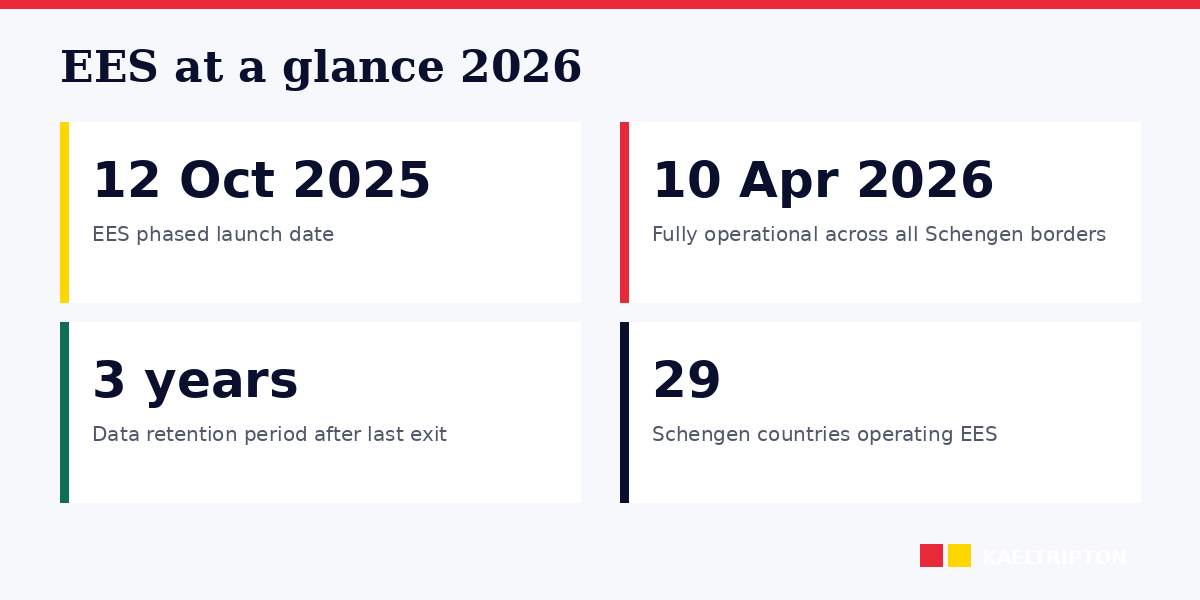
The EU Entry/Exit System (EES) began its phased rollout on 12 October 2025 and became fully operational across all 29 participating Schengen countries on 10 April 2026. Under EES, UK drivers (and other non-EU travellers) entering Schengen have their biometric data captured — facial image plus fingerprints — which replaces the manual passport stamp system. The system tracks the 90-day-in-180 short-stay limit automatically. Your first EES registration happens at the border — no pre-registration needed. Data is stored for 3 years, so subsequent trips within that window just require a quick biometric match rather than full re-registration. This guide covers what UK drivers specifically experience: Eurotunnel, Port of Dover, ferry crossings, airport arrivals, and the coming ETIAS authorisation due late 2026.
| ★ EDITOR'S VERDICT EES adds 30-60 minutes to your first EU border crossing. Subsequent crossings are faster. |
EES went live on 12 October 2025 and reached fully-operational status across all Schengen external borders on 10 April 2026. First-time registration captures your biometrics — 5-10 minutes per person. Data stored 3 years, so subsequent trips just need a quick match. Eurotunnel and Dover now process UK drivers through EES before they depart the UK. ETIAS (separate scheme, €20 online authorisation) expected late 2026, mandatory from 2027. No pre-registration needed for EES — it happens at the border. |
The timeline: from October 2025 launch to full operation
- 12 October 2025: EES phased rollout began. Some major airports (Madrid, select German airports) started live operations. Eurostar began registering business/premium class passengers.
- 9 January 2026: participating countries' registration threshold increased from 10% to 35% of third-country arrivals.
- April 2026: Full operational status declared across all participating external borders. All 29 Schengen countries must process non-EU travellers through EES with biometrics.
- Late 2026: ETIAS (separate scheme) expected to launch with a 6-month grace period, mandatory from 2027.
Despite the April 2026 "fully operational" milestone, implementation remains uneven. France in particular has been slower than other countries — at some French crossings, authorities continue manual stamping alongside partial EES registration. The practical experience for UK drivers in 2026 is a mixed system that varies by route and country.
Which 29 countries operate EES
EES applies at the external borders of:
- All 27 EU member states except Ireland and Cyprus
- Plus the four non-EU Schengen associates: Iceland, Liechtenstein, Norway, Switzerland
Ireland is exempt because of the Common Travel Area with the UK. Cyprus operates its own national entry system.
Practical note for UK drivers: if you're driving through the UK-Ireland land border, no EES applies. If you're driving through any Schengen external border (Eurotunnel, Port of Dover ferries to France/Netherlands/Belgium, flight to Schengen airport), EES applies.
What UK drivers actually do at the border
First-time registration
The first time you cross a Schengen external border after 12 October 2025, you register in EES:
- Approach the automated kiosk or border officer
- Scan your passport
- Present for facial photograph (eyes open, no glasses, neutral expression)
- Provide fingerprints (typically 4 fingers at once, both hands)
- Answer entry condition questions (purpose of visit, length of stay, accommodation, financial means)
- Border officer reviews the captured data and admits you
Typical time: 5-10 minutes per person for full registration. Longer for vehicles crossing at Eurotunnel or ferry terminals where passengers stay in the vehicle.
Subsequent crossings within 3 years
Once registered, future crossings within 3 years are faster:
- Present passport at the kiosk
- Biometric match (fingerprint or face, often face-only at newer kiosks)
- Automatic matching against stored data
- Admission within 60 seconds in smoother cases
This is why EES is expected to reduce average border wait times over the medium term — after initial registration, subsequent entries are faster than manual stamping.
Eurotunnel and Port of Dover — the UK-specific challenge
Unusually for EU border infrastructure, French border checks are conducted on UK soil at Eurotunnel Folkestone and Port of Dover under the UK-France juxtaposed controls treaty. This means EES registration happens before you depart the UK — French border officers operate EES kiosks at Folkestone terminal and Dover port.
Practical consequences:
- Vehicle crossings are complex: all passengers in a vehicle must register biometrics. In busy periods, this creates bottlenecks as families of 4-5 take 20-25 minutes to complete first-time registration before proceeding.
- Eurotunnel planning capacity: 700 vehicles per hour through EES lanes, covering approximately 2,000 passengers. Designed to cope with peak summer traffic but tight during high-volume days.
- Port of Dover: passenger registration typically at vehicle level. Ferry operators have expressed concerns about summer 2026 capacity.
The phased rollout in UK-based terminals has been cautious. Eurotunnel began EES for business/premium Eurostar passengers in October 2025 and extended gradually through early 2026. By mid-2026 most tourist vehicle traffic is EES-processed on departure.
Preparation for UK drivers crossing via Eurotunnel or Dover
- Allow 30-60 extra minutes at check-in on your first EES crossing
- Bring passports for all passengers (including children — babies and children under 12 don't provide fingerprints but still get facial scan)
- Have accommodation details ready (hotel name, address, booking reference)
- Have return ticket or onward travel evidence
- Ensure financial means evidence (recent bank statement, credit card) available
- Download the "Travel to Europe" app (Frontex) for pre-registration of passport details up to 72 hours before travel — currently voluntary and not all countries support full functionality
Who is exempt from EES
Not everyone needs EES registration:
- EU, Schengen Area, or associated country citizens — not subject to EES
- Irish citizens — exempt due to Common Travel Area
- UK passport holders with EU residency rights under the Withdrawal Agreement — exempt if lawfully resident in an EU country since before 31 December 2020
- Long-stay visa holders — those with Schengen national long-stay visas or residence permits
- Dual EU/UK citizens — travel on the EU passport to bypass EES
- Cruise passengers whose trip starts and ends outside Schengen — e.g., a UK-departing cruise stopping at Mediterranean ports doesn't trigger EES for shore excursions
If you hold settled status or pre-settled status in a Schengen EU country, bring your residence card or digital status proof (share code for UK-issued status) to avoid being routed through EES lines.
Data retention and privacy
EES stores your data for 3 years from your last exit from the Schengen area. After 3 years without re-entry, the data is deleted automatically. This is a specific legal retention limit under EU GDPR and the EES Regulation (EU 2017/2226).
Information stored:
- Name
- Passport number and type
- Biometric data (facial image and fingerprints)
- Dates and places of entry and exit
- Refusals of entry (if applicable)
Not stored: your movements within Schengen (the system tracks entry and exit, not where you travel between the two), financial data beyond what you verbally declare, or personal communications.
Your rights under GDPR: you can request access to your EES data, ask for correction of errors, and (after the 3-year period) ensure deletion. Contact the national data protection authority in any Schengen country or the European Data Protection Supervisor.
ETIAS: coming in late 2026
EES is one of two major EU border system changes. The second — ETIAS (European Travel Information and Authorisation System) — is separate and complementary. ETIAS is expected to launch in late 2026 with a 6-month grace period, mandatory from 2027.
Key differences:
- EES: happens at the border, no advance action required, tracks your entries and exits
- ETIAS: happens before you travel, costs €20 online, valid for 3 years, required for each trip
Once ETIAS is live, UK travellers to Schengen will need to apply for ETIAS online before departure (passport-linked, €20 fee, 3-year validity). That ETIAS gives you the right to travel — EES then registers your movement at the border. Both are required.
Don't apply for ETIAS yet — the official system isn't accepting applications as of April 2026. Any website claiming to sell ETIAS is fraudulent.
A real 2026 scenario: family driving Eurotunnel holiday
A family of four from Bristol drives to France for a 7-day summer holiday, crossing at Folkestone Eurotunnel in July 2026.
Before travel: all four passports valid for 6+ months beyond return. Booked Eurotunnel crossing. Downloaded the Travel to Europe app and pre-registered passport details 48 hours before travel (voluntary but speeds up the process).
Arrive at Folkestone Terminal: checks in 2 hours before departure (recommended for first EES crossing). Approaches French border pre-check area after UK exit controls.
EES first-time registration: all four family members approach kiosks. Parents complete facial scan and fingerprints. Children (ages 9 and 14) complete facial scan; 14-year-old also gives fingerprints; 9-year-old exempt from fingerprinting. Questions about holiday duration, accommodation in Dordogne, return plans. Total time: 22 minutes.
Subsequent phases: pass through French border booth. Passports scanned again, biometric match confirmed. Admitted. Proceed to Eurotunnel shuttle.
Return journey: crossing back from France to UK. EES exit biometric match. Automatic confirmation of time spent in Schengen. Future returns within 3 years will be much faster — no re-registration needed.
Lesson learned: the family wouldn't have made it without the 2-hour buffer. For summer 2026 peak week crossings, this buffer is essential.
Frequently asked questions
Is EES really live now?
Yes. EES went live with phased operations on 12 October 2025 and reached "fully operational" status on 10 April 2026. However, implementation is uneven — some French borders are still partly manual, and some regional airports haven't achieved full processing yet. By mid-to-late 2026 the system is expected to be uniform.
Do I need to do anything before my first EES crossing?
No pre-registration required. Your first registration happens at the border when you arrive. Just ensure your passport is valid (at least 3 months beyond your intended departure from Schengen), in good physical condition, and chip readable by scanners.
How long does first EES registration take?
Typically 5-10 minutes per person for full biometric capture and entry questions. For a family of 4, budget 20-30 minutes. During peak hours at busy terminals (Eurotunnel, Dover on Saturday mornings in August), wait times stack up — arrive 60-90 minutes before your intended crossing.
Does EES apply to cruise passengers?
Generally no if the cruise starts and ends outside Schengen. Shore excursions at Schengen ports typically don't trigger EES individual registration. Detailed rules vary by cruise operator and itinerary — check with your cruise line.
What's the difference between EES and ETIAS?
EES happens at the border (biometric registration when you arrive). ETIAS happens before travel (online authorisation, €20 fee, 3-year validity). EES launched October 2025; ETIAS is expected late 2026 with a 6-month grace period. From 2027, most UK travellers to Schengen will need both.
Can I opt out of EES?
No, not if you're a UK citizen entering Schengen. EES applies to all non-EU short-stay travellers. Refusal to provide biometric data results in refusal of entry. The system is a mandatory part of Schengen external border procedures.
Will I be fingerprinted every trip?
No. Your fingerprints are taken at first registration only. Subsequent entries within 3 years use biometric match — usually facial scan at modern kiosks, occasionally a fingerprint check if the face match is unclear. Data expires 3 years after your last exit; a trip after that window requires fresh registration.
Sources
- European Commission, Entry/Exit System (EES) — home-affairs.ec.europa.eu/policies/schengen/smart-borders/entry-exit-system
- Regulation (EU) 2017/2226 — establishing the Entry/Exit System
- GOV.UK, Foreign travel and the EU Entry/Exit System
- House of Commons Library, The EU Entry/Exit system and EU travel authorisation system
- ABTA, Upcoming changes for travel to Europe
- Eurotunnel, EES operational phases — eurotunnel.com
- Frontex, Travel to Europe app
- eu-LISA, EES System and Operations


