

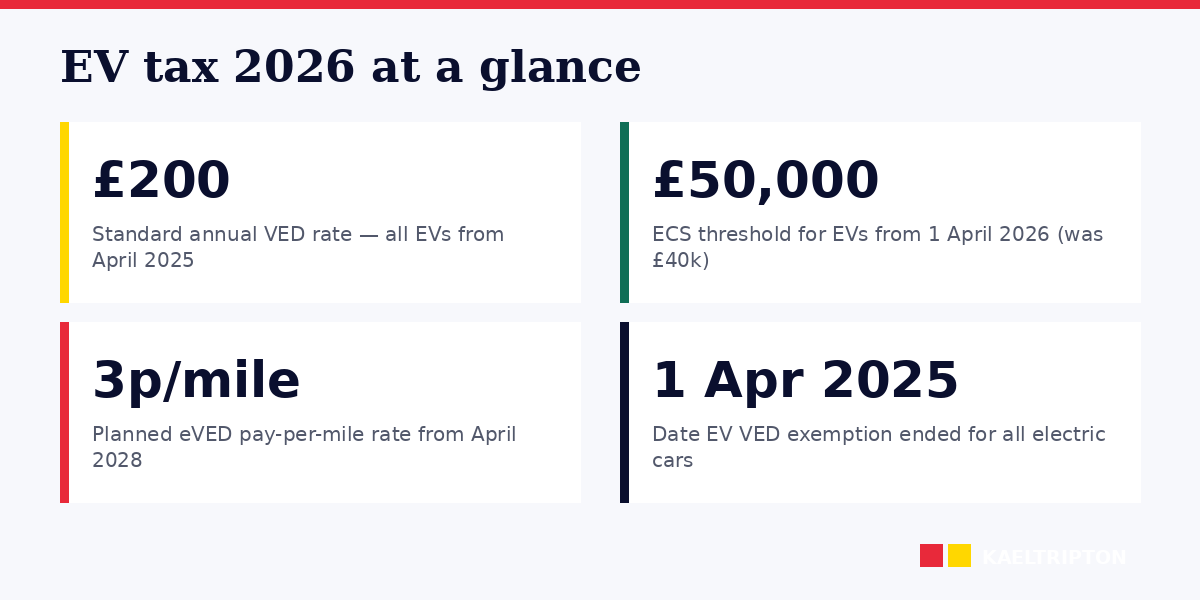
Electric cars no longer escape UK road tax. The exemption that fully excused EVs from Vehicle Excise Duty ended on 1 April 2025, and 2026 is the first full financial year all modern EVs pay VED on the same basis as petrol and diesel cars. The headline 2026-27 rates for new electric cars: £10 first-year showroom tax, then £200 standard rate from year two. The Expensive Car Supplement (£440/year for years 2-6) kicks in for EVs over £50,000, a threshold raised from £40,000 on 1 April 2026 and backdated to EVs registered since April 2025. A new pay-per-mile Electric Vehicle Excise Duty (eVED) is planned for April 2028. This guide covers exactly what EV owners pay in 2026 and what's changing.
| ★ EDITOR'S VERDICT The free lunch ended. Every EV now pays VED. |
From 1 April 2025, all electric cars in the UK pay Vehicle Excise Duty - no grandfathering. Existing and new EVs both pay £200/year standard rate. First-year showroom tax for new EVs is £10 (the lowest band). Expensive Car Supplement threshold raised from £40,000 to £50,000 for EVs from 1 April 2026 - a win for mid-range buyers. Cars over £50k list still pay £440/year for 5 years. Pay-per-mile eVED planned from April 2028: 3p/mile EV, 1.5p/mile PHEV on top of standard VED. |
The exemption that ended on 1 April 2025
Before April 2025, fully electric cars paid £0 VED. The policy was introduced in the 2010s to incentivise EV adoption during the industry's early years, with the assumption that exempt tax status would last until the market matured. By 2024, EVs accounted for roughly 20% of new car registrations - a clear sign the market was mature enough for the exemption to end.
The Conservative government announced the end of the exemption in the Autumn Statement 2022. The Labour government confirmed the policy in the Autumn Budget 2024. The Finance Act 2023 (sections 10-11) gave it legal effect. The change took effect on 1 April 2025, and the 2026-27 tax year is the first in which every EV registered in the UK pays some level of VED.
Critically, the change applies to existing EVs too - not just new ones. An EV registered in 2019 that had been paying £0/year now pays the standard rate of £200/year from April 2025 onwards. There is no grandfathering exemption for previously-registered electric vehicles.
What EV owners pay in 2026-27
The rate depends on when the EV was first registered:
EVs first registered from 1 April 2017 to 31 March 2025
Previously fully exempt. From 1 April 2025, they pay the standard £200/year rate (2026-27 figure). No first-year showroom tax applies retrospectively. If the EV's list price was over £40,000 and it's within years 2-6 of registration, the Expensive Car Supplement was initially charged at £425/year, but the April 2026 threshold change may remove that - see below.
EVs first registered from 1 April 2025 onwards
- First-year showroom tax: £10 (the lowest first-year rate in the VED system)
- Standard rate from year two: £200/year for 2026-27
- Expensive Car Supplement: £440/year for years 2-6 if list price over £50,000 (changed from £40,000 on 1 April 2026)
EVs first registered before 1 April 2017
Older electric cars (the pioneers - original Nissan Leaf, Tesla Roadster, early Renault Zoe) fall under the older CO2-band system. Most qualify for Band A at £20/year in 2026-27 given zero emissions. A handful registered during the 2001-2017 period may have more complex classifications that need checking via the DVLA vehicle enquiry service.
The Expensive Car Supplement shift: April 2026 threshold change
The ECS is the biggest issue for EV owners. It's a £440/year supplement (2026-27 figure, up from £425) paid for five years - years 2 through 6 of ownership. It applies to cars over a list-price threshold.
For petrol, diesel and hybrid cars: threshold stays at £40,000 (unchanged).
For zero-emission cars: threshold rose from £40,000 to £50,000 on 1 April 2026. This was a last-minute concession confirmed in the Autumn Budget 2025 and retrospectively applied to EVs first registered from 1 April 2025 onwards.
The practical effect for mid-range EVs (£40,000-£50,000 list price):
- Before April 2026: pay £440 ECS every year for 5 years = £2,200 extra total
- From April 2026: pay £0 ECS (below threshold) = £2,200 saved
Cars affected by this beneficial change include the Kia EV6 (base models), Hyundai Ioniq 5 (mid-trim), Ford Mustang Mach-E (standard variants), Volkswagen ID.4 (mid-spec), and Tesla Model 3 (base). If you own one of these and paid ECS in 2025-26, DVLA automatically applies the updated threshold when you next tax the vehicle - no reapplication needed.
Higher-priced EVs - Tesla Model S, BMW i5/i7, Mercedes EQS, Audi e-tron GT, Porsche Taycan - remain over the £50,000 threshold and continue to pay ECS at £440/year from April 2026.
What about plug-in hybrids?
Plug-in hybrid electric vehicles (PHEVs) follow the standard ICE tax regime based on their CO2 emissions. Most modern PHEVs have CO2 ratings of 20-60 g/km, placing them in the low first-year bands (£130-£270). The standard rate from year two is £200/year.
PHEVs face the £40,000 Expensive Car Supplement threshold (not the £50,000 EV threshold). A PHEV over £40,000 pays the £440 supplement for 5 years. This makes the total cost of ownership on premium PHEVs less favourable than fully electric alternatives from April 2026 onwards.
The proposed eVED pay-per-mile tax (April 2028) will also apply to PHEVs at half the EV rate - 1.5p/mile versus 3p/mile for fully electric cars.
Electric Vehicle Excise Duty (eVED): the 2028 change
The Autumn Budget 2025 announced a new pay-per-mile tax specifically for electric and plug-in hybrid cars, planned for April 2028. The consultation closed in March 2026 and legislation is expected in a future Finance Bill. Current proposal:
- Electric vehicles: 3p per mile paid on top of standard VED
- Plug-in hybrids: 1.5p per mile paid on top of standard VED
- Structure: annual estimate paid in advance, reconciled at year-end based on actual mileage
- No tracking devices required; mileage self-declared with verification through MOT records
- Rate set at roughly half the equivalent fuel duty on average petrol/diesel cars - designed to replace lost fuel duty revenue as the EV fleet grows
For the average EV driver covering 8,000 miles/year, this adds approximately £240 annually on top of £200 standard VED = £440/year total. For high-mileage EV drivers (15,000+ miles), the combined tax could exceed £650/year. Plug-in hybrid drivers at 8,000 miles would pay approximately £120 eVED + existing VED.
The scheme is not yet law. Rates and structure could change before April 2028 implementation. But EV buyers making long-term ownership decisions should factor it in.
The broader context: why the change happened
Three reasons explain why EVs lost the tax exemption:
1. EVs are no longer niche. With 20% of new registrations being EVs, the "let's subsidise adoption" rationale has expired. The market is established.
2. Lost fuel duty revenue. Petrol and diesel motorists pay approximately 52.95p/litre in fuel duty plus VAT. A driver covering 10,000 miles in a 40 mpg car generates around £600/year in fuel duty revenue for HMT. An EV driver covering the same 10,000 miles generates £0 in fuel duty. As the fleet electrifies, the Treasury loses billions annually.
3. Road maintenance burden is equal. EVs cause road wear at similar rates to ICE vehicles. The "user pays" principle for road infrastructure argues for equivalent taxation regardless of powertrain.
eVED (the 2028 pay-per-mile scheme) is explicitly designed to replace lost fuel duty revenue with equivalent road-use pricing for the EV fleet.
A real 2026 scenario: three EV owners compared
Driver A - 2019 Nissan Leaf (40kWh) bought used for £12,000: registered June 2019. Was exempt until April 2025. Now pays £200/year standard VED. No ECS (original list price below £40k). No first-year tax (registered long before the 2025 change). Annual cost: £200.
Driver B - 2025 Kia EV6 GT-Line (£48,000 list): registered September 2025. First-year tax was £10 at registration. In 2026-27 pays £200 standard rate. ECS initially applied at £425/year under the £40,000 threshold in 2025-26; from April 2026 the new £50,000 threshold removes ECS because the Kia's £48,000 list falls below. DVLA refunds the 2025-26 ECS portion automatically. Annual cost from 2026: £200.
Driver C - 2025 Mercedes EQE 350 (£78,000 list): registered October 2025. First-year tax was £10. Standard rate £200. ECS £440/year for years 2-6 (well over the £50,000 threshold). Annual cost years 2-6: £640. Plus potential eVED from 2028 - at 12,000 miles/year, an additional £360 = £1,000/year total by 2028.
The mid-range EV buyer (Driver B) is the clear winner of the April 2026 threshold change.
Frequently asked questions
Did all electric cars lose their tax exemption in 2025?
Yes. From 1 April 2025, every fully electric car in the UK pays VED, whether newly registered or registered years ago. No grandfathering exemption applies. The change was announced in Autumn Statement 2022 and confirmed by the Finance Act 2023.
Why does the Expensive Car Supplement threshold differ for EVs?
The Autumn Budget 2025 raised the ECS threshold for zero-emission cars from £40,000 to £50,000 from 1 April 2026 specifically to keep mid-range EVs tax-competitive. The £40,000 threshold for petrol and diesel remained unchanged. Policy rationale: support ongoing EV adoption while still capturing the luxury end of the market.
Will my 2024 EV lose its zero tax status?
Yes, from April 2025 onwards. Any EV registered before 1 April 2025 was previously exempt but now pays the standard £200/year rate. The exemption loss is not dependent on when you bought the car - it's effective from 1 April 2025 for all existing EVs.
What's the eVED pay-per-mile rate again?
3p/mile for fully electric cars, 1.5p/mile for plug-in hybrids. Expected to start April 2028. For an average EV driver covering 8,000 miles/year, this adds approximately £240/year to the existing VED bill. Final rate and implementation details are subject to consultation conclusions and future Finance Bill legislation.
Does eVED require tracking devices in the car?
No. The current proposal explicitly preserves driver privacy - no GPS trackers, no reporting of where or when miles are driven. Mileage is self-declared with verification via MOT odometer records. The system uses annual estimates reconciled at year-end.
Can I avoid paying VED by charging my EV at home on renewable energy?
No. VED is a vehicle tax, not a fuel tax. It applies regardless of where or how the car is charged, or whether the electricity came from renewable sources. The only VED exemptions are for historic vehicles (over 40 years old), disabled tax class vehicles, and vehicles declared SORN for off-road use.
If I buy an EV just under £50,000, does ECS ever apply?
Not from April 2026. Zero-emission cars with a list price of £50,000 or below are not subject to ECS. The threshold applies to the original published list price - not the actual purchase price paid or any discount you negotiated. Always confirm the list price on the manufacturer's official brochure or dealer's documentation before relying on ECS exemption.
Sources
- HM Treasury, Autumn Budget 2025 - VED and eVED policy
- House of Commons Library, Vehicle excise duty and zero emission vehicles (CBP-9690)
- Finance Act 2023, sections 10-11 (ending VED exemption for zero-emission vehicles)
- GOV.UK, Vehicle tax rates 2026-27 - gov.uk/vehicle-tax-rate-tables
- DVLA, V149 leaflet - rates of vehicle tax 2026-27
- HM Treasury, Consultation on Electric Vehicle Excise Duty (eVED) - March 2026
- Vehicle Excise and Registration Act 1994 (as amended)


