

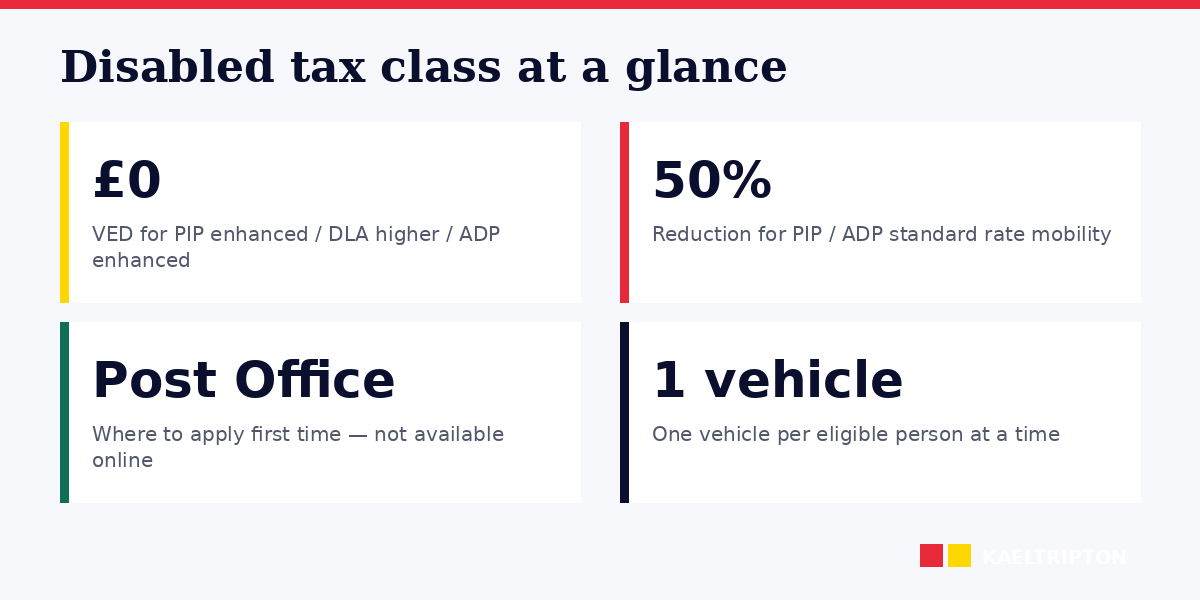
Drivers receiving certain disability benefits pay £0 Vehicle Excise Duty (VED) under the disabled tax class (tax class 85). The main qualifying benefits: enhanced rate mobility component of Personal Independence Payment (PIP), higher rate mobility component of Disability Living Allowance (DLA), enhanced rate mobility component of Adult Disability Payment (ADP, Scotland), or higher rate mobility of Child Disability Payment or Scottish Adult DLA. A 50% reduction is available on PIP standard rate mobility or ADP standard rate. Apply at a Post Office for the first-time claim using form V10, your Certificate of Entitlement from DWP, V5C, and valid MOT. One vehicle per eligible person. The vehicle must be used only for the disabled person's needs - nominated drivers cannot use it for personal errands. This guide covers the full 2026 process.
| ★ EDITOR'S VERDICT Enhanced mobility PIP, DLA higher, ADP enhanced all give £0 VED. Standard rate gets 50%. |
The disabled tax class (class 85) gives free VED to drivers receiving PIP enhanced mobility, DLA higher rate mobility, ADP enhanced rate mobility, or equivalent Scottish benefits. PIP standard rate and ADP standard rate mobility give a 50% reduction. First-time applications must be made at a Post Office with the Certificate of Entitlement, V5C, and MOT. Renewals can be done online once the tax class is established. One vehicle per eligible person. Nominated drivers can drive for the disabled person's needs only - not for their own personal errands. Misuse can trigger backdated VED charges. |
Who qualifies for free (100%) vehicle tax
Full VED exemption under tax class 85 for drivers receiving any of:
- Enhanced Rate mobility component of Personal Independence Payment (PIP) - the most common qualifying benefit in England, Wales and Northern Ireland
- Higher Rate mobility component of Disability Living Allowance (DLA) - legacy benefit being phased out as claimants are reassessed onto PIP
- Enhanced Rate mobility component of Adult Disability Payment (ADP) - Scottish equivalent of PIP
- Higher Rate mobility component of Child Disability Payment (CDP) - Scottish benefit for children
- Higher Rate mobility component of Scottish Adult DLA (SADLA)
- Armed Forces Independence Payment (AFIP)
- War Pensioner's Mobility Supplement (WPMS)
All give 100% VED exemption. You can only claim the exemption on one vehicle at any time - the vehicle must be registered in the disabled person's name or a nominated driver's name.
Who qualifies for 50% reduction
Half-price VED under a separate tax class for drivers receiving:
- Standard Rate mobility component of Personal Independence Payment (PIP)
- Standard Rate mobility component of Adult Disability Payment (ADP)
You cannot combine this reduction with other benefits. If you also receive DLA (higher rate) or AFIP or WPMS, the 100% exemption takes precedence - the 50% reduction doesn't apply if any 100% pathway is available.
Importantly: Lower Rate mobility component of DLA does not qualify for any VED reduction or exemption. Only Higher Rate.
Vehicle eligibility rules
The vehicle you're claiming for must meet specific conditions:
- Registered in the disabled person's name OR the nominated driver's name (a person who drives on behalf of the disabled person)
- Used only for the disabled person's personal needs - nominated drivers cannot use the vehicle for their own errands, shopping, or leisure
- Only one vehicle can carry the exemption/reduction at any time - if you change vehicles, you transfer the claim
- Valid MOT (or exempt by age/class)
- Valid insurance (required by law regardless of tax status)
The "personal needs" test is strict. A nominated driver can drive the disabled person to appointments, shops, or family visits. The nominated driver using the car to commute to their own job, collect their own children from school, or go out socially without the disabled person - all breach the rules. DVLA investigates reported breaches; misuse can result in the exemption being withdrawn and backdated VED charges issued.
First-time application process
If you've never claimed the disabled tax class before on a vehicle, you must apply at a Post Office that offers vehicle tax services. The online service doesn't handle first-time applications for this tax class.
Documents required for first-time 100% exemption
- Certificate of Entitlement from DWP (PIP/DLA) or Social Security Scotland (ADP/CDP/SADLA) showing the qualifying mobility component and date range. Write the vehicle registration number in the top right corner.
- V5C registration certificate or V5C/2 green slip if recently purchased
- Current MOT certificate (electronic copy accepted) or GVT certificate if applicable. MOT must be valid on the date the tax starts.
- Insurance certificate or cover note if you live in Northern Ireland (not required in Great Britain)
For first-time 50% reduction claims:
- Same documents as above
- Plus completed V10 form (vehicle tax application)
- Plus cheque or payable order for 50% of the full VED rate, made out to "DVLA, Swansea"
Don't send medical information or PIP assessment documents - only the Certificate of Entitlement. Medical assessments are not relevant to the tax class determination.
How to get a Certificate of Entitlement
The Certificate of Entitlement is a specific document DWP or Social Security Scotland sends - not the same as your PIP/DLA award letter. If you don't have one:
- PIP: contact PIP helpline 0800 121 4433 and request the Certificate of Entitlement
- DLA: contact DLA helpline 0800 121 4600
- ADP (Scotland): contact Social Security Scotland 0800 182 2222
- CDP (Scotland): same number
- AFIP: contact Veterans UK 0808 1914 218
- WPMS: contact Veterans UK 0808 1914 218
The certificate arrives within 2-3 weeks. It shows your qualifying benefit rate, the date range, and a unique serial number. Keep the serial number safe - future renewals reference it rather than requiring a fresh certificate.
Renewal after the first claim
Once your vehicle is on the disabled tax class, renewals are simpler. You can renew:
- Online at gov.uk/vehicle-tax - using the 16-digit reference from your V11 reminder or the 11-digit V5C reference. Not available for AFIP customers.
- By phone on 0300 123 4321 - automated service, same reference numbers. Not available for AFIP customers.
- At a Post Office branch - required for AFIP or if you've had problems with online/phone services
You do not need a new Certificate of Entitlement every year. The serial number on the original certificate persists. However, you need a new certificate if:
- Your benefit rate changes
- The registered keeper of the vehicle changes
- You change the vehicle the exemption is claimed on
- The original certificate is lost
Changing vehicles: transferring the exemption
When you buy a new vehicle, the disabled tax class does NOT transfer automatically. The old vehicle's exemption ends when you sell or dispose of it, and the new vehicle needs a fresh application.
Process:
- Sell or dispose of the old vehicle via V5C change of keeper
- Obtain a new Certificate of Entitlement if needed (request via DWP/Social Security Scotland)
- Apply at Post Office for the new vehicle in disabled tax class - treated as a first-time application for that vehicle
- Previous vehicle's tax automatically refunds via the standard DVLA refund process after V5C sale notification
Timing matters. Don't buy the new vehicle until you have the Certificate of Entitlement ready, or you'll be unable to tax and drive the new vehicle legally.
A real 2026 scenario: PIP enhanced mobility claimant buys a new car
A 58-year-old in Birmingham receives PIP at enhanced mobility rate. Her 2017 Nissan Leaf (currently on disabled tax class, paying £0 VED) is nearing end-of-life. She buys a 2022 Kia Niro EV.
March 2026: contacts PIP helpline, requests Certificate of Entitlement referencing the new Niro's registration. Certificate arrives 12 days later.
Same week: sells the Leaf to a dealer via V5C. DVLA automatically refunds any remaining vehicle tax on the Leaf (£0 in her case because it was on disabled class - but the class ends at sale).
Week 2: takes Certificate of Entitlement, V5C/2 from Niro purchase, Niro's valid MOT certificate to her local Post Office branch that handles vehicle tax.
At counter: Post Office staff process disabled tax class application. Tax class changed to 85 (disabled). VED rate: £0. She drives away with valid tax.
Ongoing: renews annually online using the V11 reminder number, same simple process as standard tax but with £0 amount payable.
Frequently asked questions
Do I qualify for free vehicle tax if I only have PIP standard rate mobility?
You qualify for a 50% reduction, not full exemption. The 100% exemption requires PIP enhanced rate mobility (or the equivalent rates on other qualifying benefits - DLA higher rate, ADP enhanced, etc.). PIP standard rate mobility gives you 50% off your VED.
Can I claim the exemption if my partner is the disabled person?
Yes, as a nominated driver. The vehicle must be registered in your partner's name OR your name as nominated driver. The vehicle must be used only for your partner's personal needs - you cannot use it for your own shopping, commute, or leisure activities. DVLA investigates misuse, with exemption withdrawn and backdated tax charged if breaches are confirmed.
What if my PIP is due to be reviewed?
Your exemption remains valid for the duration shown on your Certificate of Entitlement. If your PIP is revised downward at review (e.g. from enhanced to standard rate), you must inform DVLA and apply for the appropriate new tax class (50% reduction instead of full exemption, or standard VED if you lose PIP entirely).
Can I use my exemption on a second vehicle?
No. Only one vehicle can carry the exemption at any time. If you own multiple vehicles, you choose which one to apply it to. The other vehicle(s) pay standard VED.
Does the vehicle have to be modified?
No. The disabled tax class doesn't require the vehicle to be adapted. Standard cars qualify. However, VAT relief on vehicle purchase (a separate scheme) does require substantial adaptation - that's for people who use wheelchairs. VAT relief and the disabled tax class are two different benefits with different criteria.
What happens if the disabled person stops driving or the nominated driver changes?
If the disabled person can no longer drive but the vehicle is still used for their needs by a nominated driver, the exemption continues. If the nominated driver changes, update DVLA via a letter confirming the new nominee. If the vehicle is no longer used for the disabled person's needs at all, the exemption must be cancelled and standard VED resumed.
I've started receiving PIP after paying full VED - can I claim a refund?
Yes. Obtain the Certificate of Entitlement, then contact DVLA or your local Post Office with it. DVLA processes a pro-rata refund for the period from when you became eligible for PIP enhanced mobility. Keep the original paperwork and any receipts as evidence.
Sources
- GOV.UK, Financial help if you're disabled: Vehicles and transport - gov.uk/financial-help-disabled/vehicles-and-transport
- DVLA, INS216 - How to apply for free disabled tax
- GOV.UK, Get free vehicle tax if you're a driver with a disability - gov.uk/get-vehicle-tax-exemption-disability
- DWP PIP helpline 0800 121 4433
- Social Security Scotland ADP helpline 0800 182 2222
- Veterans UK AFIP/WPMS helpline 0808 1914 218
- Vehicle Excise and Registration Act 1994 (as amended), disabled person's vehicle provisions


