

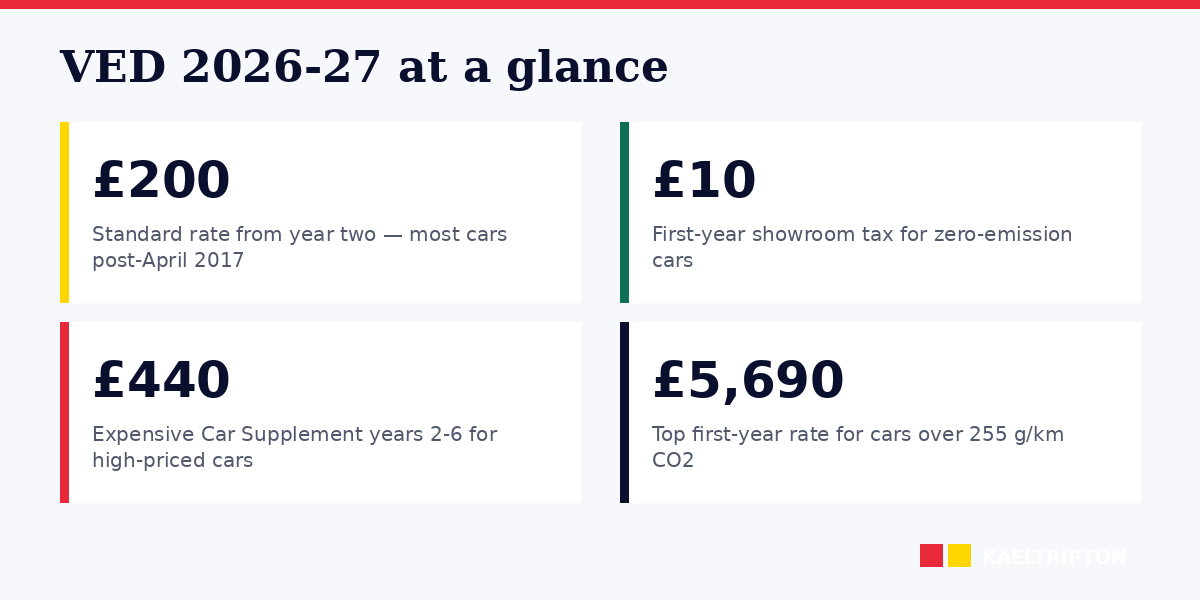
UK road tax rates rose on 1 April 2026, confirmed by HM Treasury in the Autumn Budget 2025 and enacted via Finance Act provisions. The standard annual rate is £200 (up from £195 in 2025-26). First-year showroom tax runs £10 for zero-emission cars, £195-£5,690 for petrol and diesel depending on CO2 emissions. The Expensive Car Supplement is £440 on cars over £40,000 - or £50,000 for fully electric vehicles, a change that took effect from 1 April 2026 and backdates to EVs registered from 1 April 2025. Three different tax systems coexist depending on your car's first registration date. This guide covers all 2026-27 rates with the specifics you need to know.
| ★ EDITOR'S VERDICT £200 standard, £440 ECS, £10 first-year for EVs. |
2026-27 VED is £200/year standard for cars registered from April 2017 onwards. First-year showroom tax varies from £10 (zero-emission) to £5,690 (over 255 g/km CO2). Expensive Car Supplement of £440 adds to years 2-6 for cars over £40,000 list price - raised to £50,000 for zero-emission cars from 1 April 2026. Pre-2017 cars use the CO2 band system (£20-£790 annual). Pre-2001 cars pay by engine size alone. Pay annually in one go to avoid the 5% monthly or 2.5% six-monthly DD surcharges. |
The three systems by registration date
UK car tax depends entirely on when your car was first registered. Three distinct systems apply:
- Cars registered before 1 March 2001 - flat rate based on engine size only (under 1549cc or over)
- Cars registered 1 March 2001 to 31 March 2017 - CO2-based banding A to M (13 bands)
- Cars registered from 1 April 2017 onwards - first-year showroom tax then £200 standard rate
Understanding which system applies is the first step. Your V5C logbook shows the first registration date. Cars imported from outside the UK often follow the post-April 2017 system because Great Britain registration date applies, not the vehicle's original country-of-origin date.
Cars registered from 1 April 2017 onwards (most 2026 drivers)
The dominant system for modern cars. Two components: first-year showroom tax, then a flat standard rate from year two.
First-year showroom tax 2026-27 (petrol and RDE2-compliant diesel)
| CO2 (g/km) | First-year rate 2026-27 |
|---|---|
| 0 | £10 |
| 1 - 50 | £130 |
| 51 - 75 | £270 |
| 76 - 90 | £350 |
| 91 - 100 | £390 |
| 101 - 110 | £440 |
| 111 - 130 | £540 |
| 131 - 150 | £670 |
| 151 - 170 | £1,095 |
| 171 - 190 | £1,760 |
| 191 - 225 | £2,800 |
| 226 - 255 | £3,980 |
| Over 255 | £5,690 |
The top band - cars over 255 g/km CO2 - faces £5,690 in year-one tax alone. This typically affects V8 performance cars, high-output diesels, and older-design petrol V6s. The £200 difference from 2025-26 to 2026-27 at the top band is a deliberate policy push toward lower-emission choices.
Diesel surcharge (non-RDE2 diesel)
Diesel cars that don't meet RDE2 standards face an additional first-year charge equivalent to being bumped one CO2 band higher. Most diesels first registered before September 2018 are affected. After year one, the standard rate resumes.
Standard rate from year two onwards
From the second year after first registration, all cars registered from April 2017 pay £200/year regardless of CO2 emissions (subject to the Expensive Car Supplement - see below). This flat rate replaced the complex CO2-bracketed system for years 2+ to simplify administration.
Electric cars registered from 1 April 2025 also pay £200/year from year two. Before April 2025 EVs were fully exempt from VED; that exemption ended on that date, and 2026 is the first full financial year all modern EVs pay VED on the same basis as petrol and diesel.
Cars registered 1 March 2001 to 31 March 2017 (the CO2 band era)
13 bands labelled A to M. This system covers roughly 40% of UK vehicles on the road in 2026. VED rates for 2026-27:
| Band | CO2 (g/km) | 2026-27 annual rate |
|---|---|---|
| A | Up to 100 | £20 |
| B | 101 - 110 | £20 |
| C | 111 - 120 | £35 |
| D | 121 - 130 | £170 |
| E | 131 - 140 | £200 |
| F | 141 - 150 | £225 |
| G | 151 - 165 | £275 |
| H | 166 - 175 | £325 |
| I | 176 - 185 | £360 |
| J | 186 - 200 | £410 |
| K | 201 - 225 | £445 |
| L | 226 - 255 | £760 |
| M | Over 255 | £790 |
The 2025 change that ended £0 VED for low-emission cars in this era matters. Before 2025, band A (up to 100 g/km) paid £0/year - a benefit enjoyed by efficient small diesels and early hybrids. From April 2025, all cars in this band pay £20/year. Small increase, but the "free tax" era is over for this category.
Expensive Car Supplement in 2026
The Expensive Car Supplement (ECS) is an additional £440/year on top of the standard rate for five years (years 2-6 of ownership). It applies to cars with a list price over a threshold:
- Petrol, diesel and hybrid cars: £40,000 threshold (unchanged)
- Zero-emission (fully electric) cars: £50,000 threshold from 1 April 2026
The EV threshold change is significant. Before 1 April 2026, EVs over £40,000 paid ECS just like petrol cars. The increase to £50,000 was confirmed in the Autumn Budget 2025 and backdates to EVs first registered from 1 April 2025 - meaning EVs priced between £40,000 and £50,000 registered in that earlier window no longer pay ECS from April 2026 onwards, and any ECS already paid under the lower threshold is typically refunded automatically.
Practical impact: a £55,000 petrol car pays £200 standard + £440 ECS = £640/year total in years 2-6. A £55,000 EV pays £200 + £440 = £640/year too, but an EV at £45,000 pays only £200 (no ECS) - worth noting for mid-range EV buyers.
Cars registered before 1 March 2001 (engine-size system)
For older cars, VED depends only on engine size. 2026-27 rates:
- Up to 1549cc: £220/year
- Over 1549cc: £360/year
Cars over 40 years old (the rolling historic threshold) are exempt from VED - in 2026, that means cars first registered before 1 January 1986. Application to switch to historic tax class uses form V112 or the online service once the vehicle reaches the 40-year mark.
How to pay and save
Three payment options with different total costs:
- Annual in one payment: cheapest option. £200 paid once covers the full year.
- Six-monthly (two payments): 2.5% surcharge. Total cost £205 on the £200 rate (£102.50 × 2).
- Monthly Direct Debit (12 payments): 5% surcharge. Total cost £210 on the £200 rate (£17.50 × 12).
For most drivers, annual payment saves £10/year. The Direct Debit option is useful if cash flow matters, but costs more overall.
A real 2026 scenario: comparing three cars
A family in Bristol is comparing three candidates:
Option 1 - 2023 Nissan Qashqai 1.3 petrol (141 g/km CO2, £34,000 new list price): first-year tax £670 (paid by dealer at registration, not relevant now). Standard rate 2026-27: £200. No ECS (under £40k threshold). Annual tax £200.
Option 2 - 2024 BMW 530e plug-in hybrid (38 g/km, £55,000 list): first-year tax was £130. Standard rate: £200. ECS applies (£40k+, not EV): £440/year. Annual tax £200 + £440 = £640 until year 6.
Option 3 - 2025 Kia EV6 (0 g/km, £48,000 list, registered after April 2025): first-year tax was £10. Standard rate: £200. ECS does NOT apply (under the new £50k EV threshold from April 2026 - the Kia falls below). Annual tax: £200.
Tax difference over 5 years: Option 1 = £1,000, Option 2 = £3,200, Option 3 = £1,000. The EV has rejoined petrol at comparable tax levels thanks to the April 2026 threshold change - a win for mid-range electric buyers.
Electric Vehicle Excise Duty (eVED) from 2028
The Autumn Budget 2025 announced a new pay-per-mile tax specifically for electric and plug-in hybrid cars, planned for April 2028. Under the current proposal:
- Electric vehicles: 3p per mile on top of standard VED
- Plug-in hybrids: 1.5p per mile on top of standard VED
- Annual estimate paid in advance, reconciled at year-end
- No mileage tracking devices required (privacy-preserving design)
For the average electric car driver covering 8,000 miles/year, this adds approximately £240/year. The consultation closed in March 2026; final structure expected in a future Finance Bill. This is policy, not 2026-27 law - but worth factoring into long-term EV ownership calculations.
Exemptions that still apply
- Historic vehicles - over 40 years from manufacture (rolling). Must apply via V112 or online.
- Disabled tax class (85) - PIP enhanced mobility rate, DLA higher rate, or War Pensioner's Mobility Supplement. Free VED, one vehicle per eligible person.
- Disabled Passenger Vehicle class - for organisations transporting disabled passengers.
- Mobility scooters and powered wheelchairs - zero-emission mobility vehicles.
- Statutory Off-Road Notification (SORN) - not an exemption, but a declaration that removes the tax requirement until the vehicle returns to the road.
Frequently asked questions
Does my VED rate change every year?
Yes, typically by small amounts each April in line with Retail Price Index inflation. Major changes (new bands, supplement threshold adjustments) arrive via Budget announcements. The 2026-27 changes - standard rate £195 → £200, ECS £425 → £440, EV threshold £40k → £50k - all took effect on 1 April 2026.
Why do cars registered before 2017 pay different rates?
The April 2017 reform restructured VED to a first-year-plus-flat-rate model. Pre-2017 cars stay on the CO2-band system they were originally registered under. Switching isn't possible - the car's original tax regime continues for its entire lifetime under DVLA rules.
Can I avoid the Expensive Car Supplement?
The ECS is unavoidable on qualifying vehicles for the full 5-year period. The only way to escape it is to buy a car below the list price threshold (£40,000 for petrol/diesel/hybrid, £50,000 for EVs from April 2026) or wait until year 7+ when it no longer applies. Some buyers negotiate discounts that bring list price below the threshold - but the ECS is based on the original published list price, not the actual purchase price paid.
How do I check my car's exact VED rate?
Use the DVLA vehicle enquiry service at gov.uk/get-vehicle-information-from-dvla. Enter your registration and it shows the current tax rate, MOT status, and relevant history. For a car you're thinking of buying, run the registration before committing.
Will the eVED pay-per-mile system affect my 2026 tax?
No. eVED is planned for April 2028 and requires future Finance Bill legislation. The 2026-27 VED rates for electric and plug-in hybrid cars are as described above (£10 first year for EVs, £200 standard rate). Nothing changes for 2026-27 based on the eVED announcement.
Does the diesel surcharge apply to all diesels?
No - only diesels that don't meet RDE2 (Real Driving Emissions Step 2) standards. Most diesels registered from January 2021 onwards meet RDE2 automatically. Some registered 2018-2020 meet it; earlier diesels usually don't. Your V5C shows the car's Euro standard - Euro 6d (or equivalent RDE2 certification) means no surcharge.
What happens if I refuse to pay?
Driving without valid VED is a civil offence with an automatic £80 fine (£40 if paid within 28 days), plus the car can be clamped, impounded, or crushed by DVLA enforcement teams. ANPR cameras on major roads automatically flag untaxed vehicles - fines typically arrive within 7-28 days of the tax expiring. If you're not driving the car, declare SORN to legally stop tax without penalty.
Sources
- GOV.UK, Vehicle tax rates - gov.uk/vehicle-tax-rate-tables
- HM Treasury, Autumn Budget 2025 - VED policy
- Finance Act 2023 (VED provisions for zero-emission vehicles)
- House of Commons Library, Vehicle excise duty and zero emission vehicles (CBP-9690)
- DVLA, V149 leaflet - rates of vehicle tax
- Vehicle Excise and Registration Act 1994 (as amended)
- GOV.UK, Vehicle enquiry service - gov.uk/get-vehicle-information-from-dvla


