

Paying UK car tax by Direct Debit spreads the cost over monthly or six-monthly payments rather than a single annual hit. There's a cost: 5% surcharge on monthly payments, 2.5% on six-monthly. Annual Direct Debit has no surcharge and auto-renews each year. Setup takes one minute at gov.uk/vehicle-tax during the tax payment process. Cancellation happens automatically when you sell the car or declare SORN - no separate action needed. If a payment bounces, DVLA gives 14 days to fix the issue before the tax is automatically cancelled and your car is unlicensed. This guide covers the 2026 mechanics, the real cost comparison, and the edge cases.
| ★ EDITOR'S VERDICT Annual single payment wins. DD pays for convenience. |
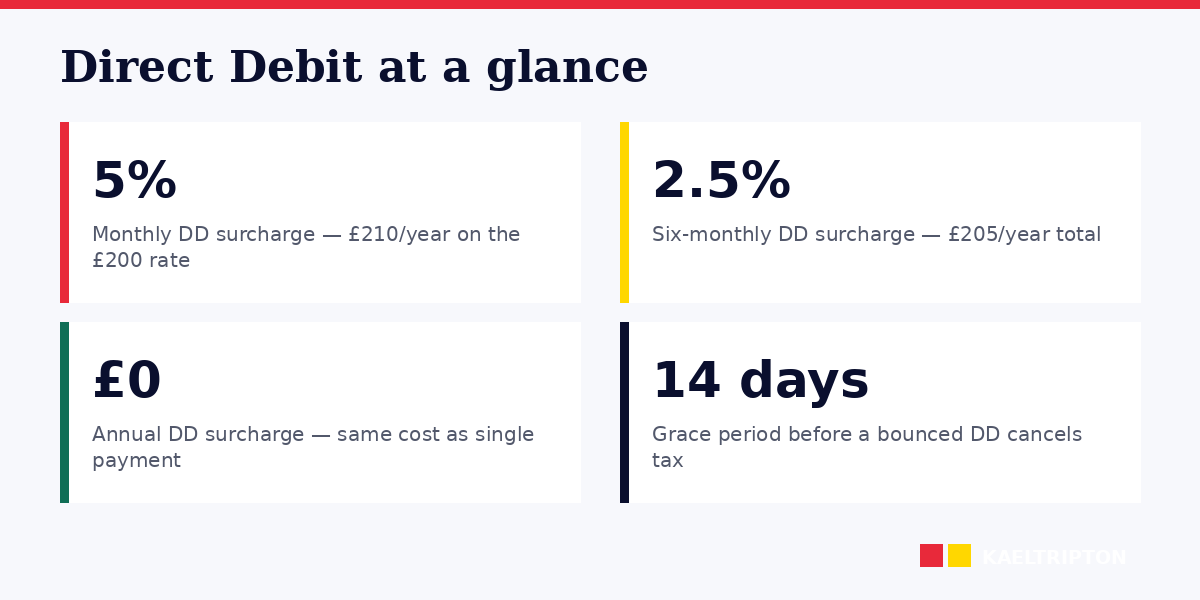
Direct Debit spreads payments but adds cost. Monthly DD is 5% more expensive; six-monthly DD is 2.5% more expensive. Annual DD has zero surcharge and auto-renews each year. For a standard £200 car, monthly DD costs £210/year - £10 extra. Over 5 years that's £50. DD auto-cancels on sale, SORN, scrap, or export. A bounced DD triggers a 14-day grace period before tax is automatically cancelled. Best mixed approach: annual payment for predictable months, monthly DD only if cash flow genuinely needs it. |
The three Direct Debit options
When you tax your vehicle at gov.uk/vehicle-tax, you choose how to pay. Three Direct Debit options plus annual single payment:
- Annual Direct Debit (auto-renewing each year): one payment per year, no surcharge. Automatically renews on the same date next year unless you cancel. Best value if you want to set-and-forget.
- Six-monthly Direct Debit (two payments per year): 2.5% surcharge. £100 six-monthly car pays £102.50 × 2 = £205/year (vs £200 annual).
- Monthly Direct Debit (12 payments per year): 5% surcharge. £200/year rate paid as £17.50/month × 12 = £210/year (10 extra pounds).
- Annual single payment (no Direct Debit): pay once for the full year by debit or credit card. No surcharge. No auto-renewal - you receive a V11 reminder roughly 4-6 weeks before expiry.
The surcharge numbers come directly from the Vehicle Excise and Registration Act 1994 as amended. They haven't changed since 2014.
The real cost comparison
For a car on the standard £200/year 2026-27 rate, the total annual cost by payment method:
| Method | Per-payment cost | Annual total | Extra vs annual |
|---|---|---|---|
| Annual single payment | £200 | £200 | - |
| Annual Direct Debit | £200 | £200 | £0 |
| Six-monthly Direct Debit | £102.50 | £205 | £5 |
| Monthly Direct Debit | £17.50 | £210 | £10 |
For a standard car, monthly DD costs £10/year more than annual. Over 5 years, that's £50 - not a huge sum, but real money. For a higher-rate car on £640/year (£200 standard + £440 ECS), monthly DD costs £32/year more - £160 over 5 years.
When Direct Debit makes sense
Despite the surcharge, monthly DD works for specific situations:
- Cash flow matters more than total cost. A £17.50/month bill is easier to absorb than a £200 annual hit, particularly if the tax renewal falls in a month you have other large outgoings.
- Multiple vehicles owned. Spreading renewals across the year via monthly DD avoids all vehicles renewing together and creating a cash-flow spike.
- Forgetfulness insurance. Annual DD auto-renews. If you're the type who lets V11 reminders pile up unopened, DD removes the risk of accidental non-payment and the £80 Late Licensing Penalty that follows.
For most drivers with settled finances, annual single payment is the cheapest and simplest option. The DD options are slightly more expensive but trade money for convenience.
How to set up Direct Debit
Setting up DD happens during the normal tax payment process, not as a separate application:
- Go to gov.uk/vehicle-tax
- Enter your V5C, V11, or V5C/2 reference number
- Confirm vehicle details
- Choose Direct Debit and select frequency (annual, six-monthly, or monthly)
- Enter UK bank account details: account holder name, sort code, account number
- Confirm DD mandate (equivalent to signing a DD authorisation)
- First payment is taken immediately. Subsequent payments taken on the same calendar day each month (or six months, or year)
The DD mandate is a standard DD Guarantee agreement protected by the UK banking industry. If DVLA takes an incorrect amount, you're entitled to an immediate refund from your bank under the DD Guarantee - though DVLA rarely makes errors.
When Direct Debit cancels automatically
You don't usually need to cancel DD manually. DVLA automatically cancels it when:
- You sell the car - DVLA is notified of the change of keeper, the DD is cancelled from the next scheduled date
- You declare SORN - SORN automatically cancels both the tax and the DD
- The car is scrapped - Certificate of Destruction filed by the Authorised Treatment Facility cancels DD
- You permanently export the vehicle - notification via V5C Section 11 cancels DD
- The car is reclassified as historic - when the 40-year threshold is reached and V112 is submitted, tax becomes £0 and DD cancels
In all these cases, any DD payment already taken for a month that's no longer relevant is generally not refunded (DVLA's rule is full-month-based, not pro-rated). The DD stops from the next scheduled payment date.
When you need to cancel Direct Debit manually
Rare situations where you cancel DD directly:
- You're changing bank accounts and need to switch the DD to the new account
- You've had a DD mandate problem (bank closed, fraud alert) and need to restart fresh
- You want to switch from DD to annual single payment
Process for manual cancellation:
- Cancel the DD at your bank (online banking or phone) - this stops future payments
- Go to gov.uk/vehicle-tax, pay for the tax using your preferred method (card payment or new DD), or declare SORN if you're taking the car off-road
Cancelling the DD at the bank without paying another way means your tax lapses - DVLA issues an £80 Late Licensing Penalty within 4-6 weeks. Always pair the cancellation with the replacement payment.
What happens if a DD payment bounces
DD failures happen - bank account closed, insufficient funds, fraud block. When a DVLA DD bounces:
- Day 0: DD fails. Bank notifies DVLA; you receive an email from DVLA within 2-3 days flagging the failure.
- Days 1-14: Grace period. DVLA tries to resolve automatically - typically reattempting the DD once. If you notice the failure and top up your bank account, the retry usually succeeds.
- Day 14: If the DD hasn't been paid, DVLA cancels the tax. Your car becomes unlicensed. DVLA issues a Late Licensing Penalty (£80 reduced to £40 if paid within 28 days).
- After Day 14: You must tax the car again via gov.uk/vehicle-tax. The previous DD is dead; set up a fresh DD or pay by card.
Monitor your DVLA emails if you've switched bank accounts recently. A common cause of DD failure is forgetting to update DVLA when you changed your main bank. The DD mandate doesn't follow you automatically.
A real 2026 scenario: family juggling multiple cars
A couple in Leeds owns three cars - her Audi A3 (£200/year), his Ford Ranger pickup (£345/year LGV class), and a classic 1986 Ford Capri (£0/year historic). Combined annual tax: £545.
Option 1 - pay all three annually: £545 hits in the single month each car falls due. If all renew in March, that's a £545 cash flow hit. If renewals are staggered (Audi March, Ranger July, Capri January), the hit spreads naturally.
Option 2 - monthly DD on all three: Audi £17.50, Ranger £30.19, Capri £0. Total £47.69/month = £572.28/year. Costs £27.28/year more than annual but spreads cash flow into small predictable monthly chunks.
Option 3 - mixed approach: Audi annual (£200, March renewal coinciding with annual bonus). Ranger monthly DD (£30.19/month, protects against cash flow volatility). Capri no tax needed. Total £200 + £362.28 = £562.28 - £17.28 more than pure annual.
Most families in similar situations find Option 3 (mixed approach) works well - annual payment where cash flow accommodates it, DD where it doesn't.
Edge case: changing bank accounts
When you switch your main bank account, your DVLA DD does not move automatically. You have two options:
- Use the Current Account Switch Service (CASS): the guaranteed 7-day switch service handles your existing DDs. Your DVLA DD is transferred to the new account automatically.
- Manual switch: cancel the DVLA DD at the old bank, then log in to gov.uk/vehicle-tax and set up a fresh DD on the new account. You'll need a taxing reference number (V5C, V11, or V5C/2).
If you're outside CASS (e.g., the old bank doesn't support it, or you've already closed the old account), manual switch is the only option. Time it carefully - a closed DD without a replacement triggers the 14-day-countdown-to-cancellation described above.
Frequently asked questions
What's the cheapest way to pay car tax?
Annual single payment (either by card or by annual auto-renewing Direct Debit). No surcharges apply. Monthly DD adds 5% to the bill; six-monthly adds 2.5%. For a standard car on £200/year, the difference is £10-£5/year. Small amounts, but free if you pay annually.
Can I set up Direct Debit without a UK bank account?
No. DD requires a UK bank account with a UK sort code. If you only have international or non-UK accounts, you need to pay annually by debit or credit card (non-UK cards accepted for one-off payment) or arrange a UK account.
Does the Direct Debit auto-renew even if I don't want it to?
Yes - that's the point of annual DD. To stop auto-renewal, either cancel the DD directly (at your bank or by logging into gov.uk/vehicle-tax and opting out before the renewal date), or declare SORN if you're taking the car off-road. DVLA sends email reminders approximately 4 weeks before each annual renewal confirming the payment is due.
What happens if DVLA takes the wrong amount?
You're protected by the Direct Debit Guarantee. Contact your bank immediately - under the Guarantee, the bank refunds you the full incorrect amount with no investigation needed. You then resolve the underlying issue with DVLA separately (likely a minor clerical error) without being out of pocket while it's sorted.
Can I pay some of the tax by DD and some by card?
No. Each vehicle must use a single payment method. You can't split the £200 annual tax across a partial DD and a card payment. If you want to mix - for example, pay most by card up-front and set up DD for any remainder - you need to pay in full by one method, then restart next year with whichever you prefer.
Does Direct Debit affect my tax rate?
Yes, via the 5% monthly / 2.5% six-monthly surcharge. Your underlying tax rate (£200, £345, etc.) is the same; the surcharge adds to the final amount collected. Annual DD adds nothing - same rate as annual single payment.
What if I want to go back to annual payment after a year of monthly DD?
Easy. At your next renewal date, the DD continues unless you cancel it. To switch to annual: log into gov.uk/vehicle-tax using your V5C/V11 reference, cancel the monthly DD, and choose annual payment (by card or new annual DD). Timing this around the renewal date keeps the process clean - mid-cycle changes leave a gap you need to fill.
Sources
- GOV.UK, Tax your vehicle - payment methods - gov.uk/vehicle-tax
- Vehicle Excise and Registration Act 1994 (as amended) - surcharge provisions
- DVLA, Direct Debit payment surcharge schedule 2026
- Direct Debit Guarantee (UK payment industry standard)
- Current Account Switch Service (CASS) - currentaccountswitch.co.uk
- HM Treasury, Autumn Budget 2025 - VED rates 2026-27


