

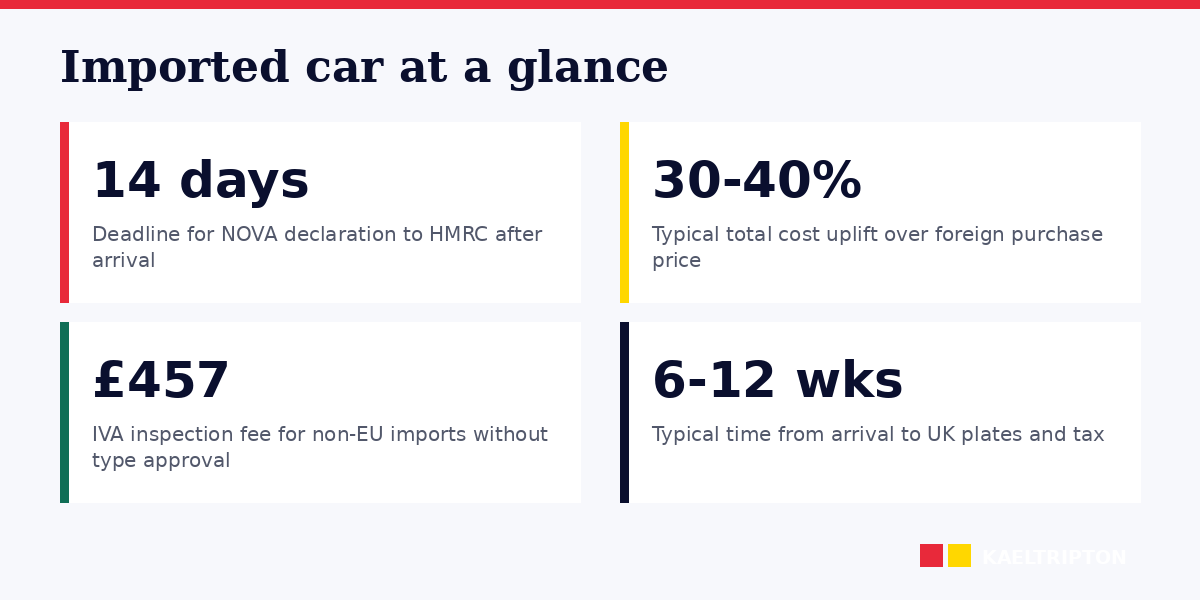
Imported a car into the UK? You need to declare it to HMRC via NOVA (Notification of Vehicle Arrival) within 14 days of arrival, pay any VAT and import duty, then apply for first UK registration using form V55/4. The DVLA processes the registration, issues a UK number plate, and sets the first vehicle tax at the first-year rate appropriate to the car's CO2 emissions. Depending on the car's type approval, you may also need to pass Individual Vehicle Approval (IVA) or Motorcycle Single Vehicle Approval (MSVA) before registration. This guide covers the 2026 sequence for personal imports, including transfer-of-residence relief, the common pitfalls, and what it actually costs to put a foreign-registered car on UK plates.
| ★ EDITOR'S VERDICT 30-40% cost uplift versus foreign purchase price. Budget accordingly. |
Importing a car to the UK costs significantly more than the sticker price suggests. NOVA within 14 days of arrival to HMRC, then VAT and 10% duty on non-EU imports (unless Transfer-of-Residence relief applies). Non-EU imports without EU type approval need IVA inspection at £457 plus modifications (typically £500-£3,000). First UK tax is based on the car's CO2 emissions at current first-year rates, not retrospective. Total timeline from arrival to UK plates is typically 6-12 weeks, longer for IVA cases. ToR relief is the big money-saver for genuine relocators. |
The four-step sequence in brief
- NOVA declaration within 14 days of arrival - HMRC system
- VAT and import duty (if applicable) - HMRC collects at point of import
- IVA/MSVA inspection - only if the car lacks EU or UK type approval
- First registration at DVLA using V55/4, V55/5, or V55/2 depending on category - producing UK V5C, plates, and first tax
Each step has its own timing and cost. The full import-to-road process typically takes 6-12 weeks for EU-sourced vehicles with type approval, and 3-6 months for imports from further afield requiring IVA.
Step 1: NOVA declaration
NOVA is HMRC's system for tracking vehicles arriving in the UK. You must declare the vehicle within 14 days of it entering Great Britain or Northern Ireland. Declaration is at gov.uk/vehicle-imports-nova using your Government Gateway account.
Information required:
- Vehicle identification number (VIN / chassis number)
- Make, model, variant
- Date and place of arrival in the UK
- Country of origin and last country of registration
- Your name, address, and VAT status if applicable
- Supporting documents: bill of sale, foreign registration document, shipping/transport records
NOVA triggers the HMRC assessment of VAT liability and import duty. You receive a NOVA1 reference number which you'll need later for DVLA registration. DVLA will not process your V55/4 application without evidence that NOVA has been submitted.
Miss the 14-day deadline and HMRC can impose penalties of £500-£1,000 depending on circumstances. More importantly, you cannot register the vehicle with DVLA until NOVA is complete - so timely declaration is in your own interest.
Step 2: VAT and import duty
Whether VAT and duty apply depends on where the car came from and how long you owned it.
Vehicles imported from outside the EU (including under Brexit from January 2021 onwards)
- Import duty: 10% on the customs value (for most cars). VAT-registered businesses can claim this back in some circumstances.
- VAT: 20% on the customs value plus any import duty
- Customs value: typically the purchase price plus shipping and insurance costs, verified by commercial invoices
A £20,000 car imported from the US with £2,000 shipping attracts approximately £2,200 duty + £4,440 VAT = £6,640 total HMRC charges. On top of the car, shipping, and UK registration fees. Genuine cost to put a US-imported car on UK plates is typically 30-40% above the foreign purchase price.
Vehicles imported from EU countries
Since Brexit, EU-sourced imports are treated as third-country imports for duty and VAT purposes. Some preferential rates apply under the UK-EU Trade and Cooperation Agreement for vehicles manufactured in the EU with sufficient UK or EU local content, but the practical effect is similar - expect VAT to apply.
Transfer-of-residence relief (ToR)
If you're permanently relocating to the UK and bringing your personal vehicle with you, transfer-of-residence relief can waive VAT and duty. Eligibility:
- You were resident outside the UK for at least 12 consecutive months
- You owned and used the vehicle for at least 6 months before the move
- You're moving your normal place of residence to the UK
- You commit not to sell, hire out, lend, or transfer the vehicle for 12 months after import
Apply for ToR via HMRC form ToR1 before the vehicle arrives (or within three months of arrival, with justification for delay). Approval issues a unique reference that you use on the NOVA declaration to waive VAT and duty.
Step 3: Type approval and IVA
To register a vehicle in Great Britain, it needs valid type approval. Three categories:
- EU type approval (e-mark): accepted for GB registration of vehicles originally sold in the EU. Most imports from EU member states qualify.
- UK type approval: for vehicles originally sold new in Great Britain. Vehicles with UK type approval generally go through V55/5 registration rather than V55/4.
- No type approval (non-EU imports): Japanese domestic market imports, US vehicles, Australian imports without EU/UK certification. These require IVA (cars/vans) or MSVA (motorcycles) inspection before registration.
IVA inspection through DVSA checks the vehicle against 40+ safety and environmental standards. Common changes needed for US or JDM imports:
- Headlight beam pattern adjustment (RHD-compatible)
- Rear fog lamp installation (required in UK, not in US/JDM)
- Speedometer conversion from mph/kph
- Seat belt mountings to UK standard
- Emissions compliance verification
IVA cost in 2026: £457 for the inspection (DVSA fee), plus any modifications needed (often £500-£3,000). IVA test centres are limited; booking delays of 8-12 weeks are common. Failed IVAs can be retested with modifications addressed.
Step 4: First UK registration
After NOVA, VAT/duty, and (if needed) IVA, the car is ready for DVLA registration. Three forms depending on category:
- V55/4: first registration of a new unregistered vehicle
- V55/5: first registration of a used vehicle previously registered abroad
- V55/2: first registration of a vehicle made before the current type approval era (for historic imports)
V55/5 (used imports) is the most common form. Documents to submit:
- Completed V55/5 with full vehicle details, keeper information, and requested tax class
- NOVA1 reference number
- Foreign registration document (original)
- Certificate of Conformity (EU type approval) or IVA certificate (non-EU)
- Proof of identity (passport, photocard licence)
- Proof of address (utility bill, bank statement)
- Evidence of VAT/duty paid or ToR relief granted
- Payment for first vehicle tax (based on CO2 emissions, first-year showroom rate)
- Payment for £55 registration fee (2026 rate)
Submit by post to DVLA Swansea or at certain Post Office counters offering the vehicle registration service. Processing typically 4-6 weeks. DVLA issues:
- UK V5C registration certificate in your name
- UK registration number (age-appropriate or Q plate if age cannot be verified)
- Tax valid from the date of application
You then have UK number plates made up by any DVLA-registered supplier (typically £15-£30). Plates can be fitted immediately - the car is now legal on UK roads subject to valid insurance.
The V5C return for the foreign registration
DVLA retains the original foreign registration document when issuing the UK V5C. This document is sent to the relevant foreign authority (for EU imports) or destroyed (for other imports) to ensure the vehicle cannot be simultaneously registered in two jurisdictions.
Before submitting the foreign registration to DVLA, some importers photograph both sides for their records. DVLA doesn't return the document - the photos are useful for future reference if any ownership history needs verifying.
First vehicle tax: based on what?
The first UK tax for an imported car is calculated on:
- CO2 emissions from the car's type approval or IVA certification - this drives the first-year showroom rate
- UK first registration date - the date DVLA enters the vehicle onto the UK register (not the original foreign registration date)
- List price equivalent - may trigger Expensive Car Supplement if the original list price was over £40,000 (£50,000 for EVs from April 2026)
Critically, a 2018 car imported in 2026 gets treated as a "new to UK" registration for tax purposes - meaning it pays the current first-year rate in 2026 based on its original CO2 figure. The age of the car doesn't shortcut the first-year rate.
After year one on UK plates, the car pays the standard £200/year rate (2026-27) from year two onwards, same as any other modern car. ECS (£440/year) applies for years 2-6 if the list price threshold was exceeded.
A real 2026 scenario: JDM import from Japan
A 41-year-old enthusiast in Newcastle imports a 2005 Honda S2000 from Japan at a cost of £11,500 (purchase + shipping to Southampton docks). The car has no EU type approval - it's JDM-specific.
Week 1 (post-arrival). Vehicle clears customs. He submits NOVA declaration with the bill of sale and Japanese registration papers. Receives NOVA1 reference. HMRC calculates 10% duty (£1,150) and 20% VAT on the combined value (£2,530). Total HMRC charges: £3,680. Paid within 7 days.
Week 2-4. Books IVA inspection with DVSA. Books the car into a modification specialist to address: rear fog lamp installation (£180), speedometer MPH conversion (£220), headlamp beam adjustment (£90), minor emissions tweak (£150). Total modifications: £640.
Week 6. IVA inspection: passes. Fee £457. IVA certificate issued.
Week 7-8. Submits V55/5 to DVLA Swansea with IVA certificate, NOVA reference, proof of VAT/duty paid, identity documents. Pays £55 registration fee plus £540 first-year tax (the S2000 has ~210 g/km CO2, 2026-27 first-year rate band).
Week 13. UK V5C arrives with an age-related S-suffix UK plate. Has plates made up at the local motor factor: £22. Fits them. Arranges insurance: £680/year (classic-adjacent policy). The car is road-legal.
Total cost to go from Japan to UK road: £11,500 (car + shipping) + £3,680 (VAT/duty) + £640 (modifications) + £457 (IVA) + £55 (registration) + £540 (first-year tax) + £22 (plates) = £16,894. Roughly 47% above the original £11,500 cost.
Frequently asked questions
How long do I have to declare an imported car?
14 days from the date the vehicle arrives in the UK via NOVA. Missing this deadline can attract HMRC penalties and delays your subsequent DVLA registration. Submit NOVA via gov.uk/vehicle-imports-nova as soon as the car arrives.
Can I drive the car on foreign plates while I wait for UK registration?
Briefly - most foreign-registered vehicles can be driven in the UK for up to 6 months under temporary admission rules, provided the car remains validly registered and insured in its home country. Once you declare yourself as permanently resident in the UK, you have up to 14 days to NOVA the vehicle and the clock starts on the full registration process. Driving beyond 6 months without UK registration is illegal.
Do I need IVA for a car imported from Germany?
Usually no, if the car has EU type approval (most modern German cars do - any vehicle originally sold new within the EU is covered). The EU Certificate of Conformity (CoC) can be submitted to DVLA instead of IVA inspection, saving ~£450 and 8-12 weeks of delay.
Can Transfer-of-Residence relief waive VAT entirely?
Yes if you qualify. 12 months' prior residence outside the UK, 6 months' ownership of the vehicle, genuine relocation of normal residence to the UK, and commitment not to sell the vehicle for 12 months after import. Apply via HMRC form ToR1 before or shortly after arrival.
Does an imported car get a new UK-age registration number?
Usually an age-related suffix number matching the vehicle's original year of first registration. For example, a 2010 car registered in the UK in 2026 gets a plate suffix appropriate to 2010 (not 2026). If DVLA cannot verify the original age from documentation, a Q plate is issued - visually distinctive and often considered undesirable for resale.
What's the difference between V55/4 and V55/5?
V55/4 is for new, previously unregistered vehicles. V55/5 is for vehicles that were previously registered in another country. Most personal imports use V55/5 because the car had foreign plates before arriving. The forms request similar information but DVLA routes them differently.
Can I import a car without paying VAT if I'm a company?
VAT-registered businesses in the UK can reclaim input VAT on commercial vehicles in some circumstances. For personal cars owned by a company, reclaim is limited (essentially only for 100% business-use vehicles, which HMRC scrutinises carefully). Speak to a VAT specialist before relying on reclaim.
Sources
- HMRC, Notification of Vehicle Arrival (NOVA) - gov.uk/vehicle-imports-nova
- GOV.UK, Import a vehicle into the UK and Vehicle registration for imported vehicles
- HMRC Notice 728, Motor vehicles: inland revenue and vehicle excise duty
- HMRC Notice 3, Transfer of Residence (ToR1) relief
- DVSA, Individual Vehicle Approval (IVA) scheme
- DVLA, V55/4 and V55/5 registration forms and fee schedule 2026
- UK-EU Trade and Cooperation Agreement (for EU imports)
- Vehicle Excise and Registration Act 1994 (as amended)


