

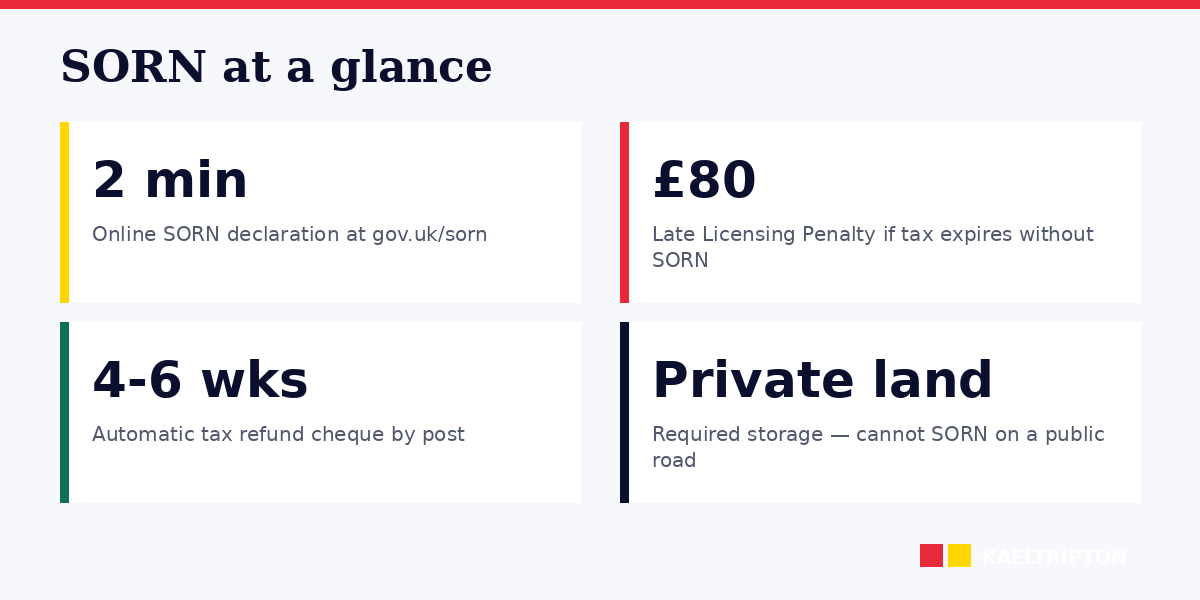
If you're not going to drive your vehicle on public roads for a while, declare a Statutory Off-Road Notification (SORN) to stop paying tax and insurance. The process takes two minutes online at gov.uk/sorn and triggers an automatic tax refund for remaining full months. The vehicle must be kept on private land (driveway, garage, private car park) - SORN does not allow parking on a public road. This guide covers the 2026 SORN process, when to use it, how to un-SORN by taxing the vehicle again, and the £80 fine for getting it wrong.
| ★ EDITOR'S VERDICT SORN is the right answer for vehicles off-road for 3+ months. |
A standard car on £195 tax plus £600 insurance is nearly £800/year of ongoing cost. If the vehicle isn't being driven, SORN at gov.uk/sorn in two minutes and stop both. Private land only - no SORN'd parking on public roads, residential streets included. ANPR catches SORN'd vehicles on public roads within days. The moment you tax the car again, the SORN ends automatically. No separate 'un-SORN' form needed - the tax payment IS the un-SORN. |
What SORN actually means
SORN is a legal declaration to DVLA that a vehicle is off the public road and will not be driven, parked, or otherwise used on public roads until the SORN is cancelled. It was introduced in 1998 by the Vehicles (Crime) Act 2001 and made mandatory in 2004 to address uninsured and untaxed vehicles on UK roads.
Once SORN'd, a vehicle:
- Does not need current vehicle tax (Vehicle Excise Duty)
- Does not need motor insurance (though insurers often offer discounted "laid up" cover for SORN vehicles)
- Must be kept on private land (driveway, garage, private field, owned off-street parking)
- Cannot be driven or towed on any public road (except directly to a pre-booked MOT appointment)
- Is automatically checked by DVLA's Continuous Insurance Enforcement against ANPR if it appears on public roads
SORN is the legal mechanism that replaces both tax and insurance while the vehicle is off-road. It is not a way to avoid paying tax on a vehicle you're still driving - doing so is fraud and carries £1,000+ fines plus prosecution.
When to declare SORN
Common reasons to SORN a vehicle:
- The vehicle is undergoing long-term restoration (classic cars, project cars)
- You are away from the UK for an extended period and storing the car
- A second car is only used occasionally - SORN for the months it's not driven, tax for the months it is
- The vehicle has failed MOT and needs major repairs you cannot afford immediately
- You have bought a car as a project and have not yet insured or taxed it
- The owner has become ill, elderly, or otherwise unable to drive
- The vehicle is for sale and you don't want ongoing tax costs while it sits on the driveway
Tax and insurance savings add up quickly. A standard car on £195 annual tax + £600/year insurance = £795/year. For a classic car on £330 tax + £200/year classic insurance = £530/year. SORN genuinely saves money when the vehicle will be off-road for 3+ months.
The three-minute online process
The fastest route is online at gov.uk/sorn:
- Go to gov.uk/sorn
- Enter the 11-digit reference number from either:
- Your V5C logbook (the "document reference number" in the yellow panel)
- Your V11 tax reminder letter (16-digit reference)
- Your V890 if you have a printed form
- Confirm the vehicle details shown
- Select whether SORN starts immediately or from the first of next month. Starting from the first of next month means you get a full month's tax refund for the transition month; starting immediately means the refund is pro-rated to the date of the declaration.
- Submit the declaration
The confirmation appears on screen and arrives by email within minutes. The SORN is effective from the selected date.
The automatic tax refund
When you declare SORN, DVLA automatically refunds the unused portion of your vehicle tax. The refund calculation:
- Covers full remaining months from the SORN effective date
- Does not cover any part-month (the month in which SORN takes effect is not refunded)
- Is sent by cheque to the registered keeper's address within 4-6 weeks
- Automatically cancels any Direct Debit tax payments - no action needed
- Is calculated on the actual tax rate paid, not the annual rate
Practical example: your tax is £195/year, paid monthly at £17.06 via Direct Debit. You SORN effective 15 March. The DD for March was already taken; you get no refund for March. DDs for April onwards are automatically cancelled, saving roughly £136 across the remaining months.
SORN by post using V890
If you cannot apply online, the paper alternative is form V890. Download from gov.uk/government/publications/vehicle-statutory-off-road-notification-v890 or order by phone from DVLA. Complete and post to DVLA in Swansea. Processing takes 4-6 weeks, though the SORN is effective from the date of declaration on the form.
Use cases for paper V890:
- You don't have any of the digital references (V5C, V11, V890) - apply for a new V5C via V62 first, then submit V890 with the reference from the replacement
- You prefer written records
- The vehicle has a complex registration status (imported, re-registered, etc.)
The paper route is always slower than online and offers no real advantages for routine SORN declarations.
Un-SORN: returning the vehicle to the road
Ending a SORN is straightforward - simply tax the vehicle again. The moment you pay the tax via gov.uk/vehicle-tax, the SORN is automatically cancelled and the car is legal to drive. No separate "un-SORN" process is needed.
Before taxing a previously SORN'd vehicle:
- The vehicle needs a valid MOT (if over 3 years old)
- You need valid motor insurance from the date of first drive
- The car should be roadworthy - particularly brakes and tyres after storage
Driving a vehicle directly from its SORN location to a pre-booked MOT appointment is legal even without current tax. Any other driving (to the supermarket, to a mechanic not for a booked MOT, around the block) is an offence and draws the full penalty for untaxed driving.
The £80 fine and enforcement
Failing to SORN correctly carries serious penalties. The three main offences:
- Not declaring SORN on an untaxed vehicle. If the vehicle has no tax and no SORN, DVLA's Continuous Vehicle Licensing Enforcement system issues an automatic Late Licensing Penalty of £80 (reduced to £40 if paid within 28 days). The system runs monthly.
- Using a SORN'd vehicle on a public road. Fine of £2,500 maximum and prosecution. The minimum fixed penalty is £40, but courts routinely impose much higher fines and points when the case goes to prosecution. The vehicle can be clamped, impounded, and crushed.
- Falsely declaring SORN while continuing to drive. Prosecuted as fraud. Fines up to £5,000, vehicle confiscated, and potential custodial sentence in egregious cases.
DVLA's enforcement is primarily automatic. ANPR cameras on motorways, major roads, and car parks routinely check registrations against the SORN database. A SORN'd vehicle caught on public roads typically generates enforcement action within 7-14 days.
A real 2026 scenario: restoring a classic over winter
A 52-year-old project enthusiast in Kent buys a 1986 Ford Escort Mk3 project car in October 2026. It needs extensive restoration - engine rebuild, body work, new interior - estimated 8-12 months of weekend work. He plans to SORN it over winter to avoid ongoing tax and insurance costs while it sits in his garage.
Day of purchase (October). Drives the car directly to his house on a trailer (driving it on the road would require tax + insurance first). Signs the V5C transfer with the seller. Fills out the new keeper slip.
Next day. Goes to gov.uk/sorn, enters the V5C reference. Declares SORN effective immediately. Confirmation arrives by email within 5 minutes.
First month on SORN. He removes the engine for rebuild. Insurance remains cancelled. No tax liability. Total cost of SORN paperwork: £0.
Spring 2027. Restoration complete. He books an MOT. Drives the car directly to the MOT centre on its pre-booked appointment. Passes. Returns home still on SORN.
Same evening. Goes to gov.uk/vehicle-tax, pays £330 annual classic vehicle tax (Mk3 Escort is over 40 years old by 2027 - should apply for historic tax class, which is £0, but that requires a separate form V112). SORN is automatically ended. Arranges classic car insurance (£180/year). Takes the car out the next morning.
Total savings during SORN period: 6 months of tax avoided (saving ~£165), 6 months of insurance avoided (saving ~£90). Total £255 saved simply by SORN'ing rather than leaving it taxed.
Frequently asked questions
Can I SORN a vehicle parked on the street?
No. SORN specifically requires the vehicle to be kept on private land - driveway, garage, private car park, or owned off-street parking. Parking a SORN'd vehicle on a public road (even outside your own house on a residential street) is an offence and triggers enforcement.
Does SORN cancel my insurance?
Not automatically - your insurer does not know about the SORN unless you tell them. Contact your insurer to cancel the policy or switch to "laid up" cover (typically £30-£80/year) that protects the vehicle against fire and theft while it's off the road. Standard motor insurance is not a legal requirement while SORN is in force, but cancelling a live policy also impacts your no-claims discount - check with your insurer before cancelling.
Can I drive to an MOT appointment on SORN?
Yes, but only directly to a pre-booked MOT appointment and back. This exemption is the only legal driving of a SORN'd vehicle. Keep the booking confirmation email as evidence if stopped by police. Any other driving draws full penalty.
How long does SORN last?
Indefinitely - there is no expiry. SORN remains in force until you tax the vehicle again (automatically cancels the SORN) or notify DVLA that you've scrapped or sold the vehicle. You do not need to renew SORN annually; the 2004 requirement to renew was abolished.
Will my tax refund arrive by cheque or bank transfer?
By cheque, sent to the registered keeper's address held by DVLA. If your address is out of date, update it before declaring SORN via gov.uk/change-address-on-driving-licence. DVLA does not pay refunds directly to bank accounts.
Can I SORN a vehicle I just bought?
Yes. Once you have the V5C/2 green slip from the seller and have notified DVLA of the transfer, you can declare SORN immediately even if you've never taxed the car in your name. The SORN is effective from the date you declare it.
What happens if I forget to SORN and the tax runs out?
DVLA's automatic system issues a Late Licensing Penalty of £80 (£40 reduced if paid within 28 days) within 4-6 weeks of the tax expiring without SORN. To stop the cycle, either tax the vehicle or declare SORN immediately. The penalty remains due even if you subsequently SORN.
Sources
- GOV.UK, Statutory Off-Road Notification (SORN) - gov.uk/sorn
- GOV.UK, Vehicle Statutory Off-Road Notification form V890 - gov.uk/government/publications/vehicle-statutory-off-road-notification-v890
- Vehicle Excise and Registration Act 1994 (as amended)
- Vehicles (Crime) Act 2001 - introduction of SORN
- Continuous Registration (Electronic Vehicle Register) Regulations 2003
- DVLA, Tax refund process for SORN declarations
- DVLA Customer Services - 0300 790 6802


