

DVLA refunds unused UK vehicle tax automatically in most scenarios - when you sell, SORN, export, scrap, or change the vehicle to a tax-exempt class. No form needed in the common scenarios. The cheque arrives at the registered keeper's address within 4-6 weeks of the triggering event. This guide covers who qualifies for an automatic refund, which actions trigger it, how the calculation works, what to do if it fails to arrive, and the specific situations where you have to chase DVLA directly.
| ★ EDITOR'S VERDICT Refunds are automatic. The cheque finds its way to you - unless the V5C address is wrong. |
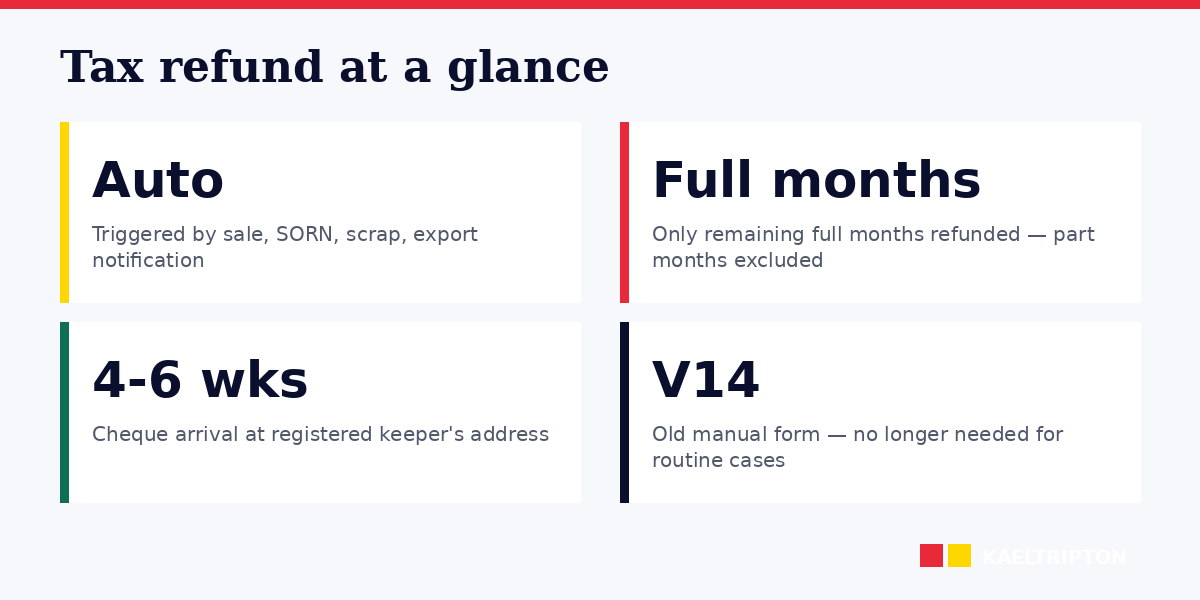
DVLA handles refunds automatically when you sell, SORN, scrap, or export. No V14 form needed in routine cases. The cheque arrives at the registered keeper's address within 4-6 weeks. If it fails to arrive, the usual cause is an out-of-date address on the V5C. Update the V5C before triggering a refund event. For Direct Debit payers, the 'refund' is simply that future payments stop - no cheque because DDs pay month by month. |
When you get an automatic refund
The DVLA system issues refunds automatically when it receives confirmation of any of these events:
- You sell or transfer the vehicle - the V5C change of keeper triggers the refund to the old keeper
- You declare SORN - Statutory Off-Road Notification triggers refund of remaining months
- You scrap the vehicle - the Authorised Treatment Facility notifies DVLA via the Certificate of Destruction
- You export the vehicle - notifying DVLA of permanent export using V5C section 11 triggers refund
- The vehicle is stolen and not recovered - police notification plus DVLA follow-up triggers refund after investigation
- The vehicle changes to a tax-exempt class - typically historic vehicle (over 40 years), or disabled tax class reclassification
- The vehicle is written off - insurance company notification plus scrapping typically triggers refund
In every automatic-refund scenario, you do not complete a form - the triggering event (sale, SORN, scrap, etc.) is enough. DVLA processes the refund and posts a cheque to the address on the V5C.
How the refund is calculated
DVLA refunds unused full months of tax - not part months. Key rules:
- The month in which the triggering event occurs is not refunded
- All subsequent full months are refunded at the monthly rate
- If you paid annually in one go, the refund rate is slightly lower than monthly Direct Debit because annual payers receive a small discount on the headline rate
- Direct Debit payments are cancelled automatically from the next due date
- The refund is sent by cheque to the registered keeper's address on the V5C
Worked example: you paid £195 annual tax on 1 January, covering 12 months. You sell the car on 15 June. DVLA automatically calculates the refund as 6 full months (July-December) × monthly rate. You receive a cheque for approximately £97 within 6 weeks.
Second example: you pay £17.06/month by Direct Debit. You SORN the car on 10 April. April's Direct Debit has already been taken; it is not refunded. May onwards DDs are automatically cancelled. No cheque is issued - the refund is effectively "no more payments" rather than money back, because DD customers pay month by month.
When the refund may fail or be delayed
Several situations cause refunds to stall or go to the wrong address:
- Address out of date on the V5C. The cheque goes to the address DVLA has on record. If you moved house without updating the V5C, the cheque goes to your old address. Update your V5C address first via gov.uk/change-address-on-driving-licence before triggering a refund event.
- V5C change of keeper not submitted properly. If you sold the car but didn't notify DVLA (either via the online service or by sending the V5C by post), no automatic refund is triggered. Submit the notification immediately - you remain liable for tax and fines until DVLA is told.
- Name change not updated. If your surname has changed (marriage, deed poll) since the V5C was issued, the cheque will be issued in your old name. Banks may refuse to cash it. Update the V5C with your new name before triggering the refund.
- Vehicle flagged for outstanding enforcement. If there are unpaid fixed penalty notices (congestion charge, CAZ, parking, ANPR) the refund may be held pending resolution. Check with DVLA and the issuing authority to resolve.
If 8 weeks have passed since the triggering event and no cheque has arrived, contact DVLA Customer Services on 0300 790 6802.
The old V14 form: no longer commonly used
Before 2014, the V14 form was the standard manual refund application. It is still accepted but essentially obsolete because all modern refund scenarios trigger automatic processing. You might encounter V14 only in unusual edge cases:
- Very old manual records that never transitioned to digital processing
- Complex cases involving multiple keeper transfers in quick succession
- Disputed refunds that DVLA has previously declined
For routine situations, do not download or fill in V14. The automatic refund process is both faster and more reliable.
Disabled tax class refund: a common gap
When a vehicle qualifies for the disabled tax class (DVLA class 85) - typically after PIP enhanced mobility rate award - the tax rate drops to £0. The owner's previous tax is refunded automatically from the date the disabled class takes effect.
Common issue: the application for disabled tax class uses form V10 plus the DVLA mobility allowance letter, and the process takes 2-3 weeks. During that window the previous tax continues. Once approved, DVLA refunds from the effective date of the class change - typically the date of the application, not the date of the PIP award.
If the effective date is unclear or disputed, submit the PIP award letter along with a written explanation to DVLA asking for the earliest possible effective date. Backdating is possible in some cases where the disability predates the tax class change.
A real 2026 scenario: selling a car mid-year
A 57-year-old accountant in Bristol sells her 2019 Volkswagen Golf in September 2026. She paid £195 annual tax in February 2026 (the month her tax fell due).
15 September. Sale completed. Buyer drives away. Seller (our accountant) notifies DVLA online via gov.uk/sold-bought-vehicle - takes 90 seconds. Hands the V5C/2 green slip to the buyer.
Same day. Automatic refund is triggered. DVLA system calculates: 4 full months remaining (October, November, December, January) × £16.25/month (approximate monthly equivalent of £195 annual) = £65.00.
Late October. Cheque for £65 arrives at her Bristol address, payable to her as the registered keeper. She banks it.
Same October. Buyer has taxed the car in his name (£195 annual, covering 12 months from his purchase). No gap in the tax record.
Total refund cost to DVLA: roughly £65. No form filled in, no phone call made, no delay beyond the 4-6 week processing window.
Export and emigration refunds
If you are permanently exporting the vehicle - for example, emigrating to France and taking the car with you - the refund process is:
- Complete section 11 of the V5C (Notification of Permanent Export)
- Send the V5C to DVLA, keeping the V5C/2 slip for the export destination country's registration process
- DVLA processes the notification and cancels UK tax from the date of export
- Automatic refund for remaining full months issued within 4-6 weeks to the UK address on the V5C
If you have already emigrated and no longer have a UK address, either ask DVLA to send the cheque to a trusted UK-based relative or friend (with a written authorisation), or arrange for the refund to be banked into a UK account. DVLA does not send refund cheques outside the UK.
For vehicles registered in the UK but taken abroad temporarily (holiday, extended EU stay), no export notification or refund is triggered - the UK tax remains valid and the vehicle is still taxed from the UK's perspective.
Frequently asked questions
How long does a DVLA tax refund take?
Typically 4-6 weeks from the triggering event (sale, SORN, export, scrap) to the cheque arriving at your registered address. If 8 weeks have passed with no cheque, contact DVLA Customer Services on 0300 790 6802.
Can I get a refund for part months?
No. DVLA refunds only full remaining months. The month in which the triggering event (sale, SORN etc.) occurs is not refunded, regardless of the date within the month. This is why declaring SORN effective "from next month" rather than immediately can add one month's refund in some cases.
What happens if I paid by Direct Debit monthly?
Direct Debit payments are automatically cancelled from the next scheduled due date following the triggering event. You do not receive a cheque for DD payments - the refund is effectively that future payments stop. Any DD already taken in the trigger month is not refunded.
Do I need to contact my insurer about the refund?
No - DVLA handles the tax refund process independently of insurance. If you also want to cancel your insurance on sale, that's a separate conversation with your insurer. Cancellation fees typically apply (typically £25-£50).
What if DVLA never sends my refund cheque?
Three likely causes: address out of date, name mismatch, or the triggering event wasn't correctly processed. Check your V5C address is current. Confirm DVLA received the sale/SORN notification. If both look correct, call DVLA Customer Services on 0300 790 6802 with your registration number and the date of the triggering event.
Can I claim a refund when I sell the car abroad?
Yes, via Section 11 of the V5C (Notification of Permanent Export). Complete it before leaving the UK, post the V5C to DVLA, and keep the V5C/2 for the destination country's registration. The refund goes to your UK address; arrange redirection if you've already emigrated.
Will the refund be the same as what I paid?
Not exactly. The refund is calculated at the monthly equivalent rate for full remaining months after the triggering event. If you paid annually upfront, your monthly equivalent is slightly higher than the headline rate suggests. If you paid monthly by DD, the refund is effectively "no more payments needed" rather than cash back.
Sources
- GOV.UK, Cancel your vehicle tax and get a refund - gov.uk/vehicle-tax-refund
- GOV.UK, Sold, transferred or bought a vehicle - gov.uk/sold-bought-vehicle
- DVLA, Vehicle refunds automatic processing rules 2026
- Vehicle Excise and Registration Act 1994 (as amended), Schedule 1
- DVLA Customer Services - 0300 790 6802
- GOV.UK, Declare SORN and get a tax refund - gov.uk/sorn
- GOV.UK, V5C section 11 - permanent export notification


