

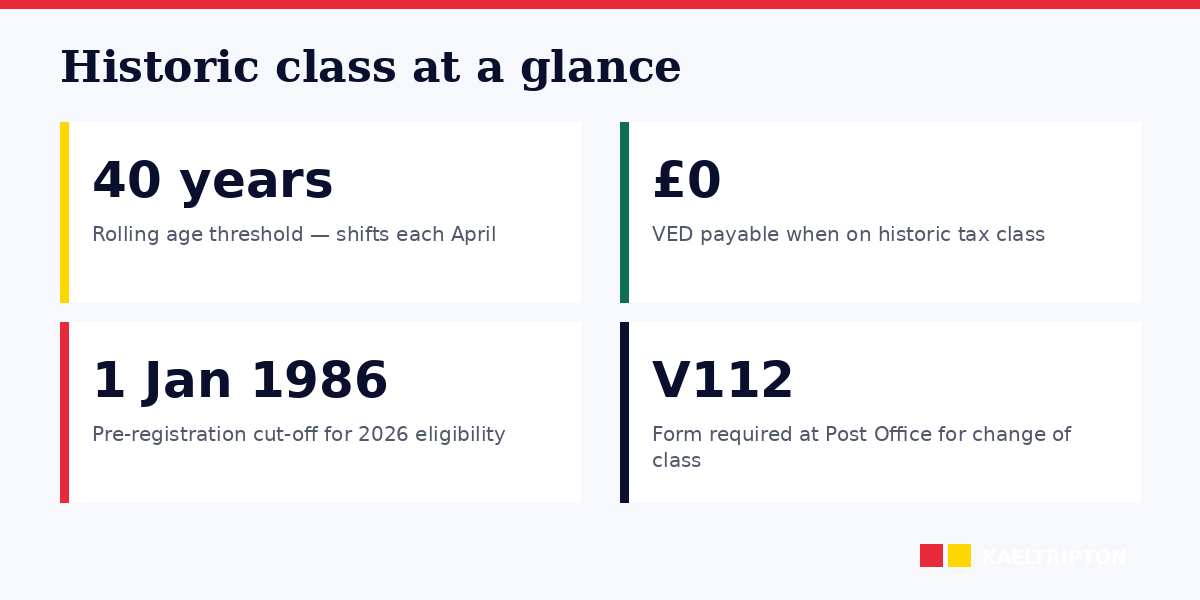
Cars over 40 years old qualify for the historic vehicle tax class (£0 Vehicle Excise Duty) under the UK's 40-year rolling exemption, introduced in April 2017. In 2026, this means vehicles first registered before 1 January 1986 are eligible - the cohort refreshes every year, bringing a new model year into exemption on 1 April annually. The rolling rule also automatically exempts these vehicles from MOT testing, though MOT remains optional and strongly recommended by safety groups. Application is free via form V112 at a Post Office. Vehicles with substantial modifications are excluded from historic class - keeping the car largely original matters. This guide covers the full 2026 process, the 1 April cycle, modification rules, and what "historic" actually means in DVLA terms.
| ★ EDITOR'S VERDICT 1985-registered cars become historic class in April 2026. £0 VED, optional MOT. |
The 40-year rolling rule means vehicles first registered before 1 January 1986 qualify for historic vehicle tax class from 1 April 2026 - £0 VED and automatic MOT exemption option. Apply via V112 at a Post Office. The rule updates each April, bringing one more model year into eligibility. Substantial modifications (engine swaps, chassis changes) exclude vehicles. Minor period-appropriate updates usually acceptable. UK first-registration date matters, not manufacture date - imported classics use UK-registered date, which can significantly delay eligibility. Insurance remains mandatory regardless of tax status. |
The 40-year rolling rule explained
The historic vehicle tax class works on a calendar cut-off that shifts each year:
- As of 1 April 2026, vehicles first registered before 1 January 1986 qualify
- As of 1 April 2027, vehicles first registered before 1 January 1987 will qualify
- And so on - each April, another model year becomes eligible
The rule was introduced on 1 April 2017 with a specific 40-year lookback. Before that, the exemption was tied to pre-1974 (or other fixed cut-offs) and not automatically progressive. The 2017 change made the exemption self-updating, meaning modern classics like the original Ford Sierra, BMW 5 Series E28, and early Audi Quattros are now reaching eligibility year by year.
Important timing: the vehicle becomes eligible based on its first registration date, not its manufacture date. A 1985-manufactured car first registered in 1986 is NOT eligible until April 2027 - because the critical question is when the DVLA (or predecessor) first registered it on UK plates. Check the V5C "date first registered in the UK" field.
What qualifies and what doesn't
Qualifying vehicles
- Cars, vans, and light commercial vehicles registered before the relevant cut-off
- Motorcycles over 40 years old
- Imported classic vehicles, provided the UK first-registration date predates the cut-off
- Vehicles with V5C class 4 or other appropriate standard registrations
Vehicles excluded from historic class
- Substantially modified vehicles. The key exclusion. Modifications that change the vehicle's fundamental character exclude it. Examples: engine swapped for a modern replacement, body modified from original, chassis changes. Minor cosmetic changes or period-appropriate modifications usually acceptable.
- Vehicles used commercially. Historic class is for personal use. Commercial hire (weddings, film hire, driving experiences) generally requires a different tax class.
- Vehicles requiring Goods Vehicle Testing (GVT) in some categories - check specific vehicle type.
- Replica or kit cars. A car built to look like a 1970s sports car from modern components doesn't qualify just because it resembles an old car.
The "substantially modified" test is decided at DVLA's discretion. Grey areas: an original engine rebuilt with modern parts (usually OK), updated electronic ignition (usually OK), replacement chassis from a different model (typically not OK).
How to apply
The application must be made at a Post Office that offers vehicle tax services. Online applications cannot currently change tax class to historic - it requires counter submission.
Documents needed
- V5C registration certificate showing the vehicle's first registration date
- Form V112 - the exemption declaration form, available free from gov.uk or at Post Offices
- MOT certificate if the vehicle currently has one (can be waived - see below)
Form V112 is a declaration. You tick the box for "Historic vehicle (HC)" and sign to confirm the vehicle is over 40 years old and has not been substantially modified from its original specification. The Post Office verifies the V5C registration date matches.
The change from your current tax class (likely PLG - Private Light Goods) to HC (Historic Class) is processed immediately. The tax becomes £0 and your new tax starts at the next annual renewal date or immediately if your current tax is expiring.
Timing your application
For a vehicle crossing the 40-year threshold during the tax year:
- You can apply from 1 April of the year the vehicle becomes eligible
- Before 1 April, the vehicle still requires standard VED (and MOT) even if it's about to cross the threshold
- Applying early - in the first few weeks of April - is common and avoids missing the benefit
You don't have to switch to historic class immediately on eligibility - some owners prefer to keep standard class if they benefit from specific tax band treatment. The switch is voluntary. Once switched, switching back to standard class is possible but requires Post Office counter action.
MOT exemption: automatic but optional
When you switch to historic tax class, the vehicle is automatically exempt from MOT testing. This is a second, separate benefit that comes with the tax change - no separate MOT exemption application needed.
However, MOT exemption is optional. You can:
- Continue MOT testing voluntarily - many historic vehicle owners do, for peace of mind and evidence of roadworthiness
- Use no MOT - legal, common for low-mileage carefully-maintained vehicles
If you choose no MOT, the vehicle must still be roadworthy. Any mechanical or structural issues that would have failed an MOT still make the vehicle illegal to drive and expose you to insurance issues in any accident.
Historic vehicle clubs and specialist insurers often recommend periodic MOT testing (every 2-3 years) even for exempt vehicles, as independent verification of condition and as insurance evidence.
Insurance considerations for historic vehicles
Historic tax class doesn't affect your insurance obligations - you still need valid motor insurance. Specialist classic car insurance is typically:
- Limited mileage policies - 1,500-5,000 miles per year, at rates much lower than standard insurance
- Agreed valuation - instead of market value at claim time
- Restrictions on daily use - some policies require a second "daily driver" vehicle
- Cherished vehicle clauses - recognition that the car is a restorable asset rather than purely utilitarian
Major specialist insurers: Footman James, Lancaster Insurance, Hagerty UK, Adrian Flux Classic, Pearson Insurance. Premiums for a typical £15,000 classic range £100-£400/year depending on the car, usage, storage, and driver profile.
A real 2026 scenario: 1985 MG Metro reaching eligibility
A 62-year-old in Kent owns a 1985 Austin Rover MG Metro 1300, first registered June 1985. The car has been on standard tax class (PLG, paying £265 in 2025-26 based on engine size). He plans to switch to historic class in 2026.
January-March 2026: waits for eligibility. The car reaches its 40-year threshold on 1 June 2025 (by manufacture date) but the rolling rule is based on registration year - he must wait until 1 April 2026 when 1985 vehicles become eligible.
Early April 2026: goes to his local Post Office that handles vehicle tax. Brings V5C confirming first registration date 14 June 1985, form V112 completed declaring vehicle has not been substantially modified, and current MOT certificate (he's kept MOT current voluntarily).
At Post Office: counter staff verify V5C registration date is pre-1 January 1986 cut-off. Accepts V112 declaration. Changes tax class from PLG to HC (Historic Class). Issues new VED certificate for £0. Processing time: 10 minutes.
From April 2026 onwards: car is on historic class, £0 VED annually. MOT becomes optional. He decides to continue MOT-testing every 2 years for peace of mind and insurance evidence.
Annual savings: £265 VED × years of continued ownership. Plus MOT cost savings if he eventually stops testing (though he continues voluntarily).
Imported classic vehicles
Classic vehicles imported into the UK from abroad have specific rules:
- UK first-registration date is what DVLA uses for the 40-year rule, not the original registration date in the country of origin
- A 1984 car brought from the US to the UK in 2020 has UK first-registration date 2020 - it would NOT become UK-historic-class-eligible until 2060, despite being 40 years old
- Exception: some vehicles imported under specific provisions retain their original registration date for historic class purposes - rare and specialist
For owners of imported classics, the practical consequence is that historic tax class is usually not available for many years after arrival. They pay standard VED based on the vehicle's engine size and emissions, sometimes with surcharges for non-compliant emissions under CAZ/ULEZ schemes.
When NOT to switch to historic class
In rare cases, standard tax class is preferable to historic class:
- If the vehicle is in the £0 CO2 band already under the 2001-2017 CO2 banding system (very rare for 40-year-old vehicles)
- If you routinely drive the vehicle in London's ULEZ zone - historic class doesn't provide ULEZ exemption (those are separate regulations), but historic vehicles (over 40 years old, original) DO qualify for ULEZ exemption under current TfL rules. Check the specific overlap before relying on either.
- If the vehicle is used substantially commercially - historic class is personal use only. Commercial use needs a different class.
The decision is typically straightforward - historic class gives £0 VED plus MOT exemption option - but check your specific situation.
Frequently asked questions
What's the exact cut-off date for the 2026 historic class eligibility?
Vehicles first registered before 1 January 1986 qualify from 1 April 2026. The cut-off updates each 1 April to include the next model year. So from 1 April 2027, vehicles registered before 1 January 1987 will be eligible.
Do I have to MOT my historic vehicle?
No, historic class vehicles are MOT-exempt. However, the vehicle must be roadworthy to drive legally. Many owners voluntarily MOT-test every 2-3 years for peace of mind. Insurance claims may be easier to handle with documented MOT passes even when not legally required.
Can a modified classic car qualify for historic class?
Depends on the extent of modification. Original engine retained, minor cosmetic updates, and period-appropriate modifications usually acceptable. Engine swap to modern unit, chassis replacement, or substantial body modifications disqualify the vehicle. DVLA has final discretion - borderline cases can be submitted with details for DVLA review.
What if I restore a classic car with period-appropriate parts?
Rebuilding to original specification using period parts (even if sourced recently) typically preserves historic class eligibility. Full concours restoration is often compatible with the rules. "Matching numbers" restorations are the clearest case. Substantial deviation from original spec is where issues arise.
Can I drive my historic vehicle every day?
Legally yes. The tax class doesn't restrict use. However, many classic cars are not designed for modern daily driving (fuel economy, emissions, comfort, safety features), and insurance policies often restrict daily use. The tax class is about tax, not usage.
If I bought an imported classic, when does historic class apply?
Based on UK first-registration date, not original date of manufacture or registration abroad. A 1975 car imported and first registered in the UK in 2015 becomes UK-historic-class-eligible in 2055 (40 years after UK first registration). For imports made before 2017, check individual case specifics.
What happens if I sell a historic class vehicle?
The vehicle stays on historic class through the sale. The new owner doesn't need to reapply - the tax class is attached to the vehicle. Standard V5C change of keeper applies. The new owner should understand the MOT exemption and any insurance implications.
Sources
- GOV.UK, Historic (classic) vehicles: MOT and vehicle tax - gov.uk/historic-vehicles
- DVLA, Form V112 - declaration of exemption from vehicle test
- Vehicle Excise and Registration Act 1994 (as amended)
- Finance Act 2017 - introduction of 40-year rolling exemption
- Transport Research Laboratory, Historic Vehicle MOT Exemption - impact assessment 2018-2025
- Federation of British Historic Vehicle Clubs (FBHVC), Historic Vehicle UK policy and advocacy


