

Ending a Statutory Off-Road Notification (SORN) is simple on the DVLA side - you just tax the vehicle again at gov.uk/vehicle-tax. The SORN automatically ends the moment you pay tax. But the practical side involves several other steps: the car must have a valid MOT before you can tax it, you need insurance active from the moment you first drive, and a vehicle that's been off-road for months needs basic checks before driving. This guide covers the full transition process - the ordered sequence, what can go wrong, and the specific checks needed depending on how long the car has been SORN'd. A vehicle off the road for 3 months has different requirements than one off for 3 years.
| ★ EDITOR'S VERDICT Just tax the car. SORN ends automatically. The admin is simple. |
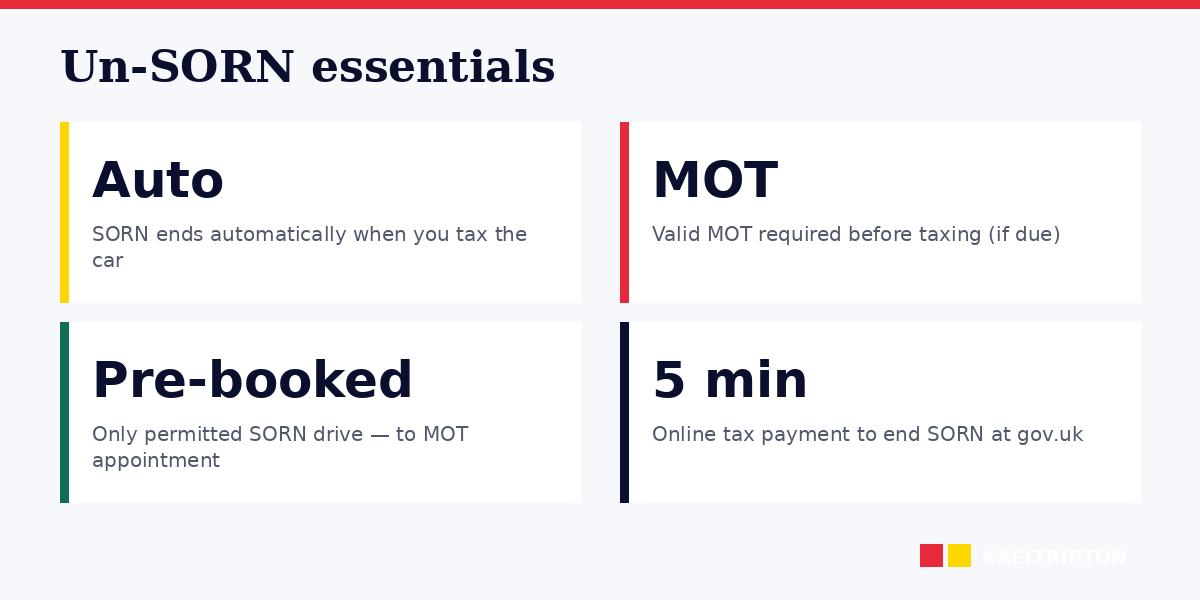
No separate 'un-SORN' form exists - ending a SORN is implicit in taxing the vehicle at gov.uk/vehicle-tax. 5-minute online process. Prerequisite: a valid MOT. If expired, drive legally to a pre-booked MOT (the one permitted SORN drive). Test passes, tax immediately, drive normally. Insurance must be active from the moment you first drive - even to the MOT. Temporary policies from £15-£25 cover the test journey. Cars SORN'd for 6+ months need realistic post-storage checks - battery, tyres, fluids, possible corrosion. Budget £100-£200 for pre-drive preparation. |
The DVLA side: just tax to un-SORN
SORN is the absence of tax. Once you tax the vehicle, the SORN ends automatically - no separate "end SORN" form or process. DVLA treats the tax payment as implicit cancellation of the SORN status.
- Go to gov.uk/vehicle-tax
- Enter reference from V5C (11-digit) or V11 reminder (16-digit)
- Choose payment frequency (annual, 6-monthly, monthly DD)
- Pay the VED fee
- Receive confirmation email - tax now valid, SORN ended
Total time: 3-5 minutes. The moment payment is confirmed, the vehicle is legal to drive. You can tax the car on your phone while standing next to it.
Prerequisite: valid MOT
Before you can tax a vehicle, it needs a valid MOT (unless exempt - typically under 3 years old in Great Britain, 4 years in Northern Ireland, or historic vehicles over 40 years old on the historic tax class).
If your SORN'd car's MOT has expired during storage:
- Book an MOT test at any DVSA-authorised garage (GB) or DVA test centre (NI)
- You're legally allowed to drive a SORN'd vehicle to a pre-booked MOT appointment - no tax needed, no additional paperwork, just the booking confirmation accessible on your phone
- Attend the test - typical Class 4 fee £35-£55 at most GB garages
- If it passes, tax the car immediately from the MOT centre - the car is now fully road-legal
- If it fails, repair then retest. The car cannot be taxed or driven until a pass
Vehicle that's been off-road for months often fails its first post-storage MOT - tyres degrade, brake fluid can absorb moisture, batteries flatten. Budget for some repair work if the vehicle has been static for 6+ months.
Insurance from the moment you drive
Arrange insurance before you drive the car away, even to the MOT centre:
- "Laid up" or storage policy during SORN: if you kept basic insurance covering fire/theft during storage, you can typically extend it to full cover for the MOT journey with a phone call to your insurer
- No insurance during SORN: you need a fresh annual policy or short-term insurance from the moment you drive. Temporary policies (Cuvva, Dayinsure) from 1 hour for the MOT journey - typical £15-£25
- Direct-to-MOT exemption: driving to a pre-booked MOT is legally permitted without tax, but insurance is still required. No exemption on insurance.
Check the Motor Insurance Database (insurancedatabase.com or askMID.com) to confirm your insurance is active before driving. Real-time database linked to police ANPR.
Pre-drive safety checks
A car that's been SORN'd for an extended period may have deteriorated in ways that affect safety. Before driving any distance:
Quick checks (5 minutes)
- Battery - attempt start. If flat, charge or jump-start. Extended storage typically drains to flat in 4-8 weeks. A trickle charger during storage prevents this.
- Tyres - pressures (check against door-jamb plate), no flat spots from long storage, tread depth above 2mm, no perishing or cracking on sidewalls. Old tyres (6+ years) may be legal but perishing.
- Fluids - oil level and colour (should be honey-amber; black/sludgy = needs change), coolant level, brake fluid, washer fluid
- Lights - all bulbs (headlights, indicators, brake lights, reversing lights)
- Horn, windscreen wipers, washers - all operational
- Brakes - pedal should feel firm; take the first few miles slowly to check
More detailed checks for vehicles SORN'd 6+ months
- Engine oil change - if due. Storage doesn't stop oil degradation entirely
- Brake fluid - absorbs moisture. Consider fresh fluid if over 2 years old
- Coolant - can degrade over time. Check condition
- Fuel - modern E10 petrol can go stale in 3-6 months. Consider draining and refilling if 6+ months static
- Tyres - flat spots from long storage may require driving 10-20 miles at moderate speed to restore roundness. Severe flat spots need replacement
- Rodent damage - check engine bay for nests, chewed wiring, or debris
Book a pre-drive inspection at a trusted garage (£30-£60) if the car's been off-road for over a year. Cheap insurance against bigger problems.
The DD cancellation and refund
When you originally SORN'd the vehicle, any annual Direct Debit VED was automatically cancelled. When you re-tax, you start fresh - new DD setup if desired, or single annual payment.
If you previously had outstanding VED from the SORN period: no, VED isn't backdated for unused months. DVLA stopped charging the moment SORN was declared; they start charging again the moment you re-tax.
A real 2026 scenario: classic car off the road for winter
A 54-year-old owns a 1987 Mazda MX-5. SORN'd on 1 November 2025 after the summer driving season. Wants to un-SORN and return it to the road in April 2026.
Early April 2026: current MOT expired 15 February 2026 - needs new test. Insurance was on a laid-up policy at £90/year during SORN.
10 April 2026: books MOT at local classic specialist for 18 April. Contacts insurer to upgrade laid-up to full policy from 15 April. Starts charging battery on trickle charger.
15 April 2026: insurance now full cover £240/year. Checks battery (now fully charged), tyres (all above 3mm, pressure slightly low - pumped up to spec). Fresh washer fluid. Starts engine - runs slightly rough for first 30 seconds, then smooth.
18 April 2026: drives the 4 miles to MOT centre. Test passes with advisories on wiper condition and one bulb near failure. Fee £38.
Immediately after MOT: taxes online via phone. 40-year-old rule means car was eligible for historic class (1 January 1986 threshold, car registered March 1987 so not quite yet - reaches historic class April 2027). Pays standard £360 for MX-5 classic tax band.
April 2026 onwards: drives normally. Total transition cost: £38 MOT + £360 tax + £150 incremental insurance premium (full vs laid-up) + £8 new wiper + £5 bulb = £561. Plus the 8 minutes of online admin.
Frequently asked questions
Do I need a separate form to end a SORN?
No. SORN ends automatically when you tax the vehicle. No separate "un-SORN" form or application is needed - the tax payment itself is the implicit end of SORN status. DVLA automatically updates the vehicle's record from SORN to taxed. Confirmation of tax = the vehicle is on-road legal.
Can I drive a SORN'd car to the MOT?
Yes, to a pre-booked MOT appointment only. This is the one permitted journey for a SORN'd vehicle. Keep the booking confirmation accessible on your phone. Any other driving (to the shops, to a different garage, to visit a friend) is an offence.
What if my MOT expired while the car was SORN'd?
You book an MOT, drive directly to the test (permitted under SORN), hope it passes, then tax the car immediately. If it fails, you repair first - you cannot tax a failed-MOT vehicle. Budget for potential repairs when planning an un-SORN from long-term storage.
Does un-SORN affect my insurance no-claims bonus?
No. Your no-claims bonus is preserved through the SORN period as long as your insurance continued (even laid-up cover counts). Many insurers explicitly treat laid-up periods as bonus-preserving. Check with your specific insurer.
Can I un-SORN partway through a tax year?
Yes. You can un-SORN any time. Your new tax runs for the next 6 or 12 months from the un-SORN date, depending on your chosen payment period. No pro-rating from an earlier tax year.
What if the car has been SORN'd for years?
Additional preparation. Battery may need replacement, fuel could be stale, tyres likely need changing (old tyres degrade over time even static), brake fluid needs replacement, possible corrosion on structural elements. A pre-MOT inspection at a garage specialising in long-dormant vehicles is highly recommended - typically £60-£150.
Can I un-SORN if the DVLA didn't receive my original SORN properly?
If there's any ambiguity about your SORN status, check at gov.uk/get-vehicle-information-from-dvla. The page shows whether the vehicle is currently SORN'd, taxed, or neither. Contact DVLA on 0300 790 6802 if the status shown doesn't match your records. Resolving this before re-tax avoids complications. Note that keeping a SORN'd vehicle on a public road - even parked - is an offence and can trigger retrospective penalties even after you un-SORN, so confirm storage arrangements before declaring SORN initially.
Sources
- GOV.UK, Tax your vehicle - gov.uk/vehicle-tax
- GOV.UK, Statutory Off-Road Notification - gov.uk/sorn
- GOV.UK, Get vehicle information from DVLA - gov.uk/get-vehicle-information-from-dvla
- Vehicle Excise and Registration Act 1994 (as amended) - SORN provisions
- DVLA, INS160 - Vehicle tax and keeping a vehicle off the road
- DVSA, Booking an MOT for a SORN'd vehicle
- Motor Insurers' Bureau, Laid-up insurance policy definitions
- DVLA Customer Services - 0300 790 6802


