

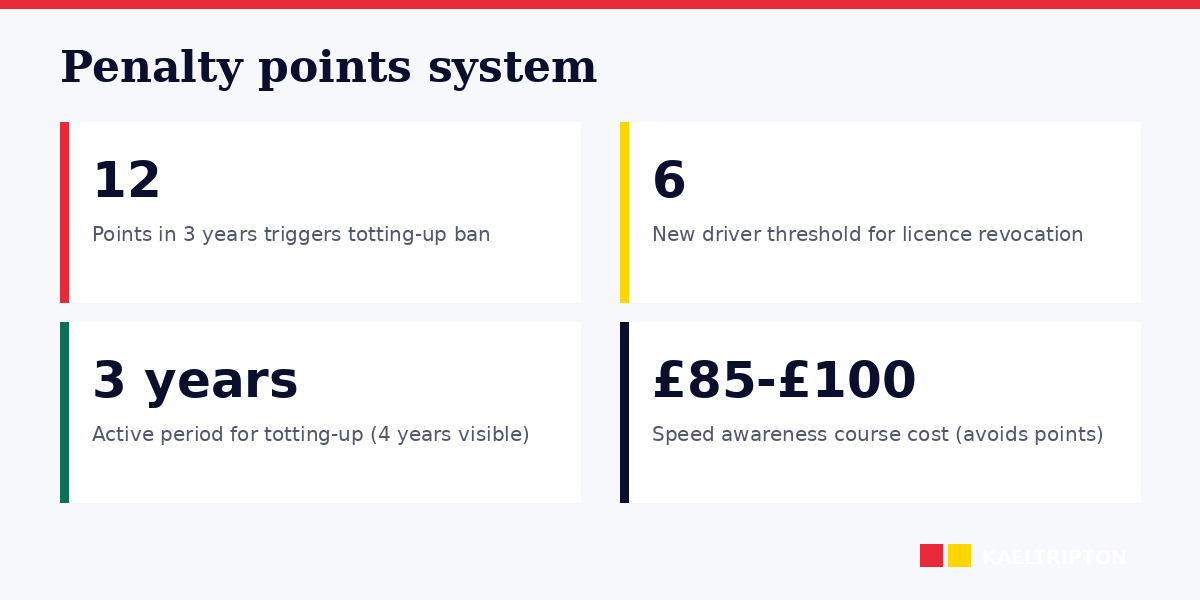
UK drivers who accumulate 12 or more penalty points within 3 years face a mandatory 6-month disqualification under the totting-up provisions of the Road Traffic Offenders Act 1988. New drivers within their first 2 years of passing face stricter rules - 6 or more points revokes the licence entirely, requiring theory and practical retests. Speed awareness courses at £85-£100 avoid points for eligible first-time minor speeding offences. Exceptional hardship arguments can prevent a ban but the burden is on the driver to show disproportionate impact. Points are active for 3 years (towards totting up) but visible on the licence for 4 years, and insurers typically require disclosure for up to 5 years. This guide covers the 2026 system with detailed rules and real consequences.
| ★ EDITOR'S VERDICT 12 points in 3 years = 6-month ban. 6 points as a new driver = licence revoked. |
UK penalty points stay active for 3 years (visible for 4). Accumulate 12+ within 3 years and a mandatory 6-month ban follows. New drivers in their first 2 years have a tougher threshold - 6 points revokes the licence entirely, requiring full retests. Speed awareness courses (£85-£100) avoid points for eligible minor speeding offences - often cheaper than the insurance premium hit of even a single SP30 conviction. Exceptional hardship arguments can save a licence in 30-40% of cases with strong evidence. |
How the points system works
Penalty points are added to a driver's record for specific offences. Common offence codes and typical points:
- SP30: exceeding statutory speed limit on a public road - 3-6 points
- SP50: exceeding speed limit on a motorway - 3-6 points
- CU80: breach of requirements regarding mobile phones while driving - 6 points
- MS90: failing to identify the driver of a vehicle - 6 points
- TS10: failing to comply with traffic signs (e.g., red light) - 3 points
- CD30: undue care and attention - 3-9 points
- IN10: using a vehicle uninsured against third party risks - 6-8 points
- DR10: driving or attempting to drive with alcohol concentration above limit - 3-11 points (plus mandatory disqualification typically)
- DR40: in charge of a vehicle while above alcohol limit - 10 points
- LC20: driving otherwise than in accordance with a licence - 3-6 points
Points stay on your record for specific durations:
- Most offences: 4 years from date of offence (3 years active for totting-up purposes, 4th year visible but not counted)
- Drink and drug driving (DR, DG codes): 11 years from date of conviction
- Causing death by dangerous driving: 11 years
The totting-up threshold: 12 points = ban
Section 35 of the Road Traffic Offenders Act 1988 establishes the totting-up rule. When a driver accumulates 12 or more active penalty points within 3 years of offence dates, the court must impose a minimum 6-month disqualification.
Key points about totting up:
- The 3-year calculation is based on the date of offence, not date of conviction
- Only points within 3 years count towards totting - older points stay on the licence but don't contribute
- The 12th point triggers mandatory disqualification - the court has no discretion except in exceptional hardship cases
- Minimum ban is 6 months for first totting-up offence
- Ban increases to 12 months if the driver has been disqualified for 56+ days in the previous 3 years
- Ban increases to 2 years if the driver has had 2 such disqualifications within 3 years
Worked example: driver receives 3 points for SP30 on 1 March 2024 (active until 1 March 2027), 3 points for SP30 on 15 October 2024 (active until 15 October 2027), and 6 points for CU80 mobile phone offence on 20 August 2025 (active until 20 August 2028). Total active points as of late 2025: 12. Totting-up disqualification applies.
New driver rules: stricter by design
Drivers within their first 2 years after passing their practical test fall under the New Driver Act 1995. The threshold is just 6 points. Reaching 6 points within the 2-year probationary period results in:
- Automatic licence revocation (not just a disqualification)
- Requirement to reapply for a provisional licence
- Mandatory retake of both theory and practical driving tests
- Cost: £34 provisional + £23 theory + £62 practical = approximately £120 in test fees alone
- Plus typical 4-12 weeks delay to re-licensing due to test booking waits
- Plus significantly higher insurance premiums for 3-5 years after any conviction
New drivers who accumulate 6+ points have no totting-up ban - they lose the licence entirely. This is more severe than the standard ban because it requires full retesting rather than just a waiting period.
Important: once a new driver completes their 2-year probationary period, they revert to the standard 12-point rule for the rest of their driving life.
Speed awareness courses: the alternative to points
For minor speeding offences, police forces often offer a speed awareness course instead of prosecution. No penalty points result if you complete the course.
Eligibility criteria (vary slightly by police force):
- Typically offered for speeds 10-24mph over the limit, though limits vary
- First-time offender status - usually no speed awareness course if you've attended one within 3 years
- Speed must not be significantly excessive - some police forces exclude speeds 30mph+ above limit
- No other aggravating circumstances (fatalities, dangerous conditions, etc.)
Cost: £85-£100, paid by the driver. Takes 3-4 hours, online or in person. Covers speed limit rationale, stopping distances, and collision consequences.
Completing the course: no points added, no conviction recorded, no court appearance. The alternative - a Fixed Penalty Notice at typically £100 plus 3-6 points - can be more expensive and certainly worse for future insurance.
Insurance implications: a speed awareness course does not count as a conviction and generally doesn't need to be declared on insurance. However, some insurers now ask directly: "Have you attended a driver awareness course in the last 3 years?" If asked, you must answer truthfully. If not asked, you don't need to volunteer the information.
Exceptional hardship: the last-chance argument
A driver facing totting-up disqualification can argue "exceptional hardship" to avoid the ban. The legal bar is high - hardship must be more than ordinary or foreseeable.
Arguments that typically succeed:
- Loss of employment where the driving licence is essential and loss would cause genuine hardship beyond lost wages
- Significant impact on elderly or disabled dependents who rely on the driver for essential transport (GP visits, hospital, care)
- Financial ruin beyond normal inconvenience - mortgage default, loss of home, inability to support family
- Loss of remote geographic access (public transport inadequate for specific needs)
- Health conditions that make a ban disproportionately damaging
Arguments that typically fail:
- General inconvenience of public transport
- Simple difficulty finding a new job
- Personal preference for driving over public transport
- Modest financial impact that most drivers could absorb
The applicant bears the burden of proof with evidence (employer letters, family medical reports, financial records). Exceptional hardship decisions vary by court and individual circumstances. Typical success rate with strong evidence: approximately 30-40% of applications prevent or reduce the ban.
Insurance disclosure: the hidden penalty
Your penalty points affect insurance in ways that often surprise drivers:
- Immediate premium increase: typically 20-60% at next renewal for 3 points from SP30
- Disclosure period: most insurers require declaration of unspent convictions for up to 5 years - even though points are only "valid" for 3 and visible for 4
- No-claims discount impact: if the offence was part of an at-fault accident, loss of NCD plus the points penalty
- Policy void risk: failure to disclose convictions when asked = potential policy void and refused claims
- Repeat offences: multiple convictions create escalating premiums - 6 points can triple a premium in some cases
Real cost over 5 years for a single SP30 conviction: £1,500-£4,000 in increased premiums alone. Far more than the £100 fixed penalty.
A real 2026 scenario: near-totting-up driver
A 38-year-old courier driver has 9 active penalty points:
- 3 points SP30 from February 2024
- 3 points SP30 from November 2024
- 3 points CU80 from June 2025 (mobile phone)
In April 2026 he's stopped for a minor speeding offence - 36mph in 30mph zone. Police offer a speed awareness course. He already completed one in 2023 (within 3 years) so not eligible again.
Option 1: Accept Fixed Penalty Notice (3 more points) - total 12 points. Triggers mandatory 6-month disqualification.
Option 2: Contest the ticket in court - if he loses, higher fine plus 3-6 points. If he wins (speed measurement challenge), no points.
Option 3: Accept FPN, but plan exceptional hardship application - engage solicitor at £800-£2,500 for representation. Prepare evidence of business impact, family dependents, difficulty finding alternative employment.
He chose Option 3. Court granted reduction to 4-month ban and kept some points deferred. Solicitor costs £1,400. Insurance premium tripled the following year. Continues driving during the defensive phase before ban begins.
Lesson: points accumulation is cumulative and expensive. A single fourth offence becomes exponentially costly.
Checking your own points
Check your driving licence status free at gov.uk/view-driving-licence:
- Shows active and expired points
- Shows any current disqualifications
- Requires your licence number, NI number, and postcode
- Free, no login required
- Updates within 2 weeks of court convictions being processed
Review periodically to confirm accuracy. Errors are rare but do occur and can be corrected by contacting DVLA.
Frequently asked questions
How long do penalty points stay on my licence?
Most offences: 4 years from date of offence. Active (for totting-up) for 3 years. Drink/drug driving and other serious convictions (DR codes): 11 years. Insurance disclosure typically required for 5 years regardless of the licence validity.
Can I pay to have points removed early?
No. There is no legal mechanism to remove active penalty points early, regardless of cost. Points automatically expire based on their validity period. Only route to "remove" them is to not accumulate more in the qualifying period.
What counts as a "new driver"?
Any driver within 2 years of passing their practical driving test. The probationary period runs from the test pass date, not the date of first licence issue. After 2 years, standard rules apply (12-point threshold).
How much is the typical speeding fine?
Fixed Penalty Notice: £100 plus 3 points (Band A speeding). Band B fines start at 100% of weekly income. Band C speeding and dangerous driving can reach £2,500 + disqualification. Income-based calculations mean higher earners pay proportionally more.
Can I drive while exceptional hardship is being considered?
Yes, until the court actually imposes the ban. If you've reached 12 points, the court process typically takes 1-3 months from offence to conviction. During this period you can continue driving. Once the ban is imposed, you must stop immediately.
What happens to my insurance if I'm banned?
Existing policy typically remains in force but cannot be used during the ban. Most insurers allow policy suspension at nominal fee, or cancellation with pro-rata refund. Once you regain licence, finding new insurance is difficult and expensive - expect 2-4x normal rates for 3-5 years.
Can I still ride my moped if I lose my car licence?
Depends on the specific offence. Some offences (drink/drug driving) apply across all categories. Others (speeding in a car) don't automatically affect motorcycle category. Check the specific ban wording - the court typically specifies which categories are affected.
Sources
- Road Traffic Offenders Act 1988 (as amended), Section 35 - totting-up provisions
- New Drivers Act 1995 - 2-year probationary period and 6-point revocation
- Road Traffic Act 1988 (as amended)
- GOV.UK, View your driving licence information - gov.uk/view-driving-licence
- GOV.UK, Penalty points (endorsements) on your driving licence
- DVLA Penalty Points Office
- Association of British Insurers (ABI), Motor insurance disclosure requirements
- UK Police forces, Speed Awareness Course eligibility criteria


