

Check any UK vehicle's exact 2026-27 Vehicle Excise Duty (VED) rate for free at the DVLA Vehicle Enquiry Service. Enter just the registration number - the service shows the current tax rate, whether tax is currently valid, the next due date, the CO2 figure used for banding, and whether the Expensive Car Supplement applies. Essential before buying a used car - you see exactly what you'll pay annually before committing. For vehicles you're considering buying new, manufacturer list price and CO2 figures determine both the first-year showroom tax and the ongoing standard rate. This guide covers how to check any vehicle, what affects your rate, and the 2026-27 rate structure you'll encounter.
| ★ EDITOR'S VERDICT Free, 30 seconds, tells you everything about any UK vehicle's tax position. |
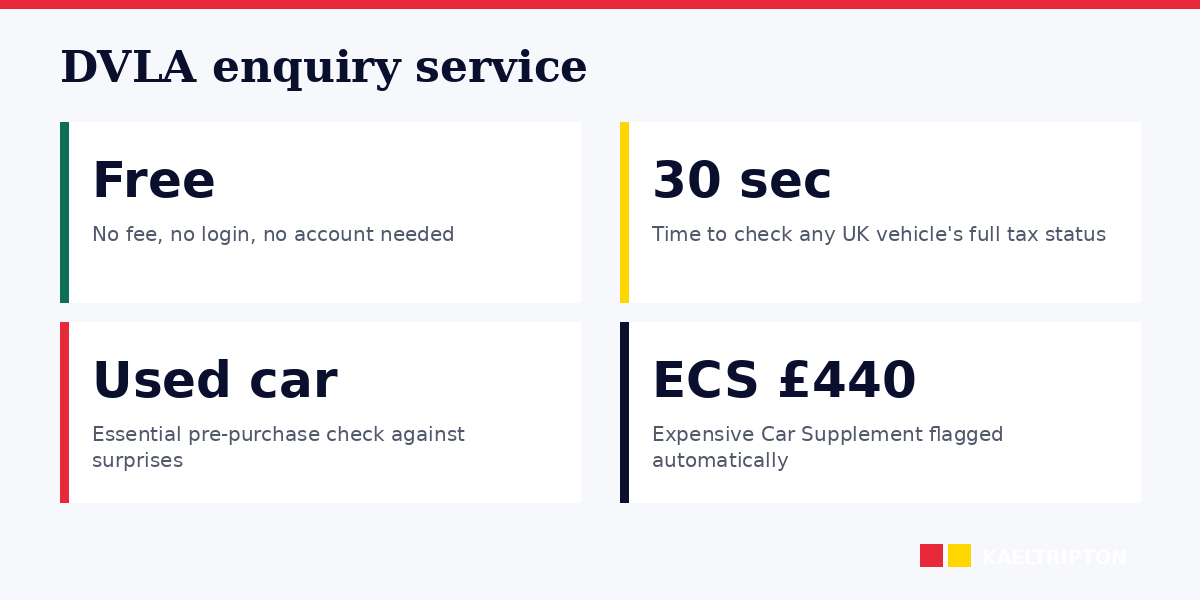
The DVLA Vehicle Enquiry Service at gov.uk/get-vehicle-information shows any UK car's exact VED rate, tax status, CO2 figure, MOT status, and first registration date - completely free. Essential before buying a used car. Catches hidden costs like Expensive Car Supplement (£440/year years 2-6 for cars over £40,000 list price, or £50,000 for EVs from April 2026). The service reflects 2026-27 rates from 1 April onwards - check timing if you're comparing rates near the fiscal year change. Third-party calculators mostly repackage this free data. Always cross-check against GOV.UK for the definitive answer. |
The DVLA Vehicle Enquiry Service
The official tool is at gov.uk/get-vehicle-information-from-dvla. The service is free, no login, no fee:
- Go to the page above
- Enter the vehicle registration number
- The service returns:
- Make and model
- Colour
- Fuel type (petrol, diesel, hybrid, electric)
- Engine size (cc)
- CO2 emissions (g/km)
- Current tax status (taxed, SORN, unregistered)
- Tax expiry date if currently taxed
- Current annual VED rate
- MOT status and expiry
- Date of first registration
- Weight (relevant for some calculations)
This is the same service insurance companies, dealers, and government agencies use. The data comes from the live DVLA database.
What determines your rate
Three factors combine to set your VED rate:
1. Vehicle age (registration date)
- Registered before 1 March 2001: flat rate based on engine size (£220 under 1549cc, £360 over 1549cc)
- Registered 1 March 2001 to 31 March 2017: CO2 bands A to M, £20 (Band A) to £790 (Band M)
- Registered from 1 April 2017: first-year showroom tax then £200 standard rate
2. CO2 emissions (g/km)
The specific figure determines which band you fall in. For post-2017 cars in year one, the first-year tax runs from £10 (zero-emission) to £5,690 (over 255 g/km). After year one, standard rate £200 applies regardless of CO2 except for hybrid and zero-emission category refinements.
3. List price (Expensive Car Supplement)
If the car's list price was over £40,000 (£50,000 for zero-emission vehicles from 1 April 2026) when new, an additional £440/year supplement applies in years 2-6. This can add £2,200 over the five-year supplement period.
Plus secondary factors
- Diesel surcharge for non-RDE2 diesel cars (first-year only - bumps you one band higher)
- Fuel type adjustment for specific categories
- Disabled tax class - £0 or 50% reduction
- Historic vehicle class - £0 if over 40 years old and unmodified
- Commercial/goods vehicle classes - different rate structure
Using the calculator before buying a used car
Run the check on the seller's registration before you commit:
- Note the current annual VED amount - that's what you'll pay each year (assuming no major changes)
- Check if the tax is currently valid - if not, you need to tax it before driving away
- Note the next renewal date - factors into your ownership timing
- Check MOT status - similar annual cost to factor in
- Verify fuel type and engine size match what the seller described
Common gotchas when buying used:
- Expensive Car Supplement still running: a car first registered 2024 at £45,000 list price owes the £440/year supplement through 2029. Buying in 2026 means 3 more years of the surcharge. Factor this in.
- Pre-2017 registration with high CO2 band: those M-band cars (£790/year) look deceptively cheap on paper, but the annual tax is punitive. Check the registration-date tier.
- Imported vehicle: UK first-registration date determines the rate tier, not the vehicle's model year. A 2015 Japanese import first registered in UK in 2022 uses post-2017 rules.
Using the calculator for a new car purchase
For a car you're considering buying new (not yet registered), the DVLA service won't help. Instead, use manufacturer and dealer information to calculate:
Step 1: Find the official CO2 figure
- Manufacturer's official WLTP CO2 figure (not NEDC, which was superseded in 2019)
- Check the manufacturer's website or the V5C sample data in the brochure
- Actual V5C will show when the car is registered
Step 2: Apply the 2026-27 first-year rate
Using the CO2 figure, look up the 2026-27 first-year band. This is a one-off tax due when the car is registered - usually paid by the dealer and added to the on-the-road (OTR) price.
Step 3: Identify the standard rate from year 2
£200 for 2026-27 (up from £195). The figure typically rises around £5 each April in line with inflation.
Step 4: Check Expensive Car Supplement eligibility
- List price over £40,000 for petrol, diesel, hybrid? £440/year years 2-6.
- List price over £50,000 for zero-emission? £440/year years 2-6.
- Between £40,000-£50,000 for EV? No ECS from April 2026 - significant saving.
Step 5: Calculate 5-year total
Add first-year showroom tax + (5 × standard rate) + (applicable years × ECS). This is your total VED cost for the first five years of ownership - materially affects total cost comparisons between models.
Third-party calculators: use with caution
Many websites (Parkers, HonestJohn, Autocar) provide car tax calculators. These are generally reliable for standard cases but:
- Verify against GOV.UK for your specific vehicle
- Some third-party calculators lag on rate changes - always cross-check current tax year figures
- Free vehicle tax check tools (often insurance or car-sale websites) are quick but sometimes incomplete
- The definitive source is gov.uk - third-party tools that contradict GOV.UK figures are wrong
A real 2026 scenario: buying a 2023 VW Golf
A buyer in Manchester views a 2023 Volkswagen Golf 1.5 TSI Life at £19,500 with 22,000 miles. The seller provides registration.
DVLA enquiry reveals:
- Make: Volkswagen
- Model: Golf
- First registered: March 2023
- Fuel: Petrol
- Engine: 1498cc
- CO2: 128 g/km
- Current tax expires: October 2026
- Current VED rate: £200/year
- List price info: £28,000 (below £40k ECS threshold)
Buyer's calculation:
- Annual VED: £200 (standard rate, no ECS applies)
- 5-year VED cost: £1,000 from year 3 onwards (years 1 and 2 already paid by prior owner)
- Tax valid until October 2026 - can drive immediately after purchase
- Re-tax due October 2026 if still owning: £200 by that date
The check takes 30 seconds and confirms the buyer's understanding of future costs. No Expensive Car Supplement surprise, no unusual CO2 issues, tax currently valid.
When the DVLA rate seems off: common scenarios
Occasionally the DVLA enquiry shows a rate that doesn't match what you'd expect. Common explanations:
- Grey import with wrong CO2 data: imported vehicles sometimes register with generic CO2 figures from emissions category averages rather than their specific tested figures. If your import shows unusually high or low CO2 for its model, request DVLA to review using manufacturer certificates.
- Fuel type change: if a vehicle was converted (petrol to LPG, or engine swap), the tax rate may reflect the original classification. Update via V5C declaration if the conversion affects tax class.
- ECS ending mid-year: if the 5-year Expensive Car Supplement period ends during your current tax year, the drop to standard rate only applies at the next annual renewal. The current annual figure shown may still include ECS.
- Historic tax class applied incorrectly: cars near the 40-year threshold sometimes show varying statuses as the rolling rule updates. Check the first-registration date carefully.
- Disabled class not yet transferred: if you recently changed vehicles while claiming disabled tax class, the new vehicle may still show standard rate until the Post Office application is processed (typically 1-2 weeks).
For any discrepancy lasting more than 2 weeks, contact DVLA directly on 0300 790 6802 with your vehicle registration and a clear description of what you believe is wrong. Many errors trace to V5C data entry issues that DVLA can correct quickly.
Frequently asked questions
Is the DVLA vehicle enquiry service really free?
Yes, completely free. No fee, no account, no login needed. The service is at gov.uk/get-vehicle-information-from-dvla. Third-party sites offering "car tax check" services typically just repackage the free DVLA data with added marketing.
How accurate is the current tax amount shown?
The amount reflects the current VED rate applicable to the vehicle. Rates change each April - the figure you see on 15 March will update on 1 April to show the new rate. For example, in late March 2026 the figure might show £195 (2025-26 rate), then flip to £200 (2026-27 rate) on 1 April.
Can I check a vehicle that's been SORN'd?
Yes. The service shows SORN status for vehicles declared off-road. You'll see "Currently SORN" rather than a tax rate. Annual VED would restart at the standard rate for that vehicle when it returns to taxed status.
Does the service show Expensive Car Supplement?
The current annual rate includes ECS if applicable. If a post-2017 car shows £640/year, that's £200 standard + £440 ECS. Once the 5-year ECS period expires, the rate drops to £200 for remaining ownership.
Can I see the list price on DVLA enquiry?
Not directly. The service shows CO2 and fuel type, not the original list price. For ECS determination, the £40,000/£50,000 threshold is based on list price when new - this info must come from manufacturer data, the car's V5C (which sometimes shows "first list price"), or dealer records.
What if the tax shown seems wrong for my car?
Check the vehicle's V5C to verify the registration date, CO2 emissions, and fuel type. Common errors: imported vehicles with wrong first-registration date, incorrect CO2 figure from older emissions data, or missing ECS application. Contact DVLA on 0300 790 6802 to resolve discrepancies.
Does the calculator work for motorcycles?
Yes. The service shows VED rates for motorcycles based on engine size - typically £25 (under 125cc) to £121 (over 600cc) in 2026-27. Motorcycle tax structure is simpler than car tax - no ECS, no CO2 banding for most classes.
Sources
- GOV.UK, Get vehicle information from DVLA - gov.uk/get-vehicle-information-from-dvla
- DVLA, V149 leaflet - rates of vehicle tax 2026-27
- GOV.UK, Vehicle tax rates - gov.uk/vehicle-tax-rate-tables
- HM Treasury, Autumn Budget 2025 VED policy
- Vehicle Excise and Registration Act 1994 (as amended)
- DVLA Customer Services - 0300 790 6802


