

Applying for a British visa in 2026 begins with a nationality check, not a visa form. Around 60 countries have visa-free access for short visits; over 130 do not. From 2 April 2025 the UK's Electronic Travel Authorisation (ETA) replaced the old visa-waiver system for most visa-exempt travellers, and from 9 April 2026 the ETA fee rose from £16 to £20. For everyone else, the starting point is gov.uk/check-uk-visa, which asks the applicant's nationality, purpose, and duration, then points to the correct route.
This guide approaches the British visa from the applicant's nationality first, not the visa category. It walks through what UK immigration means for citizens of different countries in 2026: who needs an ETA, who needs a full visa, who is visa-free, how to apply step by step from overseas, how to apply from inside the UK, and how to verify identity whether through a Visa Application Centre or the UK Immigration: ID Check app. All fees and rules reflect the Home Office schedule in force on 23 April 2026.
|
KEY FACTS (VERIFIED 23 APRIL 2026) Step 1 - check nationality: gov.uk/check-uk-visa asks your nationality, purpose, and duration. It tells you whether you need a visa, an ETA, or nothing. Electronic Travel Authorisation (ETA): £20 from 9 April 2026 (up from £16). Covers visa-exempt nationals for visits up to 6 months. Valid 2 years. Apply via UK ETA app or gov.uk. Standard Visitor visa: £135 for 6 months. £509 for 2 years, £918 for 5 years, £1,147 for 10 years. Biometrics at Visa Application Centre. Work visas (Skilled Worker): £819 up to 3 years or £1,618 over 3 years, plus £1,035/yr IHS. Salary threshold £41,700. Sponsor required. Identity verification: Visa Application Centre for most overseas cases, UKVCAS for in-country, or the UK Immigration: ID Check app where the route and passport allow. |
UK visa fees: key facts (checked 16 October 2026) Current Home Office fees (most rose on 8 April 2026). Fees are per person and paid when you apply; the health surcharge is paid on top for each year of the visa.
|
Step 1: work out what your nationality needs
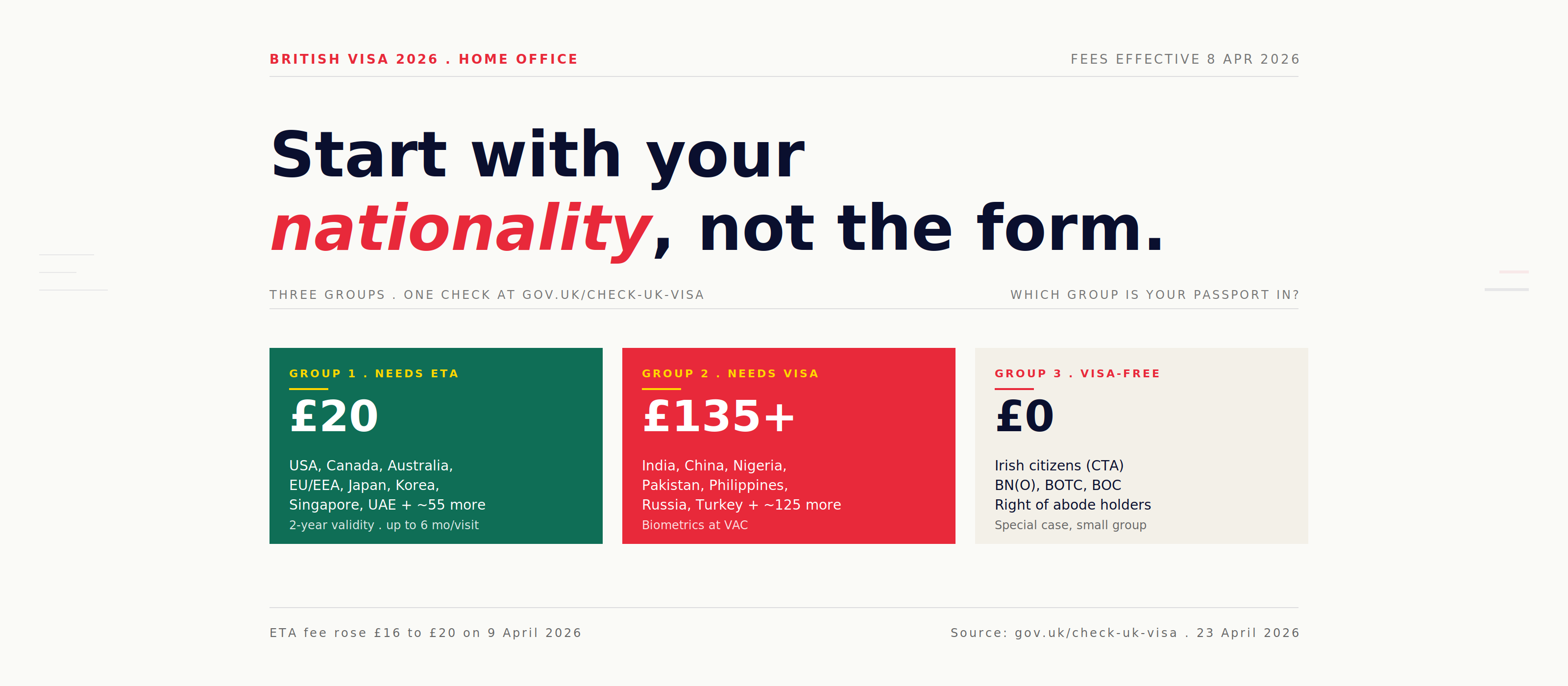
UK immigration splits the world into three groups for short visits, plus overlay rules for longer stays. The starting position for any applicant is to identify which group their passport sits in.
Group 1: Visa-free visitors needing an ETA. Citizens of countries that previously travelled to the UK without any authorisation must now obtain an Electronic Travel Authorisation before travelling. The rollout began in 2023 for Gulf states and extended to most visa-exempt nationalities through 2024 and 2025. From 2 April 2025 it applied to European countries (EU, EEA, Swiss citizens). Applicants from the United States, Canada, Australia, New Zealand, Japan, South Korea, Singapore, Hong Kong, UAE, and around 50 other countries fall into this group. The ETA costs £20 (from 9 April 2026), permits multiple entries for up to six months per visit, and is valid for two years or until the passport expires, whichever is sooner. Applications are made through the UK ETA app on iOS or Android, or via gov.uk.
Group 2: Visa national visitors. Citizens of around 130 countries must apply for a Standard Visitor visa before travel. This includes Indian, Chinese, Nigerian, Pakistani, Bangladeshi, Filipino, Russian, Turkish, Vietnamese, Thai, and many African nationals. The Standard Visitor visa costs £135 for up to six months, and long-term options at £509 (two years), £918 (five years), or £1,147 (ten years) are available for those who visit regularly. Visa national applications are lodged online and require a biometric appointment at a Visa Application Centre in the applicant's country of residence.
Group 3: Visa-free without ETA. A small number of special cases, chiefly British overseas citizens, British nationals (overseas) in certain circumstances, and Irish citizens, do not need a visa or an ETA for UK travel. Irish citizens in particular hold Common Travel Area rights and travel to the UK without any immigration control.
The gov.uk/check-uk-visa tool is the authoritative place to check which group an individual nationality falls in. It also flags special rules, for example for certain Commonwealth citizens claiming right of abode, Ukrainian nationals on Homes for Ukraine or Ukraine Permission Extension schemes, and family members of British citizens applying under separate routes.
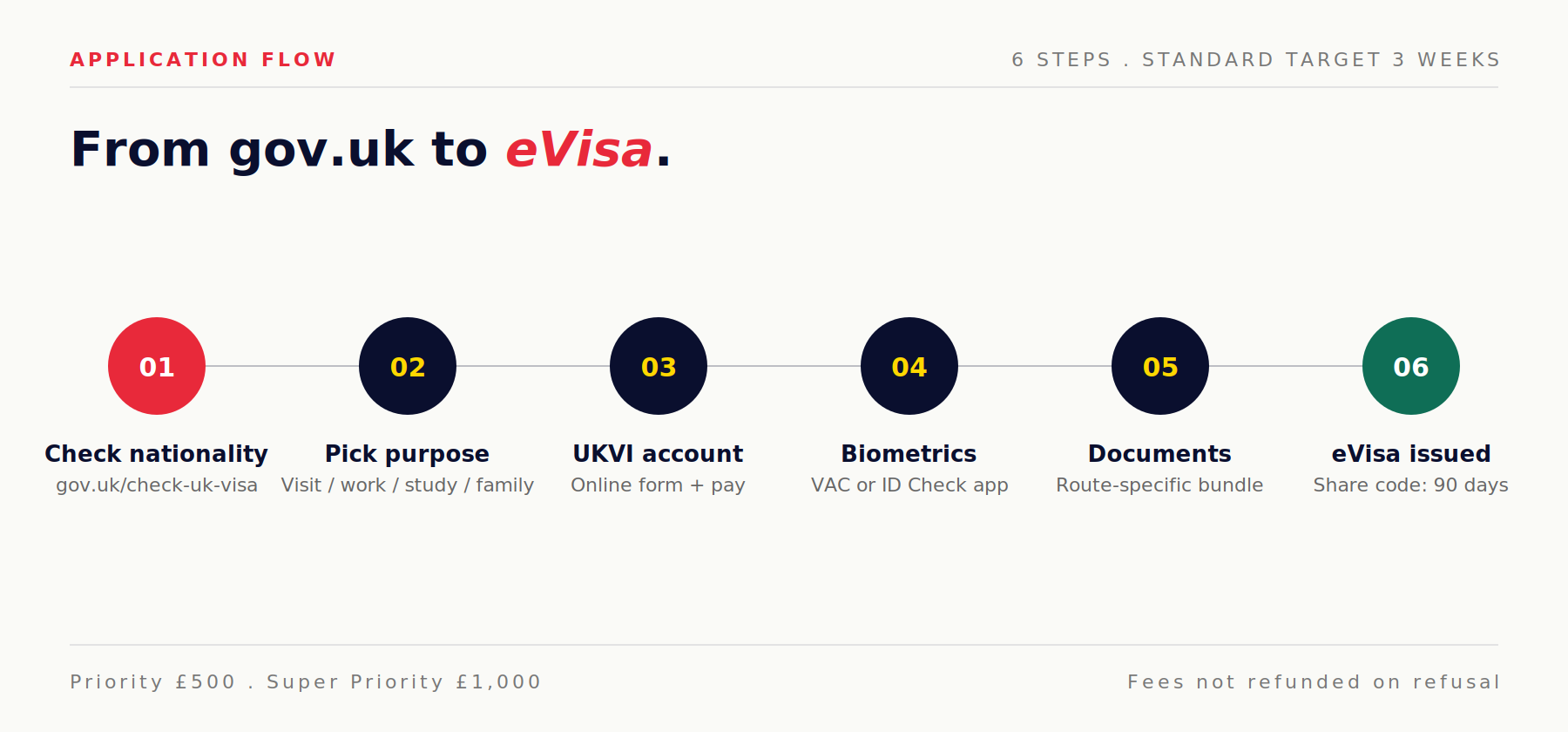
Step 2: work out what you are coming for
Once nationality is established, the purpose of travel determines whether a visitor visa or ETA is enough, or whether a specific category of visa is needed.
Tourism, family visits, business meetings, private medical treatment. These activities are all permitted on a Standard Visitor visa or (for visa-free nationals) on the ETA. The UK defines permitted visitor activities in Appendix Visitor of the Immigration Rules. Visitors cannot take paid employment, study beyond six months, or settle.
Work. A sponsored job offer from a licensed UK employer is required for most work routes. The Skilled Worker visa is the flagship: salary at least £38,700 or the occupation's going rate, whichever is higher, and English at CEFR B2. Other routes include Health and Care Worker, Graduate (post-study), Global Talent (for leaders in research, arts, digital tech), High Potential Individual (for recent graduates of top global universities), Innovator Founder, Scale-up, and Senior or Specialist Worker (Global Business Mobility). Each has its own fee and eligibility test. Working on a visitor visa is not permitted; a visa mismatch leads to refusal.
Study. A Student visa is needed for courses over six months. It requires a Confirmation of Acceptance for Studies (CAS) from a licensed UK sponsor, evidence of English at CEFR B2, and maintenance funds of £1,483 per month in London or £1,136 per month elsewhere, for up to nine months. Short courses of six months or less can be done on a Standard Visitor visa.
Family. Spouses, partners, children, and parents of British citizens or UK settled persons apply under the family visa routes. The Partner visa for a British citizen's spouse costs £1,938 from outside the UK or £1,321 from inside, plus IHS, and requires proof of the sponsor's income at £29,000 or above (raised from £18,600 in April 2024).
Transit. Passengers passing through the UK on the way to another country may need a Direct Airside Transit visa (if staying airside) or a Visitor in Transit visa (if passing through border control). Some nationalities are exempt; check gov.uk/transit-visa.
Ancestry. A separate route allows Commonwealth citizens aged 17 or over with a British grandparent to apply for an Ancestry visa, giving five years of UK residence with work rights and a path to ILR.
Step 3: apply online through gov.uk
Virtually every UK visa application in 2026 starts at gov.uk/browse/visas-immigration. The Home Office does not accept paper applications for the main routes; the entire process is digital. The applicant creates a UK Visas and Immigration (UKVI) account, selects the specific route based on nationality and purpose, and completes the online form.
The form is long, asks about immigration history, travel movements, family circumstances, employment, and finance, and auto-saves so applicants can complete it in stages. Honest, consistent answers matter: the Home Office cross-checks biographical data across previous applications, airline passenger data, and where available, foreign tax and education records. Inconsistencies trigger caseworker review and delay.
At the end of the form the applicant pays the application fee, the Immigration Health Surcharge (for visas longer than six months), and any priority service fees. Payment clears in real time; the application is not lodged until the payment completes. Use a card registered to the applicant or sponsor; declined cards are the most common reason for stalled applications.
Step 4: verify identity
Every visa application requires identity verification. The method depends on nationality, passport type, and route.
Visa Application Centre (VAC) appointment. For most overseas applications, the applicant books and attends an appointment at a Visa Application Centre run by TLScontact, VFS Global, or a similar Home Office partner in their country of residence. The VAC captures fingerprints and a facial photograph and collects supporting documents. Appointments are booked through the VAC partner's own portal, not through gov.uk. A standard appointment is free; premium lounges and priority appointments are paid-for services that do not speed up Home Office processing but do offer faster or more comfortable document submission.
UK Immigration: ID Check app. An increasing number of visa routes allow identity verification through a mobile app. Eligibility depends on nationality, passport type (a biometric chip is required), and the specific visa route. Where the app is an option, it eliminates the need for an in-person appointment: the applicant scans their passport chip with the phone, takes a live photo, and uploads identity details through the app. This is the fastest identity route and is available for many visa extensions, ETA applications, and some entry-clearance categories.
UK Visa and Citizenship Application Services (UKVCAS). For applications made from inside the UK (extensions, switches, settlement), identity verification happens at a UKVCAS service point rather than a VAC. UKVCAS is operated by Sopra Steria under contract to the Home Office. Some UKVCAS appointments are free; most locations also offer paid premium services. Applicants eligible for the ID Check app typically use it instead.
Step 5: upload supporting documents
The required evidence bundle depends entirely on the route. The Home Office publishes route-specific checklists on gov.uk.
For a Standard Visitor visa, expect to provide: passport, proof of funds (bank statements for the last three to six months), evidence of accommodation in the UK (hotel booking, host's letter with address), evidence of purpose (invitation letter, conference registration, family relationship documents), employment proof (letter from employer, business registration for self-employed), and previous travel history (passport stamps).
For a Skilled Worker visa: Certificate of Sponsorship reference number from the employer, passport, English test results (IELTS for UKVI or equivalent SELT at B2), maintenance evidence (£1,270 held for 28 consecutive days unless the sponsor certifies maintenance), criminal record certificates from any country where the applicant lived for more than 12 months in the past 10 years (for certain occupations).
For a Student visa: CAS from the sponsor institution, passport, English evidence (usually provided through the institution's own SELT), maintenance funds covering course fees plus living costs for up to nine months, parental consent if under 18.
For a Partner / Spouse visa: relationship evidence (marriage certificate, photos, correspondence, joint bills or tenancy), six months of sponsor payslips, sponsor P60s, tenancy or mortgage paperwork, English test at A1 or above (rising to B1 for extensions and B2 for settlement), accommodation suitability evidence.
Documents in languages other than English require certified translations. Originals are sometimes requested at the VAC; most applications accept scans uploaded through the UKVCAS portal or the ID Check app.
Step 6: wait for a decision
Standard processing times published by the Home Office at gov.uk/visa-processing-times are target windows. The published target for most work and study routes from outside the UK is three weeks from biometric appointment to decision. Family and settlement applications typically target 12 weeks. In-country extensions target eight weeks for Skilled Worker.
Priority service at £500 targets a decision within five working days where the route offers it. Super Priority at £1,000 targets the next working day and is typically only available in-country. Priority fees were not raised on 8 April 2026, but the underlying application fees were.
A decision arrives by email from UKVI. For successful applications from outside the UK, the email includes a digital vignette valid for 30 days, allowing the applicant to travel to the UK. Once in the UK, status is proved via the UKVI account through an eVisa. Physical Biometric Residence Permits (BRPs) are being phased out; most 2026 grants are digital-only.
If the decision is refusal, the refusal letter explains the grounds. Administrative review (£80) is available for most work and study refusals; full appeals to the First-tier Tribunal are available for family and human-rights-based refusals. Fees on the refused application are not refunded.
Scenario: the categorisation call that saved a fee and a refusal risk
Rashmi works as a senior software architect at a Pune-based fintech. Her UK client, a FinTech sandbox participant in Canary Wharf, invites her for a 12-day trip with three distinct components: five days delivering technical workshops to their engineering team on her company's API platform (paid indirectly by her employer through the existing service contract), three days attending a regulated-industry conference at ExCeL London, and four days of personal leave visiting her sister in Birmingham.
Her first instinct is the Standard Visitor visa. She starts the application online, pays the £135 fee, and reaches the Purpose of Visit section. Here the categorisation question bites. The five days of paid technical delivery is not a straightforward tourist activity. It is not a Business Visitor activity either in the narrow sense; the Home Office's Appendix Visitor distinguishes between "incidental business activities" (meetings, negotiations, attending conferences) and "work that is being paid for by a UK source" or that creates value for a UK entity beyond general business relations.
She pauses the application before submitting. Delivering technical workshops to a client's engineering team on a contracted deliverable sits in the grey zone. Two readings are possible. Under a strict reading, the activity is permitted under the Permitted Paid Engagement rules for certain qualified professionals, which allows specific short-term paid engagements without switching to a work visa, provided the activity is invited by a UK-based organisation and ends within one month of arrival. Under a less favourable reading, the caseworker might treat the workshops as inadmissible paid work on a visitor visa and refuse.
Rashmi consults an IAA-registered immigration adviser. The adviser's assessment is that the trip qualifies under Permitted Paid Engagement provided the invitation letter from the UK client explicitly frames the workshops as consultancy within the existing service contract, documents the fees as already covered by that contract (rather than a separate UK-source payment), and confirms her departure date. With that wording, the trip fits permitted visitor activities.
Rashmi returns to her application, now with clearer purpose documentation. She still applies on the Standard Visitor route; she does not need a separate Permitted Paid Engagement visa because the activities are compatible with the existing Standard Visitor rules when documented correctly. Her application bundle includes the invitation letter wording the adviser drafted, her employment letter confirming continued Indian employment, return flight booking showing her departure within 12 days, and three months of Indian bank statements showing consistent salary and savings. The visa is granted on day 18 after biometrics.
The categorisation call cost her a consultancy fee of around £500 but saved two risks. A refusal on grounds of inadmissible paid work would have left a negative immigration record and cost the £135 application fee. An unnecessary switch to a full work route (Senior or Specialist Worker under Global Business Mobility) would have cost several multiples more and required her employer to hold a UK sponsor licence, which they did not. The lesson for any applicant whose trip combines business activities, paid delivery, and tourism is that the framing in the application matters more than the activities themselves. Get the framing right and a Standard Visitor visa usually works. Get it wrong and the refusal letter arrives six weeks later.
Common reasons applications are refused
The Home Office publishes refusal statistics quarterly. The pattern is consistent across routes.
Insufficient funds or inconsistent bank statements. Visitor applications are refused when the applicant's finances do not credibly support the planned trip, or when statement balances look suspicious (large unexplained deposits shortly before application, balances that drop below threshold mid-cycle, or statements from banks the Home Office cannot verify).
Weak or unclear purpose. If the caseworker is not satisfied the applicant will return home after the visit, the application is refused. Strong ties to the home country (stable employment, property, family dependants, ongoing studies) help demonstrate intent to return.
English language evidence in the wrong format. Only specific Secure English Language Tests (SELTs) are accepted for UKVI. Standard IELTS is not accepted; only IELTS for UKVI is valid. Test certificates must be dated within two years of application.
Sponsorship issues. For work routes, a Certificate of Sponsorship that does not match the occupation or that has been used by a sponsor with a history of non-compliance can lead to refusal on Genuine Vacancy grounds. For study, a CAS from a sponsor whose licence has been revoked or suspended invalidates the application.
Immigration history. Prior refusals, overstaying, breach of conditions on a previous visa, or use of deception in a past application can trigger mandatory refusal under Part 9 of the Immigration Rules.
Costs beyond the headline fee
The Home Office application fee is rarely the total cost of getting a UK visa. Five other line items typically apply depending on the route.
Immigration Health Surcharge (IHS). Mandatory for visas longer than six months. Adults pay £1,035 per year of the visa, students and under-18s pay £776 per year. The full amount is paid upfront at application submission. A three-year Skilled Worker visa triggers £3,105 of IHS alone.
Biometric enrolment. Where the ID Check app is not used, £19.20 per applicant applies at UKVCAS centres for in-country applications. Overseas VAC fees vary by country and provider but are typically included in the headline figure.
Priority services. £500 for five-working-day Priority; £1,000 for next-working-day Super Priority where offered. These fees are not per application package, they are per person, so a family of four paying for priority adds £2,000 to the stack.
Translations and supporting documents. Certified translations for non-English documents typically cost £30 to £80 per document. TB testing (required by applicants from certain countries) costs £65 to £110. Medical records, criminal record certificates, and evidence of professional qualifications carry their own fees.
Legal advice. Immigration solicitors regulated by the Immigration Advice Authority (IAA, formerly OISC) charge fixed fees for straightforward applications (£500 to £1,500) or hourly rates for complex cases. Legal advice is not required but improves success rates on marginal applications and is effectively essential for appeals, late EUSS applications, and refused applications with administrative review rights.
WHAT TO DO NEXT First step for everyone: gov.uk/check-uk-visa. Do not start an application until this tool tells you which route and which group. An application in the wrong category is refused and the fee is not refunded. If you are a visa-exempt national (USA, Canada, EU, Japan, etc): you probably need only the £20 ETA for a short visit. Apply via the UK ETA app on iOS or Android. For anything over 6 months or for work / study, you need a full visa even if you are visa-exempt for visits. If you are a visa national (India, China, Nigeria, etc): apply at gov.uk/browse/visas-immigration, pay fees plus IHS, attend biometrics at your nearest Visa Application Centre. Standard Visitor decisions take around 3 weeks. Priority service at £500 speeds that to 5 working days. |
This article is for informational purposes only and does not constitute financial advice. Always verify rates with official sources before making any financial decision.
Frequently asked questions
How do I apply for a British visa in 2026?
Start at gov.uk/check-uk-visa to confirm whether your nationality and purpose require a visa, an ETA, or visa-free entry. If a visa is needed, apply online at gov.uk/browse/visas-immigration, pay the fee plus Immigration Health Surcharge, attend a biometric appointment at a Visa Application Centre (or use the UK Immigration: ID Check app where eligible), upload supporting documents, and wait for a decision (typically three weeks for standard work and study routes).
How long does a British visa take to come through?
Standard processing targets are three weeks for most work and study routes from outside the UK, 12 weeks for family and settlement applications, and eight weeks for in-country Skilled Worker extensions. Priority service at £500 targets five working days; Super Priority at £1,000 targets the next working day. Applications flagged for further checks can take six to eight weeks or longer.
What does a UK visa cost in 2026?
Costs range from £20 for an Electronic Travel Authorisation to £3,226 for Indefinite Leave to Remain. Standard Visitor visa is £135 for six months. Skilled Worker from outside the UK is £819 for up to three years or £1,618 for over three years. Student visa is £558. Spouse visa from outside is £1,938. The Immigration Health Surcharge adds £1,035 per year for adults on visas longer than six months.
Do I need a visa to visit the UK as a European citizen?
From 2 April 2025, EU, EEA, and Swiss citizens need an Electronic Travel Authorisation (ETA) to visit the UK for up to six months. No full visa is required for short visits. The ETA costs £20 (from 9 April 2026), is valid for two years, and allows multiple entries. Apply through the UK ETA app on iOS or Android, or at gov.uk.
Can I apply for a British visa from inside the UK?
Yes, if you are extending an existing visa, switching to a new category, or applying for ILR. In-country applications go through the same gov.uk online form as overseas applications, but biometrics are captured at a UKVCAS service point (or via the UK Immigration: ID Check app) rather than a Visa Application Centre. In-country fees are often higher than overseas fees for the same route.
What is the Immigration Health Surcharge?
The IHS is a charge that gives visa holders access to the NHS during their stay. It is £1,035 per year for adults and £776 per year for students, under-18s, and Youth Mobility Scheme applicants. It is paid upfront for the full duration of the visa. Health and Care Worker visa holders are exempt. Visitors on stays of less than six months do not pay IHS.
What happens if my British visa application is refused?
The refusal letter explains the grounds. Administrative review (£80 fee) is available for most work and study refusals. Full appeals to the First-tier Tribunal are available for family and human-rights-based refusals. Fees are not refunded. A fresh application can be made at any time, but must address the refusal grounds with new or stronger evidence.
Can I bring my family with me to the UK on a visa?
Dependants (partner, children under 18) can apply alongside the main applicant on most work and study routes. Each dependant pays the full application fee and full Immigration Health Surcharge. One exception: from January 2024, Student visa dependants are restricted to postgraduate research courses only (PhD, research masters); taught masters and undergraduate students cannot bring dependants.
Sources and verification
All rules, fees, and processes reflect the Home Office schedule and caseworker guidance in force as of 23 April 2026.


