

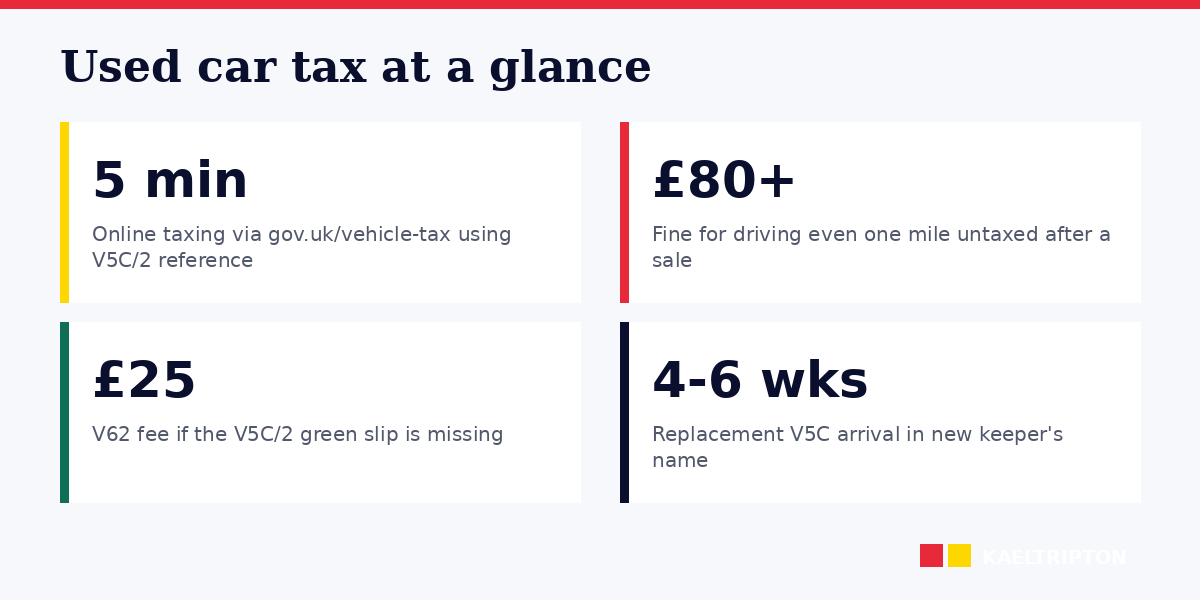
Just bought a used car in the UK? Tax does not transfer with the car. The seller's tax ends the moment ownership changes, and driving the car away untaxed - even for one mile - is an offence carrying fines from £80 up to £1,000. The practical process is simple: use the 12-digit reference number on the V5C/2 green new keeper slip at gov.uk/vehicle-tax and complete payment in about five minutes. This guide covers the full buyer's sequence for 2026: what the seller should give you, how to tax online, the MOT requirement, what to do if the V5C is missing, and the edge cases that catch first-time private buyers out.
| ★ EDITOR'S VERDICT Tax before you drive. Always. No exceptions. |
The biggest misconception in used car purchases is that tax transfers with the car. It does not. Since October 2014, the seller's tax ends at the point of sale and you must tax the car afresh in your own name before driving. The V5C/2 green slip gives you a 12-digit reference that enables a five-minute online process at gov.uk/vehicle-tax. Sat in the seller's driveway with a phone is genuinely the right time to do it. Insurance too - drive home covered or don't drive home. |
Why car tax does not transfer between owners
Since October 2014, UK vehicle tax stopped transferring with the vehicle on sale. Before that date, buying a used car meant inheriting the remainder of the seller's tax. The reform removed that - every sale now triggers: tax ends for the seller, refund calculated automatically, new keeper must tax the vehicle separately before driving.
This is the single biggest misunderstanding in used car purchases. Buyers assume the tax listed as "valid until March 2027" on the V5C carries over. It does not. The moment the V5C change of keeper is processed, the tax record ends and the buyer starts afresh.
What the seller should hand over
At the point of sale, a legitimate seller provides:
- V5C/2 green new keeper slip - the tear-off green section at the bottom of the V5C. This is your 12-digit reference for taxing the vehicle and is the only document you need to drive it home legally once you've paid the tax.
- Service history and MOT certificates (for roadworthiness evidence)
- Any existing insurance details (not transferable, but useful for the reference number if you're continuing with the same insurer)
- Keys and any spare sets
The seller keeps the full 8-page V5C logbook and is responsible for notifying DVLA of the sale - either online at gov.uk/sold-bought-vehicle or by posting the completed V5C. The new V5C in your name typically arrives within 4-6 weeks of the DVLA receiving notification.
If the seller does not give you a V5C/2 slip at all, do not drive the car away. The most common reason is that the seller has lost the full V5C and is waiting for a replacement. Your V62 route (covered below) is the fallback, but walking away from the sale until the paperwork is right is the safer play for a first-time buyer.
The five-minute online process
With the V5C/2 in hand:
- Go to gov.uk/vehicle-tax - avoid any third-party sites that charge a fee for the same service
- Enter the 12-digit reference number from the V5C/2 green slip
- Check the vehicle details shown (make, model, registration, current MOT status). If anything is wrong, stop and contact DVLA.
- Choose your payment method: annual single payment (cheapest, no surcharge), six-monthly (small surcharge), or Direct Debit monthly or six-monthly (5% surcharge on monthly, 2.5% on six-monthly)
- Pay by debit or credit card
- Confirmation email arrives within minutes. The vehicle is now legal to drive immediately - you do not need to wait for a physical reminder or certificate.
The whole process typically takes 3-5 minutes. You can do it in the car park of the seller's house before driving away.
The MOT requirement
You cannot tax a vehicle that does not have a valid MOT (unless the vehicle is legally exempt from MOT - typically less than 3 years old or over 40 years old and on the historic tax class). The DVLA system checks the MOT database in real time.
If the car you have just bought has a lapsed MOT, you have three options:
- Arrange to drive it directly to a pre-booked MOT appointment (this is legal without tax if the MOT is booked)
- Have the seller drive it to an MOT centre before completing the sale
- Recover the car on a trailer or transporter rather than driving it
The first option works but is risky - police stops to check the MOT booking do happen, and any additional drive off-route is an offence. Most buyers sensibly insist the seller refreshes the MOT before sale, or negotiate a price reduction reflecting the MOT cost and risk.
Taxing without a V5C/2: the V62 route
If the seller has genuinely lost the V5C and did not produce a V5C/2 either, you can still tax the car by applying for a new V5C using form V62 at the same time as taxing. This is slower and more expensive:
- V62 fee: £25 in 2026
- Processing time: 4-6 weeks for the new V5C to arrive
- You can tax the car at a Post Office that offers vehicle tax services by submitting the V62, proof of identity, and paying both the V62 fee and the tax
- You cannot do this online - V62 processing requires post or counter submission
If you are buying from a known private seller, the V62 route works. If the seller is a stranger on Facebook Marketplace or similar, the absence of a V5C or V5C/2 is a red flag. Stolen or cloned vehicles frequently appear for sale without proper paperwork. Run the registration through the free gov.uk vehicle enquiry service before handing over money.
Insurance: the simultaneous requirement
You cannot drive the car home without insurance either. Tax and insurance are separate requirements - taxing the car does not cover you to drive. Arrange insurance before you arrive to collect the car; most insurers can set up cover over the phone or via app in 10-15 minutes, activating at the time of purchase.
Options include:
- Driving other cars (DOC) on your existing policy - rarely useful now because most policies no longer include this, and where it does exist it's often third-party only and limited to 28 days
- Annual policy starting day of purchase - the standard route, arranged in advance with the start date set to the collection day
- Temporary short-term insurance - 1-day to 30-day cover available from Dayinsure, Cuvva, Tempcover for roughly £18-£40/day. Useful if you are collecting the car far from home and want a specific window of cover.
A real 2026 scenario: buyer in Manchester, seller in Cornwall
A 29-year-old civil engineer in Manchester buys a 2018 Honda Jazz at £7,500 from a private seller in Truro. They agree the collection will be Saturday at noon.
Wednesday before. She arranges annual insurance starting Saturday at 11:00. Books train tickets to Truro. Confirms with the seller that the V5C/2 will be ready.
Friday evening. Double-checks the gov.uk vehicle enquiry service using the registration - MOT valid until October 2026, no outstanding tax issues, recent keeper changes recorded. Clean.
Saturday 11:45. Arrives at seller's address. Inspects the car, agrees final price. Seller completes the V5C transfer by notifying DVLA online immediately via his phone. He hands her the V5C/2 green slip.
Saturday 12:10. Sat in the driveway, she goes to gov.uk/vehicle-tax on her phone, enters the 12-digit V5C/2 reference, pays £195 annual tax in one payment. Confirmation email arrives at 12:12.
Saturday 12:15. Insurance already live from 11:00. Tax confirmed. She drives home to Manchester - 6 hours on the M5 and M6 - with everything in order.
Total cost of the tax and registration process: £195 annual tax, £0 for V5C (already present), roughly 5 minutes of her time. The new V5C in her name arrives by post in the third week of October.
Common mistakes and traps
Driving away before taxing. The seller's tax ends when ownership changes; even a 500-metre drive home is uninsured and untaxed. The fine for driving without tax starts at £80 (reduced to £40 if paid within 28 days) and the car is at risk of being clamped under the DVLA's enforcement programme. ANPR on main roads catches untaxed vehicles within days.
Relying on the seller's remaining tax. A common misreading of "tax valid until March 2027" on the V5C. That was the seller's tax. It ends at the point of sale. You start a fresh tax record from the day you buy.
Losing the V5C/2 in the post. If you buy a car at a distance and the seller posts the V5C/2 to you, any delay means the car cannot be taxed online. Insist on receiving the V5C/2 in person at the point of sale, or have the seller text you a photograph of the 12-digit reference so you can tax the car the same day - though the physical slip is still needed for future processes.
Buying a car that's been SORN'd. If the seller has declared the vehicle as Statutory Off Road (SORN), it cannot be driven on public roads at all. You need to tax it before the first drive; the SORN automatically ends when new tax is issued.
What happens next
Over the following weeks:
- The new V5C in your name arrives by post within 4-6 weeks of the seller notifying DVLA
- If you paid by Direct Debit, monthly or six-monthly payments start automatically
- If you paid annually in one go, a V11 reminder arrives approximately 4-6 weeks before your next tax expiry
- You can update the V5C later if you move address (free) or if any vehicle details change
From this point onwards, responsibility for the vehicle is yours: annual tax renewal, MOT, insurance, any fixed penalty notices, and any future sale notifications.
Frequently asked questions
Does car tax transfer with the car when I buy it?
No. Since October 2014, tax no longer transfers between owners. The seller's tax ends the moment ownership changes (they get an automatic refund for full remaining months), and you must tax the car afresh in your own name before driving it.
Can I drive the car home if I forgot to tax it at the seller's address?
No. Any driving of an untaxed vehicle is an offence, including the drive home from a private sale. Tax the car online from your phone before you drive away - the process takes about five minutes and requires only the V5C/2 reference.
What if the seller hasn't given me a V5C/2 green slip?
Do not drive the car. Either insist the seller produces the V5C/2 (they may have forgotten to tear it off), or use the V62 route to apply for a replacement V5C. The V62 costs £25 and takes 4-6 weeks to process. You can tax the car via V62 through a Post Office, not online.
Do I need an MOT to tax a used car I've just bought?
Yes, unless the car is MOT-exempt (under 3 years old from first registration, or over 40 years old and in the historic tax class). The DVLA system checks the MOT database automatically. No valid MOT = no tax possible.
Will the seller's refund cover the time I paid for?
No. Your tax payment and the seller's refund are separate transactions. The DVLA automatically refunds the seller for full remaining months of tax when the sale is notified. You pay for your own tax from the day you buy the car, regardless of what the seller had paid for previously.
Can I tax the car by phone instead of online?
Yes. DVLA's automated phone service is 0300 123 4321. You still need the V5C/2 reference or the V11. Phone payment is by debit or credit card only - Direct Debit cannot be set up over the phone. Calls are charged at local rate and the process typically takes 3-5 minutes.
What happens if I buy a car that was SORN'd?
Taxing the car automatically ends the SORN status. You cannot drive a SORN'd vehicle on public roads until tax is paid. Complete the tax payment online or at a Post Office, and the vehicle becomes legal to drive immediately. No separate action is needed to end the SORN.
Sources
- GOV.UK, Tax your vehicle - gov.uk/vehicle-tax
- DVLA, V5C registration certificate and V5C/2 new keeper supplement guidance
- GOV.UK, Sold, transferred or bought a vehicle - gov.uk/sold-bought-vehicle
- DVLA, Form V62 application for a replacement V5C registration certificate
- Vehicle Excise and Registration Act 1994 (as amended), Schedule 1 (VED bands)
- Vehicle Excise Duty (VED) reform 2014 - HM Treasury policy paper
- GOV.UK, Vehicle enquiry service - vehicleenquiry.service.gov.uk


