

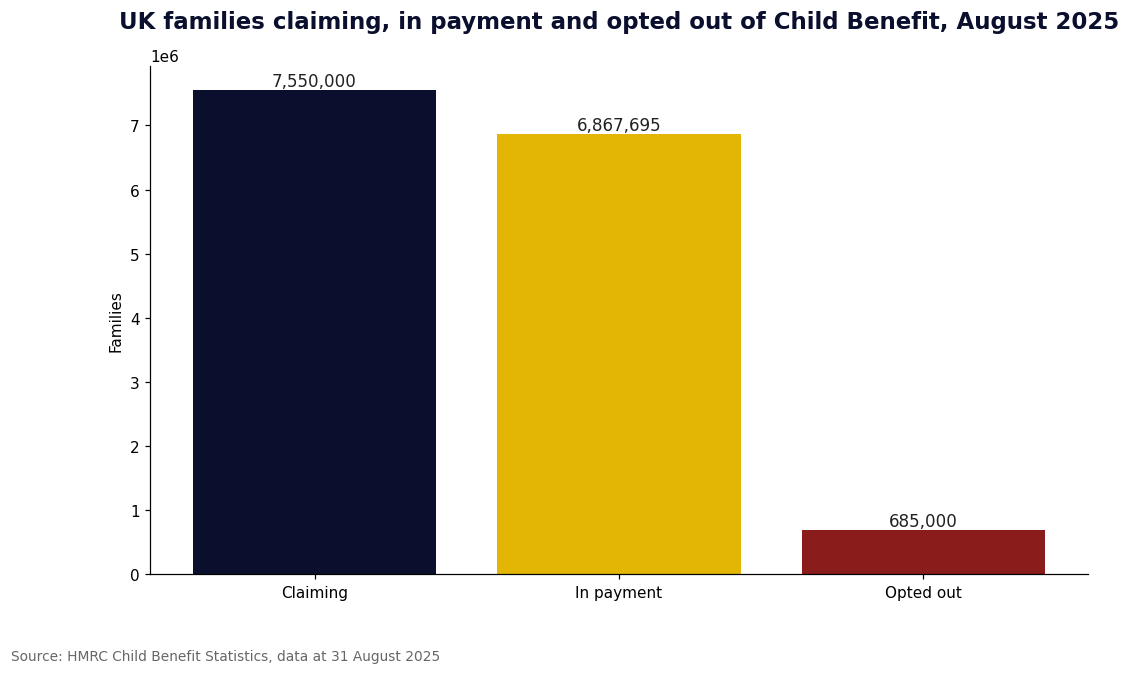
As at 31 August 2025, 7.55 million UK families were claiming Child Benefit for 12.73 million children, of which 6.87 million families received payments for 11.73 million children after 685,000 opted out (HMRC). From 6 April 2026 the rate is £27.05 a week for an eldest child and £17.90 for each other child.
TL;DR · LAST REVIEWED As at 31 August 2025, 7.55 million UK families were claiming Child Benefit for 12.73 million children, of which 6.87 million families received payments for 11.73 million children after 685,000 opted out (HMRC). From 6 April 2026 the rate is £27.05 a week for an eldest child and £17.90 for each other child.
- 7,550,000 families were claiming Child Benefit for 12,730,000 children as at 31 August 2025.
- 6,867,695 families received payments for 11,730,730 children; 685,000 families opted out - the lowest level of families in payment since HMRC records began in 2003.
- From 6 April 2026 Child Benefit is £27.05 a week for the eldest or only child and £17.90 for each other child.
- The High Income Child Benefit Charge starts at £60,000 of adjusted net income and claws back the full award by £80,000.
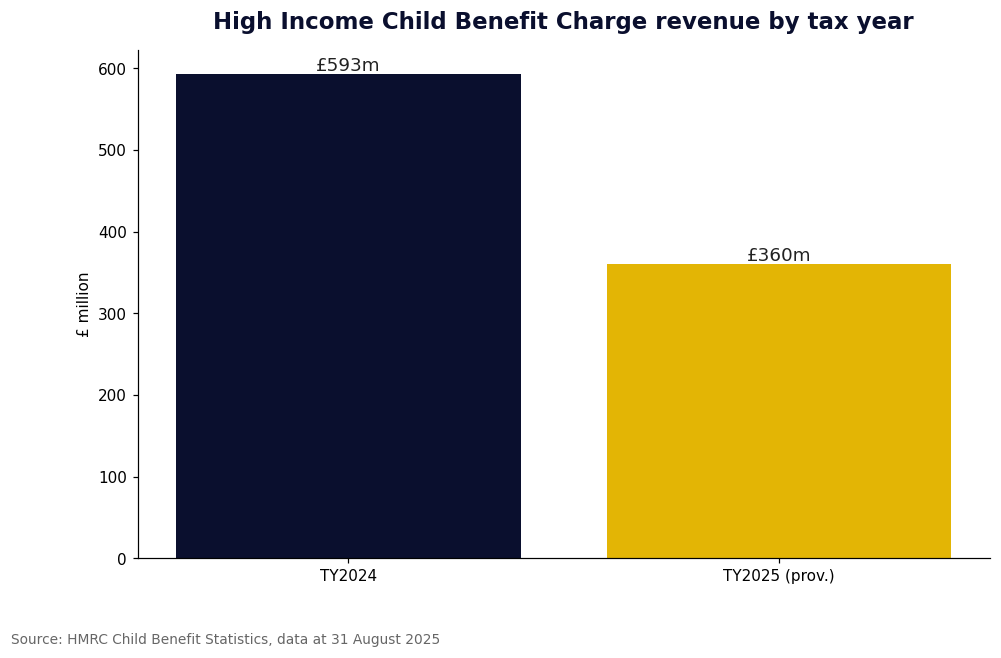
- An estimated 310,000 people had a HICBC liability of £360 million in 2024-25, down from 437,000 and £593 million.
- The take-up rate fell to 87% in 2025 from 97% in 2012; 85% of claimants are women.
| Region or nation | Families in payment | Children |
|---|---|---|
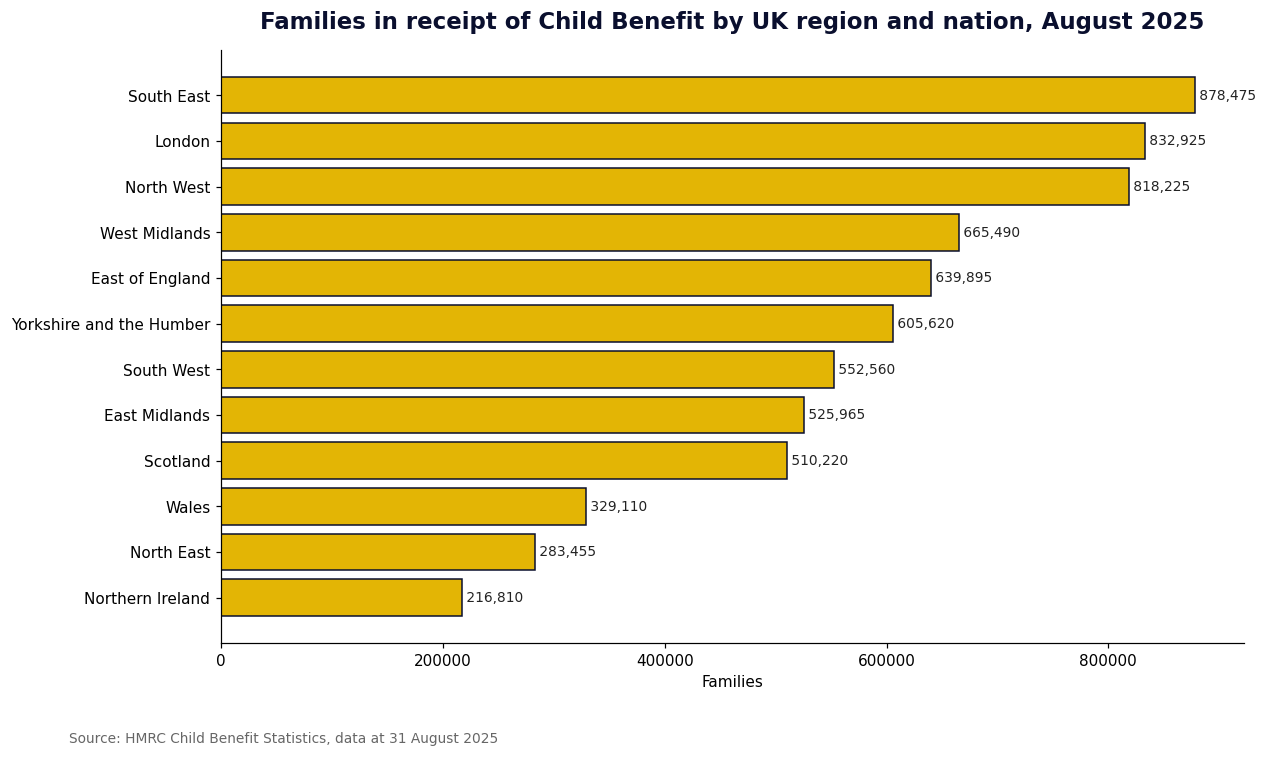
| South East | 878,475 | 1,479,375 |
| London | 832,925 | 1,435,440 |
| North West | 818,225 | 1,416,560 |
| West Midlands | 665,490 | 1,174,275 |
| East of England | 639,895 | 1,085,740 |
| Yorkshire and the Humber | 605,620 | 1,045,810 |
| South West | 552,560 | 930,510 |
| East Midlands | 525,965 | 890,835 |
| Scotland | 510,220 | 831,580 |
| Wales | 329,110 | 556,375 |
| North East | 283,455 | 477,895 |
| Northern Ireland | 216,810 | 391,770 |
| United Kingdom | 6,867,695 | 11,730,730 |
KEY FACTS
- Families claiming Child Benefit: 7,550,000 as at 31 August 2025
- Children covered by Child Benefit: 12,730,000 as at 31 August 2025
- Weekly rate for eldest child: £27.05 from 6 April 2026
- Weekly rate for other children: £17.90 from 6 April 2026
- High Income Child Benefit Charge threshold: £60,000 adjusted net income
- Full award clawed back at income: £80,000
- Take-up rate in 2025: 87%
- Claimants who are women: 85%
What Child Benefit is
Child Benefit is a non-means-tested payment from HM Revenue and Customs, not the Department for Work and Pensions, for anyone responsible for a child. It is paid regardless of savings and, for most people, regardless of income. The payment was renamed from Family Allowance in 1977.
The benefit is administered by HMRC rather than the DWP, which distinguishes it from most other state support for families. It is available to anyone responsible for a child, whether they are a parent, guardian or someone with day-to-day care. There is no test of savings or capital, and for the vast majority of claimants there is no income test either. The only income-related restriction applies to households where one person earns above a set threshold, which triggers a separate tax charge rather than reducing the benefit itself.
Because it is not means-tested, the payment does not reduce other benefits or tax credits a family may receive. It is a universal payment in principle, although the High Income Child Benefit Charge has removed universality for higher earners. The benefit is paid in full to families where neither parent has adjusted net income above the threshold, and it continues for each child in the family with no upper limit on the number of children covered.
Current rates from 6 April 2026
From 6 April 2026, Child Benefit is £27.05 a week for the eldest or only child and £17.90 a week for each additional child. A family with two children receives £44.95 a week, which is £2,337.40 a year. There is no cap on the number of children for whom payment can be made.
The weekly rate for the eldest or only child is £27.05, which equates to £1,406.60 over a full year. Each subsequent child attracts the lower rate of £17.90 a week. The difference between the two rates reflects the additional costs associated with the first child, who typically requires more spending on items such as prams, cots and nursery equipment.
For a family with two children, the combined weekly payment is £44.95, or £2,337.40 a year. A family with three children would receive £62.85 a week, and so on, with no reduction for larger families. The rates are usually uprated each April in line with inflation, although the government has discretion over the timing and size of any increase.
The payment is made for each child in the family, regardless of how many children there are. This means a family with four children receives £27.05 for the eldest and £17.90 for each of the other three, totalling £80.75 a week. There is no cap on the number of children for whom Child Benefit can be claimed.
Who is eligible
You can claim Child Benefit if you are responsible for a child under 16, or under 20 if they are in approved full-time non-advanced education or training. You must live in the UK and meet residence and right-to-reside rules. Only one person can claim for any one child.
The main eligibility condition is responsibility for a child. This means the child normally lives with you and you are paying at least the same amount as Child Benefit towards their upkeep. You do not need to be the parent, but you must be the person with day-to-day care. Only one person can claim for a child, even if care is shared.
The child must be under 16, or under 20 if they are in approved full-time education or training. Approved education includes A levels, Scottish Highers, NVQs up to level 3 and home education, but not university degrees or other advanced courses. The education or training must be full-time, which generally means more than 12 hours a week of supervised study or work.
You must also be resident in the UK and have a right to reside here. People subject to immigration control, such as those with no recourse to public funds, are generally not eligible. If you are moving to or from the UK, special rules apply, and you may need to have lived here for a set period before claiming.
How to claim
You can claim Child Benefit online or by completing form CH2. A claim can be backdated for up to three months, so it is worth claiming as soon as a child is born or comes to live with you. You need your child's birth certificate and your bank details to hand.
The quickest way to claim is online through GOV.UK. You will need to provide your National Insurance number, your child's birth or adoption certificate details, and your bank or building society account details. The online service allows you to complete the claim in one session and receive confirmation of your claim number.
Alternatively, you can download and print form CH2 and post it to the Child Benefit Office. The form asks for the same information as the online service. You should keep a copy of the form and any supporting documents for your records. Claims can be backdated for up to three months, so even if you miss the birth, you can still receive payment for the previous three months.
You should claim as soon as the child is born or comes to live with you. There is no advantage to delaying, because the backdating limit is three months. If you claim later than three months after the child arrives, you will lose entitlement for the period before your claim date. The claim process is the same whether you are a parent, guardian or someone with care of the child.
The High Income Child Benefit Charge
The High Income Child Benefit Charge applies when the higher earner in a household has adjusted net income above £60,000. The charge repays 1% of the award for every £200 of income above £60,000, and the full award is clawed back once income reaches £80,000.
The charge is not a reduction in Child Benefit itself but a tax charge collected through Self Assessment. It applies to the person in the household with the higher adjusted net income, not to the person who claims the benefit. If both parents have income below the threshold, no charge arises. If one parent earns above £60,000, they must register for Self Assessment and declare the charge.
Adjusted net income is calculated by taking total income and deducting certain reliefs. Pension contributions made through a salary sacrifice scheme or paid personally reduce adjusted net income, as do Gift Aid donations. This means someone with a gross salary above £60,000 may still have adjusted net income below the threshold if they make sufficient pension or charitable contributions.
The charge is tapered: for every £200 of adjusted net income above £60,000, the charge is 1% of the total Child Benefit award. At £80,000, the charge equals 100% of the award, meaning the full benefit is repaid through tax. The charge applies to the whole award for the family, not per child, so a family with one child and a family with four children face the same percentage taper.
Claim versus opt out
Even if you earn above the threshold, it is usually worth registering a claim and opting out of payments. A claim gives National Insurance credits that protect your State Pension until the child turns 12, and it secures the child's National Insurance number automatically.
When you claim Child Benefit, you receive National Insurance credits for each week you are entitled to the benefit, even if you opt out of receiving the money. These credits count towards your State Pension qualifying years. Most people need 35 qualifying years to receive the full State Pension, and Child Benefit credits can fill gaps in your record when you are not working or are earning below the threshold for National Insurance contributions.
The credits continue until the child turns 12, after which they stop unless you are claiming for another child. If you opt out of payments, you still receive the credits, but you must make a claim first and then choose to stop receiving the money. You can opt out online or by contacting the Child Benefit Office, and you can opt back in at any time if your circumstances change.
Claiming also ensures your child receives their National Insurance number automatically before their 16th birthday. If you do not claim, your child will need to apply for a National Insurance number separately when they start work. The claim also keeps the door open for future payments if your income falls below the threshold, because you can opt back in without making a new claim.
Children aged 16 to 19
Child Benefit can continue for a young person aged 16 to 19 if they stay in approved full-time non-advanced education or training. You must tell HMRC when the child reaches 16 and confirm their education details, or the payment will stop.
When a child turns 16, HMRC will write to you to ask whether they are continuing in education or training. You must respond to confirm the details, otherwise payments will stop on 31 August after their 16th birthday. The child must be in approved full-time non-advanced education or training, which includes A levels, Scottish Highers, NVQs up to level 3 and home education.
Approved training includes apprenticeships, but only those at a non-advanced level. Advanced apprenticeships, which are equivalent to a foundation degree, do not qualify. The education or training must be full-time, which generally means more than 12 hours a week of supervised study or work. If the young person leaves education or training, you must tell HMRC immediately.
Claims often lapse when teenagers leave and re-enter education, for example if they finish one course and start another. You need to inform HMRC of any change in circumstances, and you may need to provide evidence of the new course. Payments can be backdated for up to three months if you notify HMRC promptly, but delays can result in a gap in payments.
How and when it is paid
Child Benefit is usually paid every four weeks on a Monday or Tuesday, directly into a bank or building society account. Weekly payments are available for single parents and some people receiving certain benefits.
The standard payment schedule is every four weeks, with payments made on a Monday or Tuesday depending on your National Insurance number. The payment is made in arrears, so you receive the benefit for the previous four weeks. You can choose to have the money paid into any bank or building society account in your name, or into a joint account.
Weekly payments are available if you are a single parent or if you or your partner receive certain benefits, such as Income Support, income-based Jobseeker's Allowance or Universal Credit. Weekly payments are paid on a Monday or Tuesday each week. You can request a change to weekly payments by contacting the Child Benefit Office, and the change usually takes effect from the next payment date.
Payments are made directly into your account, so you do not need to cash a cheque or collect money from a post office. You should check your bank statement to confirm payments are arriving on time. If a payment does not arrive, you should contact the Child Benefit Office, which can investigate and arrange a replacement payment if necessary.
Child Benefit rates 2026 to 2027
From 6 April 2026, Child Benefit is £27.05 a week for an eldest or only child (£1,406.60 a year) and £17.90 a week for each additional child (£930.40 a year). There is no limit on the number of children you can claim for, and the payment is not means tested.
| Children | Weekly | Yearly |
|---|---|---|
| 1 | £27.05 | £1,406.60 |
| 2 | £44.95 | £2,337.40 |
| 3 | £62.85 | £3,268.20 |
| 4 | £80.75 | £4,199.00 |
| 5 | £98.65 | £5,129.80 |
Child Benefit statistics: the latest HMRC data
HMRC's annual figures for 31 August 2025 show 7,550,000 families claiming Child Benefit for 12,730,000 children. Of these, 6,867,695 families were actually receiving payments for 11,730,730 children, because 685,000 families had opted out of payments - typically to avoid the High Income Child Benefit Charge. This is the lowest level of families in payment since HMRC records began in 2003, and down about 67,000 claiming families (0.9%) and 40,000 in payment versus August 2024.
Take-up has fallen steadily, from 97% of eligible children in 2012 to 87% in 2025, largely reflecting the High Income Child Benefit Charge introduced in 2013. Around 85% of claimants are women (5,870,000) and 15% are men (1,000,000).
Child Benefit by region and nation
The South East had the most families in payment (878,475), followed by London and the North West. The North East had the fewest of the English regions and Northern Ireland the fewest overall.
Family size and children's ages
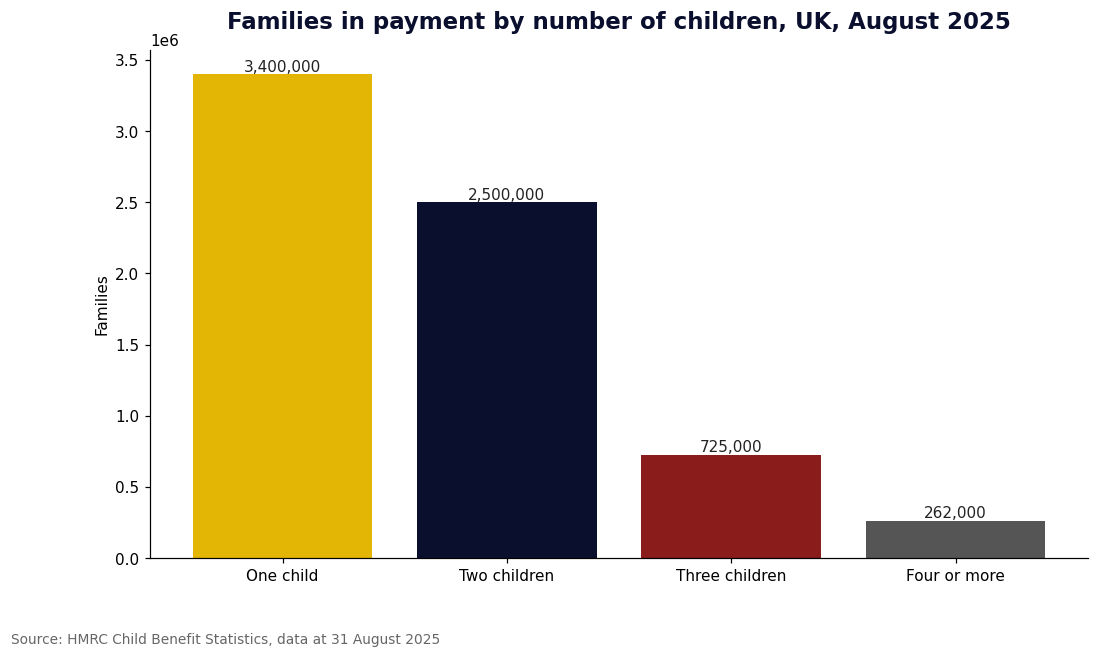
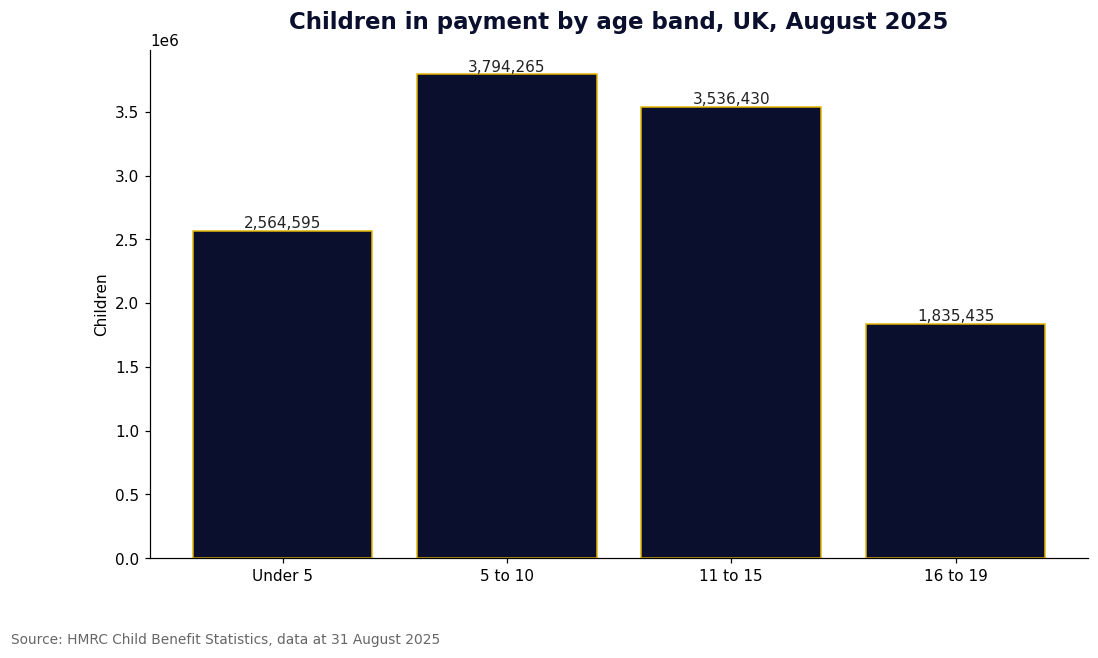
Of families in payment, 3,400,000 had one child, 2,500,000 had two, 725,000 had three and 262,000 had four or more. The largest child age band was 5 to 10 (3,794,265).
The High Income Child Benefit Charge in numbers
An estimated 310,000 people had a HICBC liability totalling £360 million in the 2024-25 tax year, down sharply from 437,000 people and £593 million a year earlier, after the threshold rose to £60,000 in April 2024.
DISCLAIMER
This article is editorial information, not financial advice. Kael Tripton Ltd is not authorised or regulated by the Financial Conduct Authority. Figures were correct at the last review date shown above; verify current rates and rules with the primary sources listed below before acting.
Frequently asked questions
How much is Child Benefit in 2026 to 2027?
It is £27.05 a week for your eldest or only child and £17.90 for each other child from 6 April 2026 - about £1,407 a year for one child.
How many families claim Child Benefit in the UK?
7,550,000 families were claiming for 12,730,000 children at 31 August 2025; 6,867,695 received payments after 685,000 opted out.
What is the Child Benefit high income charge threshold?
The High Income Child Benefit Charge starts when the higher earner's adjusted net income passes £60,000, with the full award repaid by £80,000.
Should I still claim if I earn over £60,000?
Usually yes. You can claim and opt out of payments, which still gives National Insurance credits that protect your State Pension until the child turns 12.
Can I claim Child Benefit for a 17 year old?
Yes, if they remain in approved full-time non-advanced education or training; you may need to confirm this with HMRC each year for payments to continue.
Sources


