

Around 6.3 million properties in England are in areas at risk of flooding, so home, flood, farm and life insurance are the main ways UK households protect against catastrophic loss. Flood cover is built into most home insurance and kept affordable for high-risk homes by the Flood Re scheme, which runs until 2039. Livestock and life cover are arranged through specialist and mainstream insurers.
TL;DR · LAST REVIEWED Around 6.3 million properties in England are in areas at risk of flooding, so home, flood, farm and life insurance are the main ways UK households protect against catastrophic loss. Flood cover is built into most home insurance and kept affordable for high-risk homes by the Flood Re scheme, which runs until 2039. Livestock and life cover are arranged through specialist and mainstream insurers.
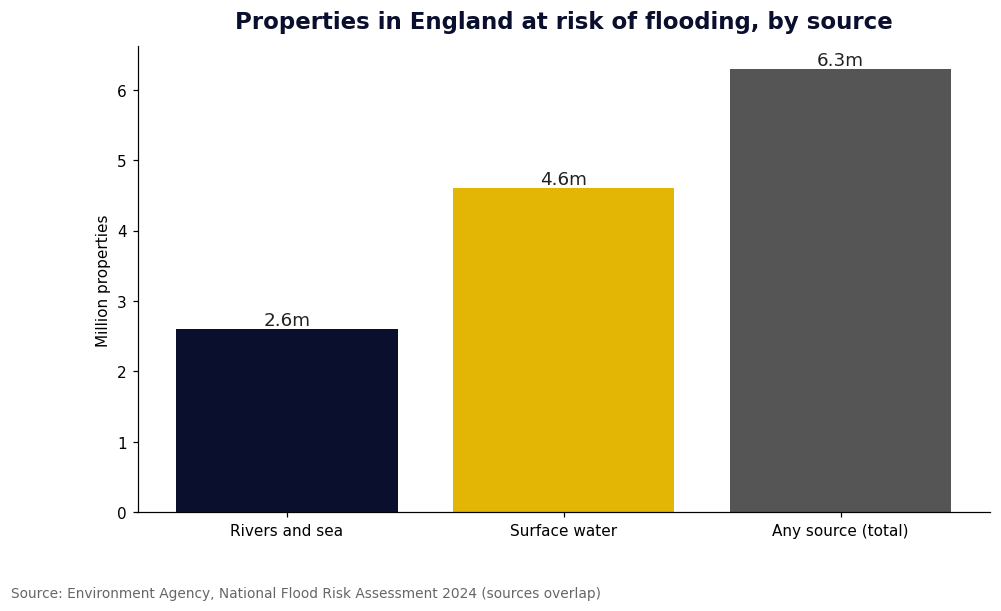
- Around 6.3 million properties in England are in areas at risk of flooding from rivers, the sea or surface water; about 4.6 million face surface-water flooding (Environment Agency, 2024).
- Flood Re, launched in 2016, keeps flood cover affordable for high-risk homes through a levy on all UK home insurance and is due to wind down in 2039.
- Flood Re only covers homes built before 2009; newer homes are not covered by the scheme.
- Insurers paid about £1.2 billion in weather-related property claims in 2025 (Association of British Insurers).
- Home insurance combines buildings cover (the structure) and contents cover (your belongings); flood, fire, storm and theft are usually included.
- Livestock and farm insurance is a specialist market, while life insurance (term, whole-of-life and over-50s plans) protects dependants or a mortgage.
| Flood source | Properties at risk (England) |
|---|---|
| Rivers and the sea | About 2.6 million |
| Surface water | About 4.6 million |
| Any source (total) | About 6.3 million |
KEY FACTS
- Around 6.3 million properties in England are in areas at risk of flooding from rivers, the sea or surface water; about 4.6 million face surface-water flooding (Environment Agency, 2024).
- Flood Re, launched in 2016, keeps flood cover affordable for high-risk homes through a levy on all UK home insurance and is due to wind down in 2039.
- Flood Re only covers homes built before 2009; newer homes are not covered by the scheme.
- Insurers paid about £1.2 billion in weather-related property claims in 2025 (Association of British Insurers).
- Home insurance combines buildings cover (the structure) and contents cover (your belongings); flood, fire, storm and theft are usually included.
- Livestock and farm insurance is a specialist market, while life insurance (term, whole-of-life and over-50s plans) protects dependants or a mortgage.
Why Protective Insurance Matters
Around 6.3 million properties in England are in areas at risk of flooding, and insurers paid about £1.2 billion in weather-related property claims in 2025. The right cover is what stands between a household or farm and catastrophic financial loss.
Flooding is the most significant natural hazard facing UK property owners. The Environment Agency estimates that 6.3 million properties are at risk from rivers, the sea or surface water, with 4.6 million of those facing surface-water flooding alone. This risk is not evenly spread; some regions are far more exposed than others, and climate change is expected to increase the frequency and severity of extreme weather events.
Without adequate insurance, the cost of repairing flood damage can run into tens of thousands of pounds. Buildings need structural drying, rewiring, replastering and new kitchens and bathrooms. Contents such as furniture, appliances and personal belongings are often written off entirely. For a farm, the losses can be even greater, with livestock, machinery, stored crops and outbuildings all exposed.
Insurance transfers this risk to a provider in exchange for a regular premium. For most households, home insurance is the primary protection, combining buildings and contents cover. For farms, specialist agricultural policies are needed. Life insurance plays a different but equally important role, protecting dependants against the financial consequences of death or serious illness.
The UK insurance market is mature and highly regulated. Policies are sold by major high-street insurers, direct providers, brokers and mutuals. The Financial Conduct Authority (FCA) oversees the market, and consumers can check any provider on the FCA register before buying. Understanding what each type of policy covers, and how to arrange it, is essential to ensuring adequate protection.
Flood Insurance and Flood Re
Flood damage is built into most home insurance policies. The Flood Re scheme, launched in 2016 and due to end in 2039, uses a levy on all home insurance to keep premiums affordable for high-risk homes built before 2009.
Flood Re is a joint initiative between the insurance industry and the government. It operates as a reinsurance pool, meaning insurers can pass the flood risk of eligible high-risk homes to Flood Re, which then covers the cost of claims. The scheme is funded by a levy of around £10.50 added to every home insurance policy in the UK, regardless of the property's own flood risk.
The scheme applies only to homes built before 2009. Properties constructed after that date are not covered, on the basis that new builds should be designed to withstand flood risk. Flood Re also excludes commercial properties, leasehold flats with more than three units, and buildings with a rateable value above a certain threshold.
Flood Re includes a Build Back Better element, which funds up to £10,000 of flood-resilient repairs after a claim. This can pay for measures such as raised electrics, flood-resistant doors and non-return valves on drains, reducing the impact of future floods. Policyholders must request this option when making a claim.
To check whether a property is at flood risk, homeowners can use the free 'check the long term flood risk for an area' service on GOV.UK, run by the Environment Agency. Entering a postcode shows the risk from rivers, the sea and surface water. This information helps when choosing cover and negotiating premiums with insurers.
Home Insurance
Home insurance combines buildings cover, which protects the structure and permanent fixtures, with contents cover for belongings. Most policies include fire, flood, storm, escape of water and theft.
Buildings insurance covers the cost of repairing or rebuilding the structure of a home. This includes walls, roofs, floors, ceilings, windows, doors and permanent fixtures such as fitted kitchens and bathrooms. It also covers outbuildings like garages and sheds, as well as walls, fences, drives and paths. The sum insured must reflect the rebuild cost, not the market value, which can be estimated using the Building Cost Information Service calculator.
Contents insurance covers belongings that would be taken when moving house. This includes furniture, carpets, curtains, electrical appliances, clothing, jewellery and personal items. The sum insured should be the total cost of replacing all contents on a new-for-old basis. A room-by-room inventory is a practical way to calculate this figure.
Most standard policies include cover for flood, fire, storm, escape of water from pipes and theft. Escape of water, such as a burst pipe or leaking appliance, is one of the most common causes of claims. Some policies also include accidental damage cover as an optional extra, protecting against spills, breakages and other mishaps.
Policies can be taken out directly from insurers, through comparison websites or via brokers. Premiums vary based on location, rebuild cost, contents value, security measures and claims history. An excess, typically between £50 and £250, applies to each claim, and choosing a higher voluntary excess can reduce the premium.
Livestock and Farm Insurance
Livestock and farm insurance is a specialist market covering animals against death, theft, disease and transit, plus farm buildings, machinery, produce, business interruption and liability.
Standard home and business policies do not cover agricultural risks. Farms require bespoke cover arranged through specialist rural insurers, mutuals or brokers, rather than mainstream comparison sites. Providers in this market include NFU Mutual, which has served the farming community for over a century, alongside other rural specialists.
Livestock cover protects animals against death, theft and disease. Policies typically cover cattle, sheep, pigs, goats and horses, with cover extending to transit, veterinary fees and loss of value. Some policies also cover consequential loss, such as the cost of replacing a dairy herd or the loss of milk production following a disease outbreak.
Farm insurance also covers buildings, including farmhouses, barns, stables and grain stores, against fire, flood, storm and other perils. Machinery and equipment, from tractors to milking parlours, can be covered on a replacement or indemnity basis. Stored produce, such as grain, hay and silage, is also insurable.
Business interruption cover is important for farms, replacing lost income if the business cannot operate after a claim. Public and employer's liability insurance is legally required where the farm has employees or members of the public on site. Specialist brokers can tailor a policy to the specific mix of activities on a farm, from arable and livestock to equestrian or tourism enterprises.
Life Insurance
Term cover protects a set period such as a mortgage, whole-of-life pays out whenever death occurs, and over-50s plans guarantee acceptance. Critical illness and income protection add-ons provide further financial security.
Term life insurance pays a lump sum if the policyholder dies during the term of the policy. It is commonly used to protect a mortgage, with the sum assured matching the outstanding loan amount. Level term policies pay a fixed sum, while decreasing term policies reduce in line with a repayment mortgage. Policies can be written on a joint basis for couples.
Whole-of-life insurance pays out whenever death occurs, regardless of when that is. Premiums are higher than term cover because a claim is guaranteed. Whole-of-life policies are often used for inheritance tax planning, to provide a lump sum to pay the tax bill on an estate, or to leave a financial legacy to dependants.
Over-50s plans are a form of whole-of-life cover that guarantees acceptance without medical questions. They are aimed at older applicants and pay a fixed sum on death, typically between £1,000 and £25,000. Premiums are fixed for life, and the policy has no cash-in value during the policyholder's lifetime.
Critical illness cover pays a lump sum on diagnosis of a specified condition, such as cancer, heart attack or stroke. Income protection pays a regular monthly benefit if the policyholder cannot work due to illness or injury. Both can be added to life insurance policies or taken out separately. Writing a policy in trust can speed up the payout and may help with inheritance tax.
How to Choose and Take Out Cover
Compare cover rather than just price, confirm the insurer is authorised on the Financial Conduct Authority register, and use a specialist broker for farm or high-risk cases.
When choosing home insurance, compare the level of cover, not just the premium. Check what perils are included, the sum insured, the excess and any exclusions. A cheaper policy may provide less cover or have higher excesses. The Financial Conduct Authority register lists all authorised insurers and brokers, and consumers should verify any provider before buying.
For flood cover, check the property's flood risk on GOV.UK before obtaining quotes. High-risk homes may need to approach insurers directly, as some comparison sites do not show flood cover availability. Flood Re ensures that eligible homes can obtain affordable cover, but premiums still reflect the level of risk.
For farm insurance, use a specialist broker who understands agricultural risks. Brokers can access multiple insurers and tailor cover to the specific mix of activities on the farm. They can also advise on liability limits, business interruption and specialist cover for unusual livestock or enterprises.
For life insurance, consider the purpose of the cover, the term required and the sum assured. Use an independent broker or comparison site to compare quotes from multiple providers. Disclose all medical conditions and lifestyle factors accurately, as non-disclosure can invalidate a policy. Review cover regularly to ensure it keeps pace with changing circumstances.
This guide is independent reference material. It does not sell, rank or recommend specific products, and it is not a substitute for professional financial advice.
UK insurers and what they cover
The lists below name well-known UK-authorised insurers and specialist providers for each type of cover, for reference only. They are in alphabetical order, are not rankings or recommendations, and no provider pays to appear. Kael Tripton does not sell insurance or earn commission on regulated products. Always check a firm is authorised on the Financial Conduct Authority register and compare cover for your own circumstances.
Home, buildings and contents insurers (all participate in Flood Re)
| Provider | Cover offered |
|---|---|
| Admiral | Buildings and contents; flood cover via Flood Re for eligible homes |
| Ageas | Buildings and contents; flood cover via Flood Re for eligible homes |
| Aviva | Buildings and contents; flood cover via Flood Re for eligible homes |
| AXA | Buildings and contents; flood cover via Flood Re for eligible homes |
| Churchill | Buildings and contents; flood cover via Flood Re for eligible homes |
| Direct Line | Buildings and contents; flood cover via Flood Re for eligible homes |
| LV= | Buildings and contents; flood cover via Flood Re for eligible homes |
| NFU Mutual | Buildings and contents; flood cover via Flood Re for eligible homes |
| RSA | Buildings and contents; flood cover via Flood Re for eligible homes |
| Zurich | Buildings and contents; flood cover via Flood Re for eligible homes |
Farm and livestock insurers and specialist brokers
| Provider | Cover offered |
|---|---|
| Acorn Insurance | Livestock, farm buildings and machinery, business interruption and liability |
| Cornish Mutual | Livestock, farm buildings and machinery, business interruption and liability |
| H&H Insurance Brokers | Livestock, farm buildings and machinery, business interruption and liability |
| Lycetts | Livestock, farm buildings and machinery, business interruption and liability |
| NFU Mutual | Livestock, farm buildings and machinery, business interruption and liability |
| Rural Insurance | Livestock, farm buildings and machinery, business interruption and liability |
Life insurers
| Provider | Cover offered |
|---|---|
| Aviva | Term life, whole-of-life, over-50s plans, critical illness and income protection |
| Legal & General | Term life, whole-of-life, over-50s plans, critical illness and income protection |
| LV= | Term life, whole-of-life, over-50s plans, critical illness and income protection |
| Royal London | Term life, whole-of-life, over-50s plans, critical illness and income protection |
| Scottish Widows | Term life, whole-of-life, over-50s plans, critical illness and income protection |
| Vitality | Term life, whole-of-life, over-50s plans, critical illness and income protection |
| Zurich | Term life, whole-of-life, over-50s plans, critical illness and income protection |
DISCLAIMER
This article is editorial information, not financial advice. Kael Tripton Ltd is not authorised or regulated by the Financial Conduct Authority. Figures were correct at the last review date shown above; verify current rates and rules with the primary sources listed below before acting.
Frequently asked questions
Is flood cover included in home insurance?
Usually yes. Most standard buildings and contents policies include flood damage, and for high-risk homes the Flood Re scheme keeps it affordable.
What is Flood Re and who does it help?
Flood Re is a joint industry and government reinsurance scheme, launched in 2016, that lets insurers offer affordable flood cover for high-risk homes built before 2009. It is due to end in 2039.
How do I check if my property is at flood risk?
Use the free 'check the long term flood risk for an area' service on GOV.UK, run by the Environment Agency, using your postcode.
How is livestock or farm insurance arranged?
Through specialist rural insurers, mutuals and brokers such as NFU Mutual, which cover animals, farm buildings, machinery, business interruption and liability.
What type of life insurance should I consider?
Term cover protects a set period such as a mortgage, whole-of-life pays out whenever you die, and over-50s plans guarantee acceptance; writing a policy in trust can speed payout and help with inheritance tax.
Sources


