

UK vessels have already landed 103% of the 2026 Northern Blue Whiting quota, 62,549 tonnes against a 62,576 tonne allocation, while North Sea whiting sits at under 6% uptake, MMO data to 22 July shows. The contrast is how the quota system works: seasonal fisheries, tradeable allocations, and payback when limits are exceeded.
TL;DR · LAST REVIEWED 22 July 2026
- MMO quota use data to 22 July 2026 shows sharply split uptake across the major stocks in Areas 4 and 6, the pelagic fisheries, deep sea and Faroes waters: some quotas are already exhausted while others are barely touched.
- Northern Blue Whiting is at 103% of its 62,576 tonne UK allocation, and Atlanto-Scandian herring at 98% with around 250 tonnes remaining, while North Sea whiting (5.6%), herring (7%) and plaice (1.6%) have most of the year's quota still to catch.
- The split is largely seasonal: blue whiting is an early-year fishery and the main mackerel season runs later in the year, so mid-July uptake maps the fishing calendar rather than fleet performance.
- UK quotas start as Total Allowable Catches agreed in international negotiations, are shared to the UK under the post-Brexit framework, and are then apportioned to fishing groups: producer organisations manage most quota, with a separately managed pool for the under-10-metre fleet.
- Quota moves constantly during the year through swaps and adjustments, visible throughout the MMO data, and exceeding a quota triggers fishery closures and deductions from future allocations.
- Across the roughly 824,000 tonnes of stocks covered by this report, 26.6% had been landed by 22 July, with the heaviest pelagic seasons still ahead.
UK quota uptake for major stocks in this report, 1 January to 22 July 2026, tonnes and percentage taken
| Northern Blue Whiting | 62,576 | 103.3% | Early-year fishery, quota effectively exhausted |
| Atlanto-Scandian Herring | 11,271 | 98.3% | Around 250 tonnes remaining at 22 July |
| Western Mackerel | 92,656 | 37.7% | Main season runs later in the year |
| North Sea Haddock | 66,618 | 29.9% | Whitefish, landed through the year |
| North Sea Nephrops | 20,707 | 24.5% | Langoustine, key shellfish stock |
| North Sea Whiting | 109,591 | 5.6% | Largest single allocation in the report, mostly still to catch |
| North Sea Herring | 58,409 | 7.0% | Season concentrated later in the year |
| North Sea Plaice | 42,155 | 1.6% | Lowest uptake among major stocks |
Source: Marine Management Organisation quota use statistics, 22 July 2026
KEY FACTS
- Northern Blue Whiting: 62,549 tonnes landed against a 62,576 tonne allocation, 103% uptake, the first major 2026 quota effectively exhausted
- Atlanto-Scandian herring: 98% uptake with roughly 250 tonnes remaining at 22 July 2026
- Largest allocations in this report: North Sea whiting 109,591 tonnes (5.6% taken), Western mackerel 92,656 tonnes (37.7%), North Sea haddock 66,618 tonnes (29.9%)
- Scope: the report covers Areas 4 and 6, major pelagic stocks, deep sea and Faroes waters; other UK fishing areas are reported separately
- Aggregate across the stocks covered: around 824,000 tonnes allocated, 26.6% landed by 22 July, 56% of the way through the year
How do UK fishing quotas work
Each stock gets a Total Allowable Catch agreed in international negotiations; the UK's share is then apportioned to the fishing industry, with producer organisations managing most quota and the Marine Management Organisation managing a pool for the smallest boats.
The system starts outside the UK. For shared stocks, annual catch limits, Total Allowable Catches, are agreed between the UK, the EU, Norway and other coastal states in yearly negotiations, informed by scientific advice on what each stock can sustain. The UK's share of each TAC is set under the post-Brexit fisheries framework established by the Fisheries Act 2020 and the Trade and Cooperation Agreement with the EU. That national share is then apportioned within the UK: quota is distributed across the fleet largely on the basis of fixed quota allocation units built up over decades, and most of it is managed day to day by producer organisations, industry bodies that hold and manage their member vessels' quota collectively. The MMO data shows this structure directly: every stock's allocation is broken down across more than twenty producer organisations and groups, from Shetland and Aberdeen to Cornish and Northern Irish organisations, alongside separately managed pools for vessels of 10 metres and under in each home nation, the small-boat fleet whose quota the authorities administer directly. Scotland, Wales and Northern Ireland manage their own fleets' quota under the same UK-wide framework.
What does the 2026 uptake data show
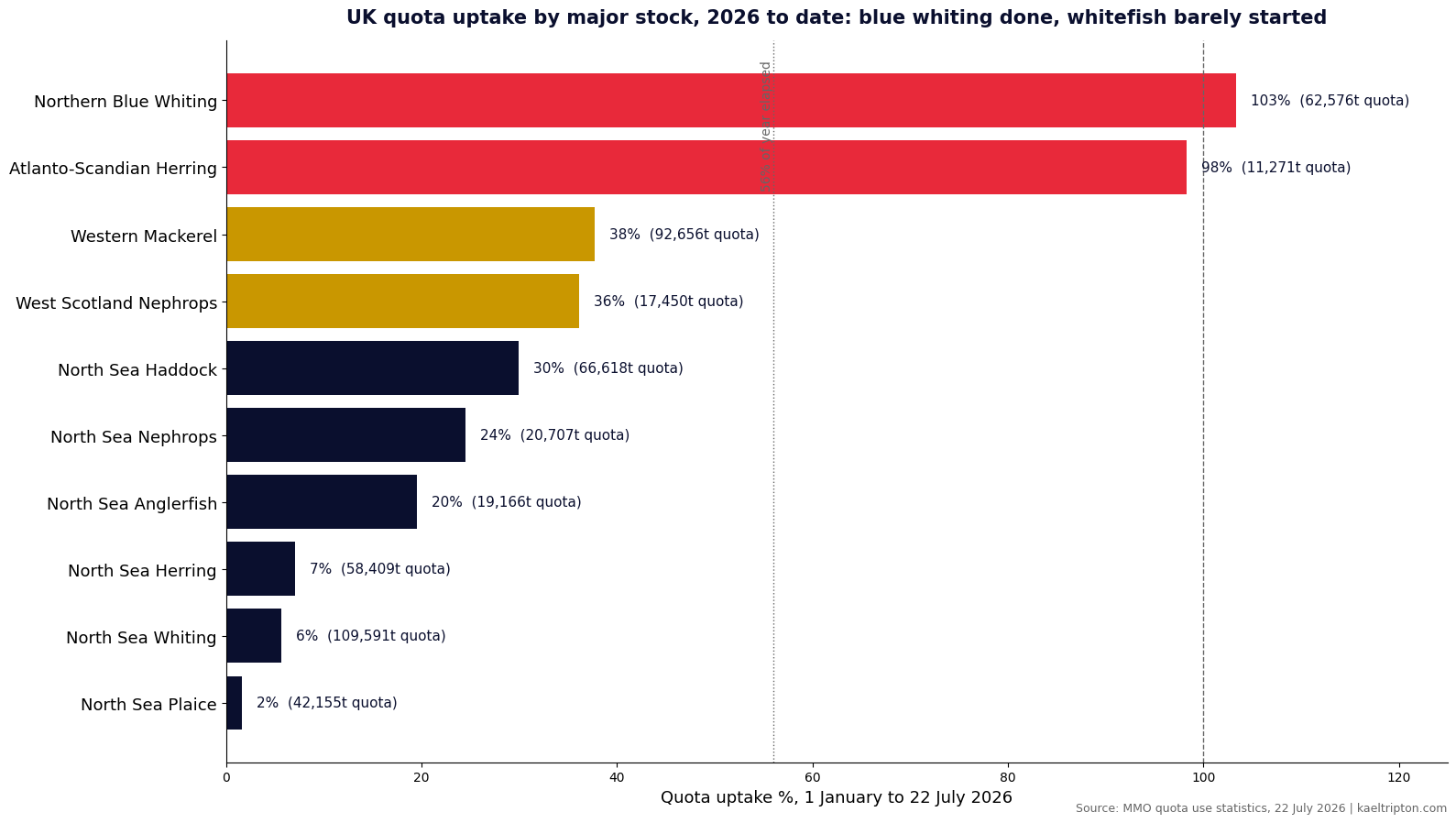
A system split by season: Northern Blue Whiting is at 103% of its quota and Atlanto-Scandian herring at 98%, while the biggest whitefish allocations, North Sea whiting, herring and plaice, sit below 10% with over half the year gone.
The Marine Management Organisation publishes quota uptake weekly, and the report to 22 July 2026, covering Areas 4 and 6, the major pelagic stocks, deep sea and Faroes waters, shows both ends of the cycle at once. At the top, Northern Blue Whiting has recorded landings of 62,549 tonnes against a 62,576 tonne adapted allocation, 103% uptake, and Atlanto-Scandian herring stands at 98% with roughly 250 tonnes left. At the other end, North Sea whiting, the single largest allocation in the report at 109,591 tonnes, shows just 5.6% taken, with North Sea herring at 7% and plaice at 1.6%. Across everything the report covers, around 824,000 tonnes of allocation, 26.6% had been landed with 56% of the year elapsed. Read naively, that looks like failure; read against the fishing calendar, it is the system working. Blue whiting is an intense early-year fishery, effectively complete by spring. The main Western mackerel season, the UK's most valuable catch, runs in the autumn and winter, which is why its 92,656 tonne quota shows 37.7% now with the bulk still deliberately unfished. Uptake percentages only mean something alongside each stock's season.
What happens when a quota is exceeded
Fisheries are closed when quota runs out, and any overshoot is paid back through deductions from future allocations, with in-year swaps and flexibility mechanisms used to keep landings inside the limits.
A figure above 100%, like blue whiting's 103%, does not mean unregulated fishing. Quota management runs continuously through the year: allocations are adjusted by inter-annual flexibility, carrying limited amounts between years, and by swaps, in which producer organisations and the UK itself trade quota for one stock against another, movements visible throughout the MMO tables as in-year changes to individual organisations' allocations. When a stock's remaining quota approaches zero, authorities close the fishery to further targeted catches, and any amount landed beyond the final adapted allocation is recovered through deductions from the following year's quota, so an overshoot is borrowed, not free. The same machinery works in the other direction: quota that a group cannot use can be swapped to those who can, or in defined cases banked, which is why allocations in the data change week to week. For the businesses involved, quota is therefore both a regulatory limit and a tradeable asset, and the weekly uptake report is effectively the market's scoreboard, showing which stocks are tightening and where spare volume sits as each season advances.
Why do fishing quotas matter beyond the fleet
Quotas underpin coastal economies and the sustainability of stocks, shape UK-EU and coastal state negotiations each year, and feed through to the supply and price of fish landed into UK ports.
The tonnages in this data are the raw material of several larger stories. Economically, quota is the licence to operate for fleets from Shetland to Cornwall, and the distribution across producer organisations in the data maps where the industry's weight sits, with the pelagic and whitefish allocations concentrated heavily in Scottish organisations. Politically, the annual TAC negotiations with the EU, Norway and the coastal states are among the most contested recurring items in the post-Brexit relationship, and the access arrangements agreed under the Trade and Cooperation Agreement remain subject to renegotiation, which keeps quota shares a live diplomatic issue. For consumers, quotas are one of the quiet determinants of what appears on fish counters and at what price: a stock fished to its limit early, or a TAC cut on scientific advice, tightens supply of that species into the market. And for sustainability, the uptake data is the enforcement record in public view: the weekly publication of landings against limits, stock by stock and organisation by organisation, is how a catch-limit system is held accountable, which is why the MMO releases it openly rather than as an internal record.
RELATED GUIDES
DISCLAIMER
This article is for general information only and does not constitute legal or business advice. Figures are drawn from the MMO quota use report to 22 July 2026 covering Areas 4 and 6, major pelagic, deep sea and Faroes stocks; other areas are reported separately and allocations change through the year via swaps and adjustments. Operators should rely on official MMO notices for current limits and closures.
Frequently asked questions
How are UK fishing quotas set
Annual Total Allowable Catches are agreed in international negotiations between the UK, EU, Norway and other coastal states, informed by scientific advice. The UK's share is then apportioned across the fleet, with producer organisations managing most quota and separate pools for the under-10-metre fleet.
What is a producer organisation in fishing
An industry body that holds and manages fishing quota collectively on behalf of its member vessels, handling allocations, swaps and uptake through the year. Most UK quota is managed through producer organisations, from Shetland and Aberdeen to Cornish and Northern Irish groups.
What happens if a fishing quota is exceeded
The fishery is closed to further targeted catches and any overshoot is recovered through deductions from future allocations. Northern Blue Whiting's 103% uptake in 2026 will be balanced through these adjustment mechanisms rather than standing as a free overshoot.
Why is mackerel quota uptake low in July
Seasonality. The main Western mackerel season runs in the autumn and winter, so mid-year uptake of 37.7% against the 92,656 tonne quota reflects the fishing calendar, not unused capacity. Blue whiting shows the reverse pattern as an early-year fishery.
Where is UK quota uptake data published
The Marine Management Organisation publishes quota use statistics on GOV.UK, updated weekly, showing allocations, landings and remaining quota for each stock and each producer organisation.
SOURCES
- Marine Management Organisation, quota use statistics - accessed 23 July 2026
- Fisheries Act 2020, legislation.gov.uk - accessed 23 July 2026
- Marine Management Organisation, GOV.UK - accessed 23 July 2026


