

Ofsted's 2025-26 annual report shows total operating expenditure of £227.5 million, up from £208.7 million the year before. The regulator inspected 1,420 schools under its new report-card system, identified 710 unregistered children's homes, and increased early years risk-assessments by 24 percent.
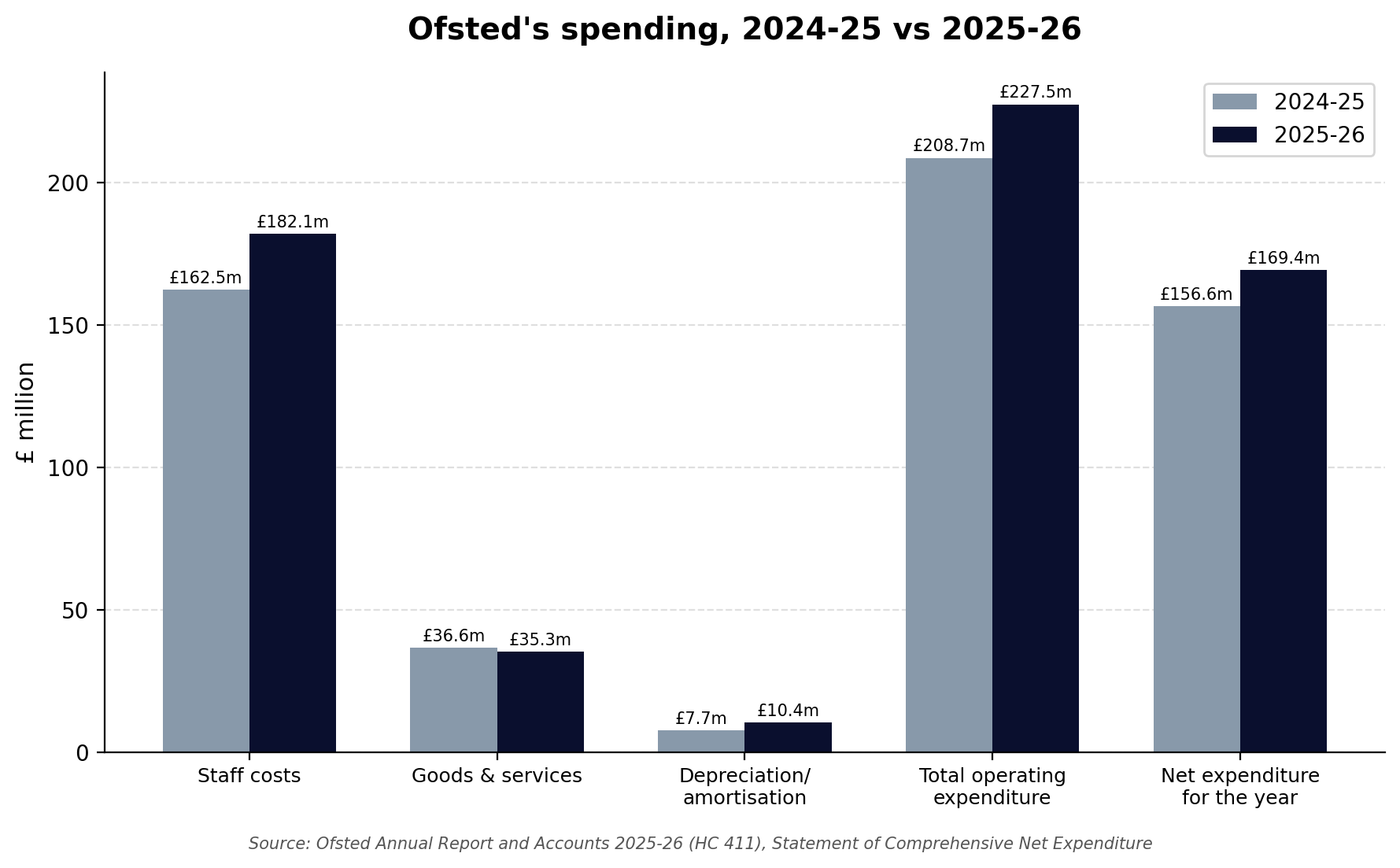
Ofsted's year-on-year spending, built from the Statement of Comprehensive Net Expenditure in the 2025-26 Annual Report and Accounts (HC 411) -- this comparison is not in the press release, only in the full financial statements.
TL;DR · LAST REVIEWED 14 July 2026
- Ofsted's total operating expenditure for 2025-26 was £227.5 million, up from £208.7 million the year before, with staff costs rising to £182.1 million.
- A new education inspection framework replaced single-word grades with report cards from November 2025; Ofsted has since inspected 1,420 state-funded schools, 1,380 of them full inspections.
- Early years risk-assessments rose 24% to around 14,800, covering roughly 9,440 providers; 970 concern-driven inspections followed, 55% of them unannounced.
- Ofsted's unregistered schools team opened 260 investigations and issued 23 warning notices; separately, 710 unregistered children's homes were identified, leading to 5 criminal investigations and 2 prosecutions.
- Around 350 children's home registration applications were withdrawn, refused or closed this year, despite record numbers of new applications, reflecting continued pressure on placement capacity.
- The Children's Wellbeing and Schools Act 2026 gives Ofsted new powers to investigate and fine illegal childcare and school providers, addressing a gap the regulator had flagged as a long-standing weakness.
KEY FACTS
- Total operating expenditure 2025-26: £227.5m (up from £208.7m)
- Net expenditure for the year: £169.4m (up from £156.6m)
- Schools inspected under new report-card system: 1,420 (1,380 full inspections)
- Early years risk-assessments: ~14,800 (+24% year on year)
- Unregistered children's homes identified: 710
- Regulated population: 1,160 independent schools; 27,900 non-domestic childcare providers; 31,700 childminders
A new way of grading schools
From September 2025, Ofsted set out a renewed education inspection framework, replacing the single-word overall effectiveness grade with a new-style report card intended to give parents, carers and professionals a more detailed picture of a school's strengths and weaknesses across different areas, rather than one headline judgement. Before the framework launched in November 2025, Ofsted ran 45 test visits and pilot inspections to refine the approach. Since the new framework began, Ofsted has inspected 1,420 state-funded schools, 1,380 of which were full inspections, separately from meeting its commitment to have inspected every school open in England by August 2025 that was funded through the 2021 Spending Review.
Early years: more checks, more often
Ofsted risk-assessed around 14,800 notifications from roughly 9,440 early years providers during the year, a 24 percent increase on the year before, reflecting both a growing sector and closer scrutiny. It completed 970 inspections prompted specifically by concerns raised about a setting, 55 percent of which were unannounced. From April 2026, Ofsted moved to a more frequent routine inspection cycle for early years settings, visiting at least every 4 years instead of every 6, and now inspects newly registered settings within 18 months of registration rather than waiting longer to confirm a new nursery or childminder is operating safely.
The children's homes capacity crisis
Applications to register new children's homes reached the highest number in Ofsted's history this year, yet the regulator says there are still not enough of the right homes in the right places to meet the needs of children in care, with capacity unevenly distributed: some regions are saturated with provision while others have real gaps. Around 350 applications were withdrawn, refused or closed during the year, and processing has taken longer than usual as a result of the surge in applications. Ofsted has since published updated prioritisation criteria and expected timeframes for processing children's home registrations, aiming to give the sector clearer expectations while it works through the backlog.
Cracking down on unregistered and illegal provision
Ofsted's unregistered schools team opened 260 investigations and carried out 130 inspections of suspected unregistered schools during the year, issuing 23 warning notices to 20 settings. Separately, and more significantly, Ofsted's investigators identified 710 unregistered children's homes, most of which received warning letters; five criminal investigations were carried out, leading to prosecutions in two cases. Ofsted has said it remains deeply concerned that children with the most complex needs, including some in care, continue to be placed in unregistered homes with no regulatory oversight at all. The Children's Wellbeing and Schools Act 2026 is intended to close this gap by giving Ofsted stronger investigative powers and, for the first time, the ability to fine illegal providers rather than relying solely on prosecution.
What Ofsted spent, and on what
Ofsted's total operating expenditure for 2025-26 was £227.5 million, up from £208.7 million the year before, driven mainly by a rise in staff costs to £182.1 million from £162.5 million, alongside higher depreciation and amortisation charges linked to digital system upgrades. Total operating income, largely from fees charged to providers for registration and inspection, was £58.1 million, leaving net expenditure for the year of £169.4 million, up from £156.6 million. Ofsted received a multi-year spending review settlement in June 2025 to support its reform programme, including a new inspection model for multi-academy trusts and updates to the digital systems that underpin all of its regulatory activity.
A new law, and what it changes
The Children's Wellbeing and Schools Act, which became law in April 2026, gives Ofsted new powers to investigate and close unregistered and illegal education and childcare settings, including the ability to seize evidence and, in time, issue financial penalties rather than relying only on prosecution through the courts. Ofsted has said this addresses a long-standing gap in its enforcement toolkit, since previously an unregistered provider that ignored a warning notice could often only be stopped through a lengthy criminal prosecution. Ofsted has also launched a consultation on strengthening how it inspects children's social care, including a proposal that a local authority's use of unregistered children's homes could itself count against it in future inspections of council-run children's services.
RELATED GUIDES
DISCLAIMER
This article is editorial information, not financial advice. Kael Tripton Ltd is not authorised or regulated by the Financial Conduct Authority. Figures were correct at the last review date shown above; verify current rates and rules with the primary sources listed below before acting.
Frequently asked questions
What replaced Ofsted's single-word school grades?
A new-style report card, introduced from November 2025, giving more detailed judgements across different areas rather than one overall grade.
How much did Ofsted spend in 2025-26?
Total operating expenditure was £227.5 million, up from £208.7 million the year before, with staff costs the largest component at £182.1 million.
How many unregistered children's homes did Ofsted find?
710, most of which received warning letters; five criminal investigations were carried out, leading to two prosecutions.
Why is there a shortage of children's home places despite record applications?
Capacity is unevenly distributed across regions, with some areas saturated and others lacking the right type of provision, so record applications haven't closed the gap.
What new powers does the Children's Wellbeing and Schools Act give Ofsted?
The ability to investigate, seize evidence from, and eventually fine illegal or unregistered education and childcare providers, rather than relying only on prosecution.
SOURCES
- GOV.UK / Ofsted - Annual Report and Accounts 2025 to 2026 Published - accessed 14 July 2026
- Ofsted - Annual Report and Accounts 2025-26 (HC 411) - accessed 14 July 2026


