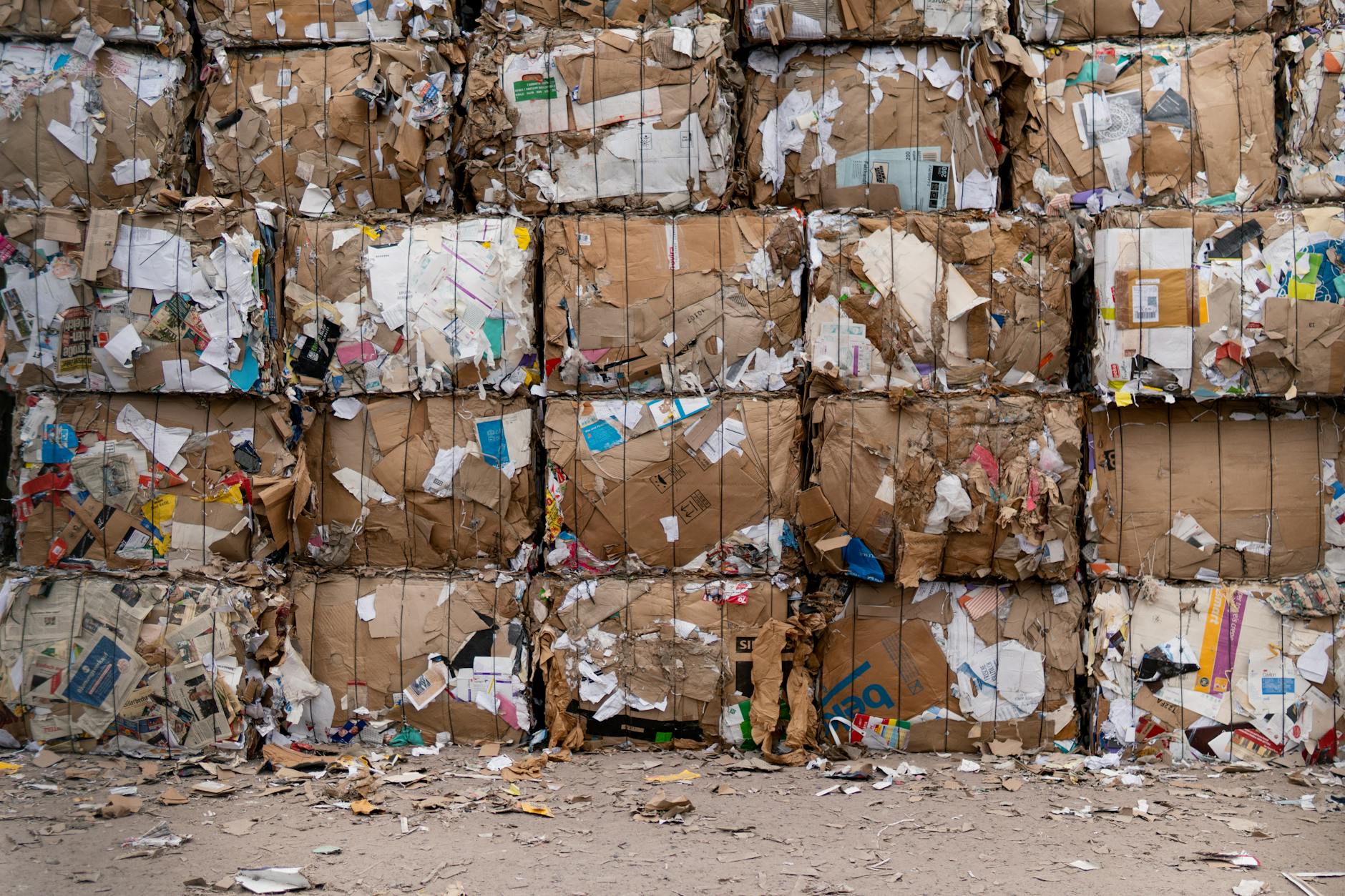
Cardboard recycling UK services split into two broad shapes: baled collection for sites that generate enough volume to compact and store cardboard on a pallet or in a baler, and loose collection for smaller premises that put out flat-packed boxes in a wheeled bin or a cage. The right choice changes the price, the rebate, the bin footprint and the carbon claim. This guide compares cardboard recycling UK providers including DS Smith, Saica, Biffa, FirstMile, Veolia and Bywaters across bale collection, loose collection, rebate structures and the regulation that sits behind every collection.
TL;DR: Cardboard (OCC, or old corrugated containers) is one of the few waste streams that can pay you back rather than cost you, because reprocessors compete for clean fibre. High-volume sites baling their own cardboard can earn a rebate per tonne from paper-mill-backed buyers such as DS Smith and Saica. Lower-volume sites typically pay a per-lift or per-bin charge through broker-led collectors such as FirstMile and Biffa, or regional independents such as Bywaters in London. The headline drivers are contamination, volume and whether the cardboard is baled or loose. Every collection is governed by the Waste Duty of Care, so a Waste Transfer Note and a registered carrier are non-negotiable regardless of who lifts the bin.
Key facts
- Cardboard is the most valuable common business recyclable because corrugated fibre feeds directly back into UK and European paper mills.
- Baled cardboard (typically 250kg to 500kg per bale) attracts the strongest rebates; loose cardboard usually carries a collection charge.
- Contamination, mainly food, polystyrene, plastic film and wet fibre, is the single biggest reason a rebate is downgraded or a load is rejected.
- Every business is a waste producer and carries the Waste Duty of Care under the Environmental Protection Act 1990, section 34, with no expiry.
- Mixed municipal waste sent to landfill carries the standard rate of Landfill Tax; diverting cardboard to recycling avoids that cost entirely. Verify the current Landfill Tax rate with HMRC before relying on it.
- From 31 March 2025, the Simpler Recycling rules in England require most workplaces to arrange recycling collection for dry materials including paper and card, separately from general waste where practicable.
- Indicative loose cardboard collection runs from roughly 5 to 12 pounds per lift for a 1100 litre bin; baled rebates can run into the tens of pounds per tonne, both indicative and contract-dependent.
At a glance: best-fit cardboard recycling UK providers
The grid below maps each provider to the type of site it suits. Read it as a shortlist starting point rather than a ranking, because the right cardboard recycling UK partner depends on your tonnage, your location and whether you can bale on site.
DS Smith
Best fit for: high-volume sites that can bale
Paper-mill-backed recovery. Suited to manufacturers, large retailers and distribution centres producing baled OCC by the tonne, where closed-loop fibre and a competitive rebate matter most.
Saica Natur
Best fit for: industrial and packaging-heavy sites
Reprocessor-owned collection arm. Most commonly chosen by factories and packaging users that want a direct route into a paper mill rather than a broker.
Biffa
Best fit for: multi-site national contracts
Suited to retailers, offices and hospitality groups that want cardboard bundled into a single national waste contract with broad geographic coverage.
FirstMile
Best fit for: SMEs and urban offices
Sack and bin based, no fixed contract in many cases. Operators typically shortlist FirstMile for city-centre offices, cafes and small shops with modest, predictable volumes.
Veolia
Best fit for: large and public-sector estates
Suited to councils, NHS estates, universities and corporates that want resource-recovery infrastructure and ESG reporting alongside collection.
Bywaters
Best fit for: London commercial premises
London-focused independent with its own materials recovery facility. Most commonly chosen by City and central London offices that value local routing and high recycling rates.
SUEZ
Best fit for: regional and industrial volume
Suited to mid-to-large industrial sites wanting recycling integrated with wider resource management across multiple regions.
Local independents
Best fit for: single-site, price-sensitive
Suited to a single premises that wants a sharp local price and a named local contact, accepting narrower coverage and fewer reporting tools.
Quick comparison table
The table sets each provider against the criteria that decide a cardboard contract. Indicative monthly figures are illustrative starting points only and vary heavily by volume, location and whether cardboard is baled or loose. Treat every figure as indicative.
| Provider | Best fit for | Indicative monthly from | Pricing basis | UK HQ | Regulatory focus | Inclusions |
|---|---|---|---|---|---|---|
| DS Smith | High-volume balers | Rebate possible (net credit) | Per tonne of baled OCC, rebate-led | London | EPR, Duty of Care, closed-loop fibre | Bale collection, weighbridge tickets, mill recovery |
| Saica Natur | Industrial and packaging sites | Rebate possible (net credit) | Per tonne, reprocessor-direct | Manchester area (UK ops) | EPR, Duty of Care | Bale and loose collection, baler supply, recovery |
| Biffa | National multi-site | From ~30 to 90 pounds | Per lift plus rental, contract | High Wycombe | Duty of Care, Simpler Recycling, EPR | Bins, WTN, collection, national coverage |
| FirstMile | SMEs and urban offices | From ~20 to 70 pounds | Per sack or per lift, flexible | London | Duty of Care, Simpler Recycling | Sacks or bins, WTN, online portal |
| Veolia | Large and public estates | From ~40 to 120 pounds | Per lift plus rental, contract | London | Duty of Care, EPR, ESG reporting | Bins, recovery, carbon and tonnage reporting |
| SUEZ | Regional industrial | From ~35 to 110 pounds | Per lift plus rental, contract | Maidenhead | Duty of Care, EPR | Bins, recovery, reporting |
| Bywaters | London commercial | From ~30 to 90 pounds | Per lift plus rental, contract | London (Bow) | Duty of Care, high recycling rate | Bins, own MRF, WTN, reporting |
| Enva | Regional and Ireland | From ~30 to 100 pounds | Per lift plus rental, contract | Leicestershire | Duty of Care, EPR | Bins, baled fibre recovery, WTN |
| Grundon | South and central England | From ~35 to 100 pounds | Per lift plus rental, contract | Oxfordshire (Ewelme) | Duty of Care, EPR | Bins, recovery, WTN |
What cardboard recycling as a category actually is
Cardboard recycling covers the collection, sorting and reprocessing of paper-based packaging back into new fibre products. In the trade the prized grade is OCC, old corrugated containers, the brown fluted board used for shipping boxes and outer cases. Office card, grey board and Kraft paper are also recyclable, but corrugated commands the best value because its long fibres can be re-pulped several times.
The category divides on one practical question: baled or loose. Baled cardboard is flattened, compacted and bound into dense blocks by an on-site baler or compactor, then collected on a flat-bed or by a hook lift. Loose cardboard is flat-packed boxes placed in a wheeled bin, a cage or clear sacks, then collected by a refuse vehicle. Baling concentrates value, cuts the number of collections and is what unlocks a rebate. Loose collection is simpler, needs no equipment and suits sites that cannot justify a baler.
The other defining feature of this category is that cardboard is a positive-value stream when clean. Reprocessors and paper mills compete for clean OCC, so a high-volume producer can be paid for material rather than charged to remove it. That is rare in waste management and it is the single biggest reason cardboard is handled separately from general waste rather than thrown into a mixed bin.
Bale collection versus loose collection
Bale collection is the route to a rebate. A baler turns scattered, bulky boxes into dense bales that store on a small footprint, fill a vehicle efficiently and reach a mill with minimal handling. The trade-off is capital: a mill-size vertical baler or a horizontal baler is an investment or a rental commitment, and someone has to operate it. Best fit for retailers, warehouses, factories and any site filling more than a bin a day.
Loose collection is the route for everyone else. Boxes are flattened and put out in a 240, 660 or 1100 litre wheeled bin, a roll cage or clear recycling sacks. There is no equipment to fund and no operator to train. The cost is a per-lift or per-sack charge, and loose cardboard takes far more vehicle space per tonne, which is why it rarely earns a rebate. Best fit for offices, cafes, small shops and any premises producing modest, irregular volumes.
Cardboard waste management services in context
Cardboard waste management services rarely stand alone. Most providers fold cardboard into a wider commercial recycling offer alongside mixed recycling, food waste and general waste, because a single collection round covering several streams is cheaper to run. That bundling matters when comparing quotes: a low cardboard rate inside an expensive general waste contract can cost more overall than a slightly higher cardboard rate inside a competitive bundle.
UK regulation behind cardboard recycling
Cardboard collection is bound by the same core waste law as any other stream, plus packaging-specific rules. Lead with the obligation, then the rate, then the date.
Waste Duty of Care, no expiry date
The Waste Duty of Care under section 34 of the Environmental Protection Act 1990 applies to every business that produces, holds or moves waste, including cardboard. It requires you to store waste safely, transfer it only to an authorised person, and complete a Waste Transfer Note describing the waste and confirming the carrier is registered. There is no start or end date: the duty is continuous. The statutory Code of Practice sets out exactly what is expected. See the Waste Duty of Care Code of Practice.
Simpler Recycling in England, from 31 March 2025
From 31 March 2025, the Simpler Recycling reforms in England require most workplaces to arrange the collection of the core dry recyclable materials, which include paper and card, separately from general waste where it is technically and economically practicable. The intention is to standardise what businesses recycle and to keep clean cardboard out of general waste. Devolved nations run their own equivalents through their environment regulators. Confirm the latest position with Defra and the relevant regulator before relying on it.
Extended Producer Responsibility for packaging
Extended Producer Responsibility (EPR) for packaging shifts the net cost of dealing with household packaging waste onto the businesses that place packaging on the market. Producers above the relevant thresholds must report packaging data and, under the scheme, face fees based on the materials they use, with modulation intended to reward more recyclable choices. This changes the economics of cardboard because corrugated board is among the most recyclable formats. Read the current rules and reporting obligations at packaging EPR on GOV.UK.
Landfill Tax makes recycling the cheaper route
Landfill Tax is charged on waste sent to landfill at the standard rate for active waste and a lower rate for inert waste. Diverting cardboard to recycling avoids the tax entirely, which is part of why separate cardboard collection is usually cheaper than dumping it in a general bin. The rate is set by HMRC and changes; state the figure but verify the current Landfill Tax rate with HMRC before relying on it. See Landfill Tax on GOV.UK.
Classification and the regulators
Clean, source-separated cardboard is non-hazardous waste. It still needs correct classification under the waste codes, particularly where it is mixed with other materials. The Environment Agency regulates waste in England, the Scottish Environment Protection Agency in Scotland, Natural Resources Wales in Wales, and the Department of Agriculture, Environment and Rural Affairs in Northern Ireland. Guidance on how to classify waste is at how to classify waste. Where balers and compactors are operated, the Health and Safety Executive sets the relevant machinery safety expectations.
Cardboard recycling UK vendors in detail
The profiles below set out who each provider suits, how it tends to price, and what it brings to a cardboard contract. Figures are indicative and contract-dependent.
DS Smith
DS Smith is a paper and packaging group that runs its own mills, so cardboard it collects can feed straight back into new corrugated board, a genuine closed loop. That integration is the draw for high-volume sites: when a buyer also owns the mill, the rebate on clean baled OCC tends to be competitive and the recovery story is easy to evidence for ESG reporting. Most commonly chosen by manufacturers, large retailers and distribution centres that already bale. Less suited to a single small office, where the tonnage cannot justify a mill-direct relationship.
Saica Natur
Saica Natur is the recovery and recycling arm of the Saica Group, a major European paper and packaging producer. Like DS Smith, it offers a reprocessor-direct route, which can mean stronger rebates and reliable offtake for sites producing serious volume. Saica can supply baling equipment and structure a collection round around it. Best fit for factories, packaging users and industrial sites that want to deal with a reprocessor rather than a broker.
Biffa
Biffa is one of the largest UK waste and recycling operators, with national collection coverage. For cardboard it is most commonly chosen by multi-site businesses that want every premises, from a flagship store to a regional depot, on one contract and one invoice. Cardboard is typically collected loose in wheeled bins or baled on larger sites. Suited to retail chains, hospitality groups and corporates that value coverage and consistency over a bespoke local price. Read the dedicated Biffa review.
FirstMile
FirstMile built its model around city-centre SMEs, using clear recycling sacks and bins with flexible, often contract-light, terms and a strong online portal for Waste Transfer Notes and reporting. For cardboard that means a small office or shop can recycle boxes without a long tie-in or a baler. Operators typically shortlist FirstMile where volumes are modest and predictable and where space for a large bin is tight. Less suited to a warehouse producing baled tonnage. See the FirstMile review.
Veolia
Veolia is a global resource-management operator with deep UK recovery infrastructure and detailed tonnage and carbon reporting. For cardboard it suits large estates, public-sector bodies and corporates that need recycling integrated with wider environmental services and want auditable diversion data. Best fit where reporting and infrastructure matter more than a rock-bottom per-lift price. Read the Veolia review.
Bywaters
Bywaters is a London-focused independent operating its own materials recovery facility in Bow, which keeps routing local and supports a high recycling rate. For cardboard it is most commonly chosen by City and central London offices that want a single regional partner, quick collections and strong diversion figures. Best fit inside the M25; less relevant for a national footprint. See the Bywaters review.
SUEZ
SUEZ runs recycling and recovery infrastructure across multiple UK regions and suits mid-to-large industrial sites that want cardboard handled inside a broader resource-management contract. Best fit for manufacturers and distribution operations with steady volume across more than one site. Read the SUEZ review.
Enva
Enva provides recycling and recovery across the UK and Ireland, including fibre recovery for baled and loose cardboard. Suited to regional businesses and any operation with sites that straddle the UK and Ireland. See the Enva review.
Grundon
Grundon is a long-established family-owned operator strong across the south and central England, offering cardboard collection within a broad commercial waste service. Best fit for businesses in its core regions that want an established independent rather than a multinational. Read the Grundon review.
Pricing and procurement for cardboard recycling UK
Cardboard pricing is unusual because the material has value. Three structures dominate, and which one applies depends almost entirely on volume and whether the cardboard is baled.
Per-lift and per-bin charges, loose collection
For loose cardboard in a wheeled bin, the cost is usually a per-lift charge plus a bin rental and sometimes a fixed service or admin fee. Indicatively, a 1100 litre cardboard bin lift might run from roughly 5 to 12 pounds, with rental on top, all dependent on location, frequency and the wider contract. These figures are indicative and not a quote. The advantage is simplicity; the downside is that loose cardboard is bulky, so per-tonne it is the most expensive way to move fibre.
Per-tonne rebates, baled collection
For baled OCC, the model can flip: instead of paying, a high-volume site may receive a rebate per tonne. Rebate levels track the recovered-paper market, which moves with global fibre demand, so a rebate quoted today is not guaranteed for the life of a contract. Clean, well-formed bales of a consistent grade command the best rates. Contamination, mixed grades or poorly bound bales reduce the figure or convert it into a charge. Treat any rebate as indicative and market-linked.
Sack-based pricing, micro-volumes
For the smallest sites, clear recycling sacks priced per sack remove the need for a bin entirely. This suits a small office producing a few boxes a week. It is the simplest entry point into cardboard recycling UK collection and is where contract-light providers focus.
What actually moves the price
- Volume and frequency: more tonnage and fuller loads lower the unit cost and improve any rebate.
- Baled versus loose: baling concentrates value and is the gateway to a rebate.
- Contamination: food, film, polystyrene and wet board downgrade or reject a load.
- Location and access: tight urban access, timed collections and congestion zones add cost.
- Bundling: a competitive overall contract can beat a cheap cardboard rate sitting inside an expensive general waste deal.
For a deeper breakdown of how UK collection charges are built, see the waste collection cost guide.
Strengths and limitations of cardboard recycling UK collection
Strengths
- Cardboard is the one common business stream that can pay a rebate rather than a charge when baled and clean.
- Diverting cardboard from general waste avoids Landfill Tax and reduces general waste lift frequency.
- Corrugated fibre is genuinely circular, with a credible closed-loop recovery story for ESG reporting.
- Separating cardboard is increasingly required anyway under Simpler Recycling in England.
Limitations
- Loose cardboard is bulky and space-hungry, so without baling the per-tonne economics are weak.
- Rebates are market-linked and can fall or vanish when recovered-paper prices drop.
- Contamination is unforgiving: one wet or food-soiled load can lose a whole rebate.
- Balers cost capital and need operator training and HSE-compliant safe operation.
Alternatives and adjacent options
Cardboard rarely sits in isolation, so the realistic alternatives are about how you route it rather than whether you recycle it.
Mixed dry recycling instead of segregated cardboard
Smaller sites sometimes put cardboard into a mixed dry recycling bin alongside paper, plastics and cans. This is simpler and needs fewer bins, but it forfeits the cardboard rebate and risks cross-contamination. Best fit for very low volumes where a dedicated cardboard bin cannot be filled.
Reprocessor-direct versus broker
High-volume balers can deal directly with a reprocessor such as DS Smith or Saica Natur, capturing more of the fibre value. Lower-volume sites usually go through a collector or broker such as FirstMile, Biffa or a regional independent, trading some rebate for convenience and bundled services.
Wider commercial waste bundling
Many businesses fold cardboard into one commercial waste contract. The best commercial waste guide compares full-service providers, and for project or clearance volumes the skip hire guide may fit better. For paper-heavy offices, the office waste guide and the confidential waste guide are the adjacent reads, since shredded paper and cardboard often travel together.
Cardboard recycling UK evaluation checklist
Run any shortlisted provider through these questions before signing.
- Is the carrier a registered waste carrier and will you receive a Waste Transfer Note for every collection?
- Can you bale on site, and if so is a rebate on offer, and is it fixed or market-linked?
- What exactly counts as contamination, and what happens to the price if a load is contaminated?
- Is the cardboard rate quoted in isolation or inside a wider waste contract, and how does the total compare?
- What bin or sack sizes and collection frequencies are available, and what are the access constraints at your site?
- Does the provider supply tonnage and diversion reporting you can use for Simpler Recycling and ESG evidence?
- What is the contract length, the price-review mechanism and the notice period?
- Does coverage actually reach your location, or is this a national brand subcontracting your area?
Common mistakes with cardboard recycling
- Leaving boxes whole. Un-flattened boxes fill a bin with air, raising the per-lift cost and cutting any rebate. Always flatten.
- Contaminating clean fibre. Food, polystyrene, plastic film, tape-heavy or wet board all downgrade a load. Keep cardboard dry and separate.
- Chasing a headline rebate. A strong rebate inside a poor overall contract can still cost more than a modest rebate inside a competitive one.
- Ignoring the Waste Transfer Note. No WTN means a Duty of Care breach regardless of how green the recycling looks.
- Buying a baler too soon. A baler only pays back above a real volume threshold; below it, loose or sack collection is cheaper.
Regional coverage
Cardboard collection availability and price vary by city, mostly driven by how close you are to a reprocessing site and how congested access is. National operators such as Biffa, Veolia and SUEZ cover most regions; independents are stronger locally. Coverage spans Birmingham, Manchester, Leeds, Glasgow, Bristol, Liverpool, Edinburgh, Cardiff, Belfast, Newcastle, Nottingham and Oxford, among others.
Search demand is strongest where industrial and distribution volume concentrates: cardboard recycling Manchester is a high-intent query reflecting the city's logistics and packaging base, while cardboard waste management Liverpool reflects its port and warehousing activity. Cardboard waste management services in Birmingham, Leeds and Glasgow follow similar industrial patterns. For a city-by-city breakdown, see the waste management by UK city guide.
Editorial note: This guide is independent UK editorial and is not financial, legal or regulatory advice. kaeltripton earns no commission and routes no leads. Pricing is indicative and varies by contract, location and waste stream. Confirm regulatory obligations with the named UK authorities before acting.
Cardboard recycling UK FAQ
What is the best cardboard recycling UK option for a small office?
For a small office producing a few boxes a week, a sack-based or small-bin loose collection from a contract-light provider such as FirstMile is the most common fit. There is no baler to fund and no long tie-in. Flatten every box, keep the cardboard dry and separate, and confirm you receive a Waste Transfer Note for each collection.
How much does cardboard recycling cost in the UK?
For loose cardboard, indicative per-lift charges run from roughly 5 to 12 pounds for a 1100 litre bin, plus rental, varying by location, frequency and contract. High-volume baled cardboard can instead earn a rebate per tonne. All figures are indicative and not a quote; get a site-specific price.
Can I get paid for cardboard recycling?
Yes, if you produce enough clean, baled OCC. Reprocessors such as DS Smith and Saica Natur compete for clean fibre and may pay a rebate per tonne. The rebate is market-linked and depends on bale quality and grade, so it can rise or fall and is not guaranteed for the contract term.
Is baled or loose cardboard collection better?
Baled collection concentrates value, cuts collection frequency and is the route to a rebate, but it needs a baler and an operator. Loose collection needs no equipment and suits modest volumes, but it is bulky and rarely earns a rebate. The threshold is volume: baling pays back above a real daily tonnage.
Does cardboard need to be separated from general waste?
In England, from 31 March 2025, Simpler Recycling requires most workplaces to arrange separate collection of dry recyclables including paper and card where practicable. Beyond compliance, separating clean cardboard protects its value and avoids Landfill Tax on the diverted material. Confirm the current rules with Defra.
What contaminates a cardboard load?
Food residue, grease, polystyrene, plastic film, polythene, tape-heavy board and wet or waxed cardboard all count as contamination. Any of these can downgrade a rebate or cause a load to be rejected. Keep cardboard dry, flat and free of other materials.
What is OCC in cardboard recycling?
OCC stands for old corrugated containers, the brown fluted shipping board that is the most valuable common cardboard grade. Its long fibres re-pulp well, so reprocessors prize clean OCC and pay the best rebates for it.
Do I still need a Waste Transfer Note for cardboard?
Yes. The Waste Duty of Care under section 34 of the Environmental Protection Act 1990 applies to all business waste including cardboard, with no expiry. Every transfer needs a Waste Transfer Note and the carrier must be registered, regardless of how recyclable the material is.
Is cardboard recycling in Manchester different from elsewhere?
The rules are the same nationally, but price and availability vary locally. Cardboard recycling Manchester benefits from the city's dense logistics and packaging base and proximity to reprocessing, which can sharpen pricing. Compare a national operator against a local independent for the best fit.
Who collects baled cardboard for the best value?
Reprocessor-owned operators such as DS Smith and Saica Natur offer a mill-direct route that can capture more fibre value for high-volume balers. Brokers and collectors such as Biffa, FirstMile and regional independents trade some rebate for convenience and bundled services.
Does cardboard recycling reduce my Plastic Packaging Tax or EPR cost?
Recycling cardboard does not directly reduce Plastic Packaging Tax, which targets plastic packaging. However, EPR for packaging fees are influenced by the recyclability of materials you place on the market, and corrugated cardboard is among the most recyclable formats. Verify the current Plastic Packaging Tax rate and EPR fees with HMRC and the EPR scheme before relying on them.
What is the difference between cardboard recycling and confidential waste?
Cardboard recycling handles clean packaging board for fibre recovery. Confidential waste handles documents that must be securely destroyed before recycling. They often travel together in offices, but confidential waste needs a secure, audited destruction process. See the confidential waste guide for that route.
How do I start a cardboard recycling UK contract?
Estimate your weekly volume, decide whether you can bale, then ask two or three providers for a site-specific quote covering rate, rebate basis, contamination terms, contract length and reporting. Confirm the carrier is registered and that you will receive a Waste Transfer Note, then compare the total cost rather than the cardboard line alone.
Sources
- Waste Duty of Care Code of Practice (GOV.UK)
- Department for Environment, Food and Rural Affairs
- Packaging Extended Producer Responsibility (GOV.UK)
- Plastic Packaging Tax (GOV.UK)
- Landfill Tax (GOV.UK)
- How to classify different types of waste (GOV.UK)
- Environment Agency
- Scottish Environment Protection Agency
- Natural Resources Wales
- Department of Agriculture, Environment and Rural Affairs (NI)
- Health and Safety Executive
- legislation.gov.uk


