
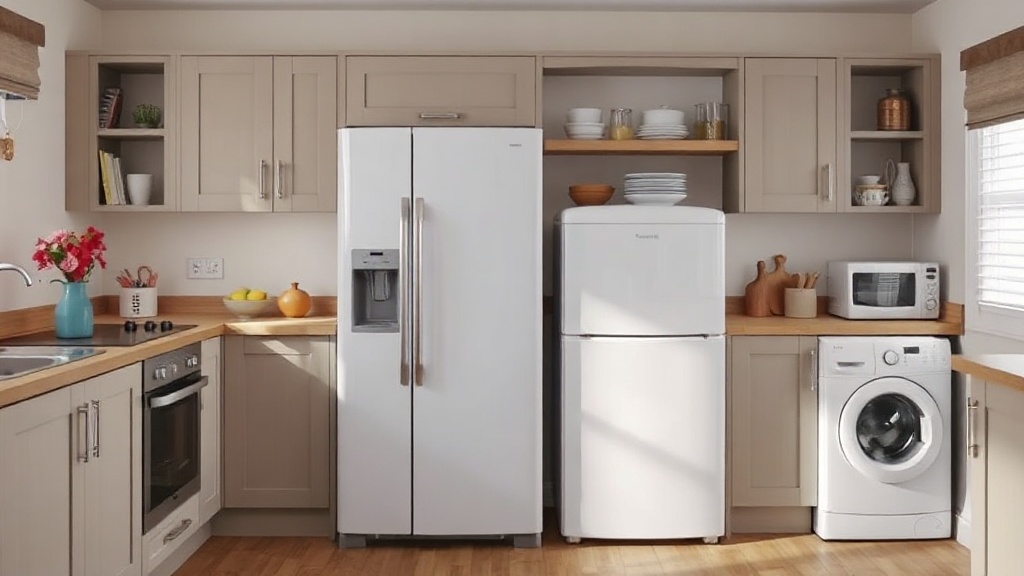
TL;DR: Home appliance insurance covers the repair or replacement of household white goods and domestic equipment when they break down. Before committing to a policy, it pays to understand exactly what is covered, how excess and age-limit rules affect claims, and the specific questions worth putting to any provider.
★ Featured Partner · Sponsored
Compare Insurance Quotes
Search and compare quotes from leading UK insurers. Quotezone's panel includes specialist insurers not always on the four major comparison sites.
Compare Quotes →What Home Appliance Insurance Actually Covers
Home appliance insurance, sometimes marketed as white goods insurance or domestic appliance cover, is a financial product that pays the cost of repairing or replacing household equipment when it stops working through mechanical or electrical breakdown. The category is separate from general home contents insurance, though it is sometimes bundled with contents policies as an optional add-on, and it is distinct from the extended warranties sold at point of purchase by retailers.
In its most basic form, a policy covers a single named appliance. Multi-appliance policies bundle several items under one monthly or annual premium, which usually reduces the per-item cost. The core promise is that if a covered appliance develops an internal fault that prevents normal operation, the insurer will arrange and pay for a qualified engineer to carry out a repair, or, where repair is not economical or possible, replace the item with one of equivalent specification.
Most standard policies cover the following categories of appliance: washing machines, tumble dryers, washer-dryers, dishwashers, fridge-freezers, upright fridges, chest freezers, electric cookers, range cookers, gas hobs, electric hobs, built-in ovens, microwave ovens, and integrated kitchen units. Some providers extend cover to smaller domestic electricals such as coffee machines, vacuum cleaners, and televisions, though these are less commonly included in entry-level tiers.
It is equally important to understand what standard policies do not cover. Cosmetic damage, such as scratches, dents, or discolouration, is almost universally excluded. Loss of food due to freezer breakdown is sometimes offered as an optional extra but is rarely included in the base premium. Damage caused by blocked pipes, limescale, or failure to maintain the appliance according to the manufacturer guidance is frequently excluded. Many policies also exclude the first 14 to 30 days of cover while waiting periods expire, and most contain explicit exclusions for pre-existing faults.
Breakdown Cover, Accidental Damage Cover and Contents Insurance: Key Differences
These three products are often confused with one another, and the distinction matters when deciding what type of cover suits a particular household.
Breakdown cover, the most common form of standalone appliance insurance, activates only when an appliance fails through an internal mechanical or electrical fault. It does not respond to physical damage caused by an external event. If a washing machine develops a fault with its motor bearings through normal wear, breakdown cover pays out. If the same machine is damaged because a shelf collapsed onto it, breakdown cover does not apply.
Accidental damage cover is designed for exactly that external scenario. It covers physical damage caused by a sudden, unexpected, and unintentional event: dropping a television, spilling liquid into an appliance's control panel, or a child pushing a hard object into a machine drum. Accidental damage is sometimes available as a standalone product but is more commonly sold as an add-on to either breakdown cover or to a home contents insurance policy.
Home contents insurance, regulated by the Financial Conduct Authority under the Financial Services and Markets Act 2000, is a broad policy covering the possessions inside a property against a range of risks including fire, flood, theft, and, where the accidental damage extension is purchased, sudden physical damage. Appliances can be claimed under contents insurance, but the claim is subject to the policy excess, which on contents policies is frequently higher than on a dedicated appliance policy. Contents insurance also uses a sum-insured model, meaning repeated appliance claims erode the overall cover available for other possessions and can trigger premium increases at renewal.
For households with multiple appliances of significant value, a dedicated multi-appliance breakdown policy typically offers lower per-item excesses, faster engineer response times, and a more straightforward claims route than relying on contents insurance.
How Age Limits Work and Why They Matter
Age limits are among the most consequential features of any home appliance policy and among the most frequently overlooked at the point of purchase. Almost all providers impose a maximum appliance age, typically ranging from 8 to 12 years from the original purchase date, beyond which cover is either unavailable or subject to materially different terms.
The practical consequence is that a household might pay premiums for several years on an appliance approaching that threshold, only to find that when the item develops a fault it has aged out of cover eligibility. Some providers conduct an age check at the point of application; others confirm the purchase date only when a claim is submitted, which can result in a claim being declined on an appliance the policyholder assumed was covered.
A related concept is the useful economic life rule, applied by some insurers independently of the stated age limit. Under this rule, even if an appliance is within the stated maximum age, the insurer may decline to authorise repair if the estimated repair cost exceeds a defined percentage of the appliance's current replacement value, typically 50 to 70 per cent. In that scenario, the insurer offers a replacement, but the replacement specification may be an entry-level model rather than the equivalent of the original item.
Newer appliances may also be subject to the original manufacturer's guarantee, which complicates the value calculation. If a washing machine is still within its two-year manufacturer guarantee, a standalone appliance insurance policy may not accept it, or may apply a waiting period until the manufacturer's responsibility lapses. It is worth confirming with any potential provider whether the policy is intended to sit alongside a live manufacturer guarantee or whether it commences only after that guarantee expires.
Excess Structures and What They Mean in Practice
An excess is the amount the policyholder contributes towards each claim before the insurer pays the remainder. Appliance insurance policies typically operate with a per-claim excess rather than an annual excess. This means the excess applies each time an engineer is called out, not once per policy year.
Standard per-claim excesses on entry-level single-appliance policies typically range from zero to £75. On comprehensive multi-appliance policies, per-claim excesses of £50 to £100 are common. Some providers offer nil-excess policies in exchange for a higher monthly premium; others offer a choice of excess level at the point of purchase, with a lower premium available if the policyholder accepts a higher excess.
The structure to scrutinise carefully is the tiered replacement excess. Where an insurer decides that a repair is uneconomical and offers a replacement appliance instead, some policies charge a separate replacement excess, which can be considerably higher than the standard repair excess. A policy that lists a £50 repair excess may charge a £150 or £200 replacement excess in small print. Since replacement scenarios are precisely the high-value claims where the policy is most useful, this distinction has significant financial impact.
It is also worth noting how the excess interacts with low-cost repairs. If a dishwasher requires a door seal replacement costing approximately £80 including engineer labour, and the policy carries a £75 excess, the practical benefit of the claim is minimal. Understanding the likely range of repair costs for a given appliance helps calibrate whether the excess structure on a particular policy represents genuine value.
Response Times, Call-Out Guarantees and Repair Timelines
A policy's response-time guarantee defines how quickly an engineer will attend following a successful claim authorisation. Most providers publish a target response time rather than a contractual guarantee. Common targets are next business day, within 48 hours, or within five to seven working days. The distinction between a guaranteed response and a target is material: a target creates no enforceable obligation.
Some premium-tier policies offer guaranteed same-day or next-day visits. These policies carry higher premiums but are particularly relevant for primary appliances such as refrigerators, where a multi-day wait for an engineer creates additional costs in spoiled food, or for families where a non-functional washing machine creates immediate and significant disruption.
Beyond the initial engineer visit, the time to complete a repair depends on parts availability. Many policies include a parts guarantee, committing the insurer to source a required component within a defined timeframe, commonly seven to ten working days. Where parts are unavailable within that window, the policy should trigger the replacement process. Reviewing whether a policy carries a parts availability guarantee, and what the escalation path to replacement looks like, is important when assessing multi-appliance policies covering older models where parts may be harder to source.
Waiting Periods and Pre-Existing Fault Exclusions
A waiting period is the interval between a policy start date and the point at which claims can first be submitted. Most providers apply a waiting period of between 14 and 30 days. The commercial rationale is to prevent customers from taking out a policy on an appliance that has already begun to malfunction and immediately submitting a claim.
The pre-existing fault exclusion works alongside the waiting period. Even after a waiting period has elapsed, a claim can be declined if the insurer determines that the fault existed, or was developing, before the policy commenced. In practice, this exclusion is applied by examining whether the fault could reasonably be attributed to gradual deterioration that pre-dated cover. Intermittent faults, noise issues, or performance reduction that the policyholder was aware of before taking out the policy are the scenarios most vulnerable to this exclusion.
Some providers require an engineer inspection at the point of application, particularly for appliances over a certain age, to verify that the item is in good working order before cover commences. This inspection, which may carry a fee, provides a degree of protection for the policyholder by creating a documented baseline that limits the insurer's ability to invoke pre-existing fault exclusions at claim stage.
Landlord Considerations vs Homeowner Cover
Appliance insurance operates differently depending on whether the policyholder is a residential owner-occupier or a landlord covering appliances in a let property. Landlords who provide appliances as part of a furnished tenancy have a legal obligation under the Landlord and Tenant Act 1985 to ensure that the property is fit for human habitation and that supplied equipment is maintained in working order. Appliance insurance can support that obligation, but standard consumer policies are often invalid if the property is occupied by tenants rather than the policyholder.
Specialist landlord appliance cover is available from several providers and is structured to address the different risk profile of rented properties. Appliances in let properties typically experience more intensive use and are subject to higher rates of accidental damage. Landlord-specific policies usually include a notification pathway for tenants to report faults directly to the insurer or managing agent, reducing the delays inherent in a chain where the tenant reports to the landlord who then contacts the insurer.
For owner-occupiers, the primary distinction to clarify is whether the policy covers appliances in a property that is occasionally let, for example through a short-term holiday rental platform. Many standard residential policies contain a commercial use exclusion that voids cover when the property is used for any form of paid accommodation. Homeowners who let their property even infrequently should confirm with the provider whether this affects cover for appliances.
Cost Tiers: What Different Price Points Deliver
Appliance insurance premiums vary considerably depending on the number of appliances covered, the level of cover selected, and whether the policy includes accidental damage protection. The table below summarises the main cost tiers and what each typically includes.
| Tier | Typical Monthly Cost | Appliances Covered | Accidental Damage | Typical Per-Claim Excess | Response Time Target |
|---|---|---|---|---|---|
| Basic single-appliance | GBP 5 to GBP 10 | 1 named appliance | Not included | GBP 0 to GBP 75 | 5 to 7 working days |
| Mid-tier single-appliance | GBP 10 to GBP 20 | 1 named appliance | Optional add-on | GBP 25 to GBP 75 | 2 to 3 working days |
| Basic multi-appliance | GBP 15 to GBP 30 | 5 to 10 appliances | Not included | GBP 50 to GBP 100 | 3 to 5 working days |
| Comprehensive multi-appliance | GBP 20 to GBP 50 | All domestic appliances | Included | GBP 50 to GBP 100 | Next day to 48 hours |
| Premium whole-home | GBP 40 to GBP 80 | All appliances + boiler | Included | GBP 0 to GBP 50 | Same day or next day |
Prices shown reflect published market rates across a range of UK providers and are intended as orientation guides. Actual premiums depend on appliance age, property location, and the provider's own underwriting criteria. Annual premium equivalents typically carry a discount of between 5 and 15 per cent compared to the total of 12 monthly payments.
Comparing Policies Effectively
When comparing home appliance policies, the headline premium figure is rarely the most important variable. The combination of excess, age limit, replacement terms, and response-time guarantee determines the practical value of a policy far more than the monthly cost alone.
A structured comparison should capture the following for each policy under consideration: the maximum appliance age accepted, the per-claim repair excess, the replacement excess (which is frequently different and higher), whether accidental damage is included or optional, the stated response-time target and whether it is contractually guaranteed, the parts availability commitment, the waiting period duration, and whether the replacement appliance will be of equivalent specification or determined by a different formula.
Price comparison websites aggregate some appliance insurance products, but the scope of comparison tools in this category is narrower than in motor or home insurance. The Financial Conduct Authority's register of authorised firms, available at register.fca.org.uk, allows verification that any provider or broker considered holds the appropriate authorisation to sell and administer insurance products in the UK. Policies sold without FCA authorisation do not carry the protections of the Financial Services Compensation Scheme, which provides cover of up to 90 per cent of the value of a valid claim if an insurer becomes insolvent.
Citizens Advice publishes general guidance on extended warranties and appliance cover that provides a useful consumer-protection framework, including the right to cancel within a cooling-off period under the Consumer Contracts (Information, Cancellation and Additional Charges) Regulations 2013 and the right to complain to the Financial Ombudsman Service if a claim is handled incorrectly. These consumer protections apply to regulated insurance products and represent an important backstop that is unavailable with unregulated retail warranties.
The Questions to Ask a Provider Before Signing Up
The pre-purchase stage is the single most effective point at which to surface potential problems with a policy. Once cover has commenced and a claim arises, the policy terms are fixed. The following questions are designed to extract the information that most commonly causes disputes between policyholders and appliance insurers at claim stage.
First, ask for the exact age limit applied to the specific appliances being covered. Do not rely on a general statement that appliances must be "not too old"; request the precise year of manufacture threshold and confirm how the insurer verifies age when a claim is submitted.
Second, ask how the replacement appliance specification is determined. Specifically, ask whether the replacement will be of the same brand, energy rating class, capacity, and feature set as the original, or whether the insurer reserves the right to substitute a lower-specification model of equivalent market value at the time of replacement rather than equivalent original purchase value.
Third, ask what the escalation process is if parts for a repair are not available within the standard parts-sourcing window. Confirm at what point the policy transitions from repair authorisation to replacement authorisation, and whether the replacement excess differs from the repair excess.
Fourth, ask how the pre-existing fault exclusion is defined and applied. Request clarity on whether a fault that manifests within the waiting period or shortly after it expires is automatically treated as pre-existing, or whether the insurer uses an engineer assessment to make that determination.
Fifth, ask whether the policy is underwritten by an FCA-authorised insurer and, if the policy is sold through a broker or third party, who the actual insurer of record is. This allows independent verification through the FCA register and confirms which entity the Financial Ombudsman Service would have jurisdiction over in the event of a dispute.
Sixth, if the property is ever let or shared with non-family members, ask whether the policy contains any commercial use or non-owner-occupier restriction that could void a claim. This question is particularly important for households in the private rented sector where the tenant, rather than the landlord, is considering taking out cover on appliances they own personally and have installed in a rented property.
Asking these questions before purchasing creates a documented record of the provider's representations. If those representations turn out to be inaccurate or if the policy terms contradict them, the Financial Ombudsman Service takes into account pre-contractual statements when adjudicating disputes under the Insurance Act 2015 and the Consumer Insurance (Disclosure and Representations) Act 2012.
Making Sense of the Total Cost of Cover
A final consideration before purchasing is whether the cost of a dedicated appliance policy represents sound financial planning relative to the alternative of self-insuring through a savings buffer. A washing machine costing GBP 400 to GBP 600, if it fails after seven years, will either require a repair costing GBP 80 to GBP 200 for a common fault or replacement at broadly original cost. A policy costing GBP 8 per month over seven years carries a total premium cost of approximately GBP 672, which, depending on excess and claim history, may or may not represent a net benefit.
The value calculation shifts significantly for households with multiple high-value appliances, for older appliances approaching the end of their serviceable life, or for households where a sudden large repair or replacement cost would cause genuine financial difficulty. For those households, the certainty provided by a comprehensive multi-appliance policy at GBP 20 to GBP 50 per month has tangible financial utility beyond the expected-value arithmetic.
The Association of British Insurers publishes annual data on claims frequency and settlement rates across domestic insurance categories. Reviewing that data alongside published policy terms helps calibrate whether a particular provider's claims record is consistent with the coverage commitments made in its product literature. Policies that carry unusually low premiums relative to the market median sometimes reflect tighter claim-acceptance criteria rather than operational efficiency, and interrogating those criteria through the pre-purchase questions above is the most reliable way to identify the difference.
Important: This article is general information about UK home appliance and home cover and does not constitute financial, insurance or legal advice. Policy terms, prices and statutory entitlements change over time and vary between providers. Always read the full policy documents and the relevant guidance from a qualified adviser or the named primary sources before making a decision.
Frequently asked questions
Can I insure a second-hand appliance I bought from a private seller?
Some providers accept second-hand appliances, but the age limit applies from the original manufacture date rather than the date of your purchase. If the appliance is already seven or eight years old when you acquire it, many standard policies will not accept it or will apply restrictive terms. It is worth confirming the manufacture date before applying and declaring it accurately, as misrepresentation can void cover under the Consumer Insurance (Disclosure and Representations) Act 2012.
Is home appliance insurance worth it for a new appliance still under manufacturer guarantee?
Manufacturer guarantees typically run for one to two years and cover manufacturing defects. A standalone appliance policy may not accept a claim during the guarantee period, and some providers will not commence cover until the guarantee has expired. If your goal is continuous long-term cover, it is worth comparing the cost of taking out a policy from year two or three onwards against the total multi-year cost of an extended warranty offered at point of sale, which can sometimes be more expensive per year than the open-market equivalent.
What happens if the insurer cannot find parts to repair my appliance?
Most policies include a parts sourcing commitment, commonly seven to ten working days. If parts cannot be sourced within that window, the policy should escalate to replacement. I would recommend checking the exact escalation wording before signing up, because some policies require the policyholder to request a replacement actively rather than triggering it automatically, and others apply a different, higher excess to replacements than to repairs.
Does a standard home appliance policy cover appliances in a garage or outbuilding?
This depends on the policy wording. Many standard policies define the covered location as the main residential property, which may or may not include attached or detached outbuildings. Freezers kept in garages are a common example of an appliance that falls into ambiguous territory. The safest approach is to list any appliances outside the main building when applying and to obtain written confirmation of whether they are covered.
Can I claim for the same appliance multiple times in one year?
Most policies allow multiple claims per appliance per year, subject to a per-claim excess each time. However, some policies include a fair use clause or a maximum number of callouts per appliance per year, and a small number of providers can decline to renew a policy or increase the premium significantly after a high number of claims. It is worth checking whether any callout frequency limit or claims-frequency premium review clause applies before committing to a policy.
Sources and further reading
Related guide on this topic: Appliance Insurance UK: What It Covers, What It Costs and How to Compare Policies


