
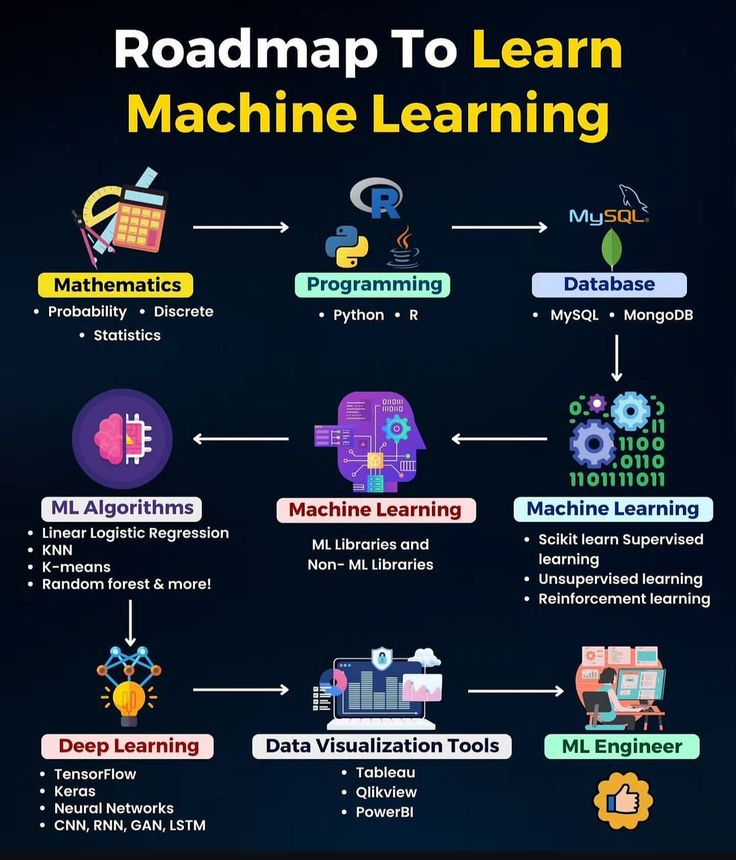
Machine Learning (ML) is transforming industries, powering intelligent applications, and shaping the future of technology. Whether you're a beginner or an experienced developer looking to transition into ML, having a structured roadmap is essential. This guide outlines a step-by-step approach to mastering Machine Learning, from foundational concepts to advanced applications.
Step 1: Understanding the Basics
1.1 What is Machine Learning?
Machine Learning is a subset of Artificial Intelligence (AI) that enables computers to learn patterns and make decisions without being explicitly programmed. It is used in applications such as recommendation systems, fraud detection, autonomous vehicles, and natural language processing.
1.2 Key Concepts in ML
- Supervised Learning – Learning from labeled data (e.g., classification and regression tasks)
- Unsupervised Learning – Identifying patterns in unlabeled data (e.g., clustering and dimensionality reduction)
- Reinforcement Learning – Learning by interacting with an environment to maximize rewards
Step 2: Building a Strong Mathematical Foundation
To excel in Machine Learning, understanding the underlying mathematics is crucial.
2.1 Linear Algebra
- Vectors and Matrices
- Matrix Operations
- Eigenvalues and Eigenvectors
2.2 Probability and Statistics
- Probability Distributions
- Bayes’ Theorem
- Hypothesis Testing
2.3 Calculus
- Derivatives and Integrals
- Gradient Descent Optimization
2.4 Optimization Techniques
- Convex Optimization
- Stochastic Gradient Descent (SGD)
Step 3: Learning Programming and Libraries
3.1 Choosing a Programming Language
- Python (Recommended) – Widely used with extensive libraries
- R – Popular for statistical computing
3.2 Essential ML Libraries
- NumPy & Pandas – Data handling and manipulation
- Matplotlib & Seaborn – Data visualization
- Scikit-learn – Basic ML models and feature engineering
- TensorFlow & PyTorch – Deep learning frameworks
Step 4: Data Collection and Preprocessing
Machine Learning models require high-quality data. Understanding how to collect and preprocess data is essential.
4.1 Data Collection Methods
- APIs and Web Scraping
- Public Datasets (Kaggle, UCI ML Repository)
4.2 Data Cleaning
- Handling missing values
- Dealing with outliers
- Normalization and Standardization
4.3 Feature Engineering
- Feature Selection
- Feature Scaling
- Dimensionality Reduction (PCA, t-SNE)
Step 5: Implementing Machine Learning Models
5.1 Supervised Learning Algorithms
- Linear Regression
- Logistic Regression
- Decision Trees
- Random Forests
- Support Vector Machines (SVM)
- Neural Networks
5.2 Unsupervised Learning Algorithms
- K-Means Clustering
- Hierarchical Clustering
- Principal Component Analysis (PCA)
5.3 Model Evaluation Metrics
- Accuracy, Precision, Recall, F1 Score
- ROC-AUC Curve
- Mean Squared Error (MSE), R-Squared for Regression
Step 6: Deep Learning and Neural Networks
Deep Learning is an advanced subfield of ML that deals with complex neural network architectures.
6.1 Fundamentals of Neural Networks
- Artificial Neurons
- Activation Functions
- Forward and Backpropagation
6.2 Deep Learning Architectures
- Convolutional Neural Networks (CNN) – Used for image recognition
- Recurrent Neural Networks (RNN) – Used for sequential data
- Transformers – Used in NLP tasks (e.g., BERT, GPT)
6.3 Training and Tuning Deep Learning Models
- Hyperparameter Tuning
- Dropout and Regularization
- Transfer Learning
Step 7: Working on Real-World Projects
Practical experience is crucial in mastering ML.
7.1 Beginner-Level Projects
- House Price Prediction (Regression)
- Spam Email Detection (Classification)
- Customer Segmentation (Clustering)
7.2 Intermediate-Level Projects
- Sentiment Analysis on Twitter Data
- Handwritten Digit Recognition using CNNs
- Recommendation Systems (Collaborative Filtering)
7.3 Advanced-Level Projects
- Object Detection with YOLO
- Machine Translation with Transformers
- Self-Driving Car Simulation
Step 8: Model Deployment and Production
8.1 Deployment Strategies
- Flask and FastAPI for building ML APIs
- Docker for containerization
- Cloud Deployment (AWS, GCP, Azure)
8.2 Model Monitoring and Maintenance
- Handling Model Drift
- Automating Model Updates
Step 9: Staying Up-to-Date in ML
Machine Learning is a rapidly evolving field. Keeping up with trends is crucial.
9.1 Follow Research Papers and Blogs
- arXiv, Papers with Code
- Towards Data Science, KDnuggets
9.2 Participate in Competitions
- Kaggle Challenges
- Google AI Competitions
9.3 Join Online Communities
- AI & ML Meetups
- GitHub Projects and Open-Source Contributions
Conclusion
Mastering Machine Learning is a journey that requires continuous learning and practical experience. By following this roadmap, you’ll gain a solid foundation in ML concepts, hands-on experience with real-world projects, and the ability to deploy models effectively. Keep experimenting, keep learning, and embrace the ever-growing field of Machine Learning!


